Purpose of the article: The purpose of this article is to provide an overview of the situation of women in the French labor market. It also analyzes the various explanations for the gender pay gap and suggests ways to combat it.
Summary:
- Although the female labor force participation rate has increased since the 1970s, it remains lower than that of men (68% for women compared to 76% for men in 2018).
- On average, women earn 16% less than men (ILO, 2018). Within the same socio-professional category, women earn on average less than their male counterparts;
- This wage gap can be partly explained by differences in education (chosen fields of study) and sectors of activity.
- The fact that women on average hold lower-level and lower-paying positions (glass ceiling), motherhood, and the persistence of gender stereotypes also explain these gender pay gaps.

Every year on March 8, International Women’s Day is celebrated. It is an opportunity to bring the issue of gender inequality back to the forefront of public debate.The Global Gender Gap Index, compiled by the World Economic Forum, provides an overview of gender differences in four key areas: health, education, economics, and politics. Based on an average of all criteria, the latest estimates rank France12th out of 149 countries in 2018. Gender inequality is evident in many areas, particularly in the labor market.
In terms of economic gender gaps, France ranks only63rd out of 149 countries in 2018. By comparison, Germany and the United Kingdom rank36th and52nd respectively. So what is the situation for women in the French labor market in 2018?
1. Women’s participation in the labor market
Ensuring equal access to the labor market is not only a matter of social equity but also represents a real economic gain. Gender parity in the labor market would lead to gains that go beyond simply increasing the labor supply. Indeed, women can bring skills to the labor market that complement those of men and benefit society as a whole (Ostry et al., 2018). A recent International Monetary Fund study of two million European non-financial companies showed a positive correlation between gender diversity in management positions and the financial performance of these companies (Christiansen et al., 2016). Furthermore, significant inequalities can discourage women from accumulating human capital and lead to a misallocation of resources when individuals with high potential—in this case, women—are excluded from the highest positions.
In France, the labor force participation rate of women has risen sharply since the 1970s to converge with that of men (Figure 1). While the female labor force participation rate was only 53% in 1975 (compared to 84% for men), it now stands at 68% (compared to 76% for men). This 8 pp. gap has remained stable since the early 2000s.
Figure 1: Labor force participation rate by gender for 15-64 year olds

Sources: INSEE, BSI Economics
2. Gender pay gaps: facts and possible explanations
Do working women earn similar wages to their male counterparts? An initial approach is to look at the differences in hourly pay between men and women. On average, women in France earn 16.3% less than men (ILO, 2018). This difference widens when monthly rather than hourly wages are considered (23% difference). This gap between hourly and monthly wages can be explained in part by the fact that part-time employment is much more common among women than among men. According to INSEE, in 2018, 29% of women in employment worked part-time, compared with only 8% of men. What could explain these wage differences?
The training and education angle
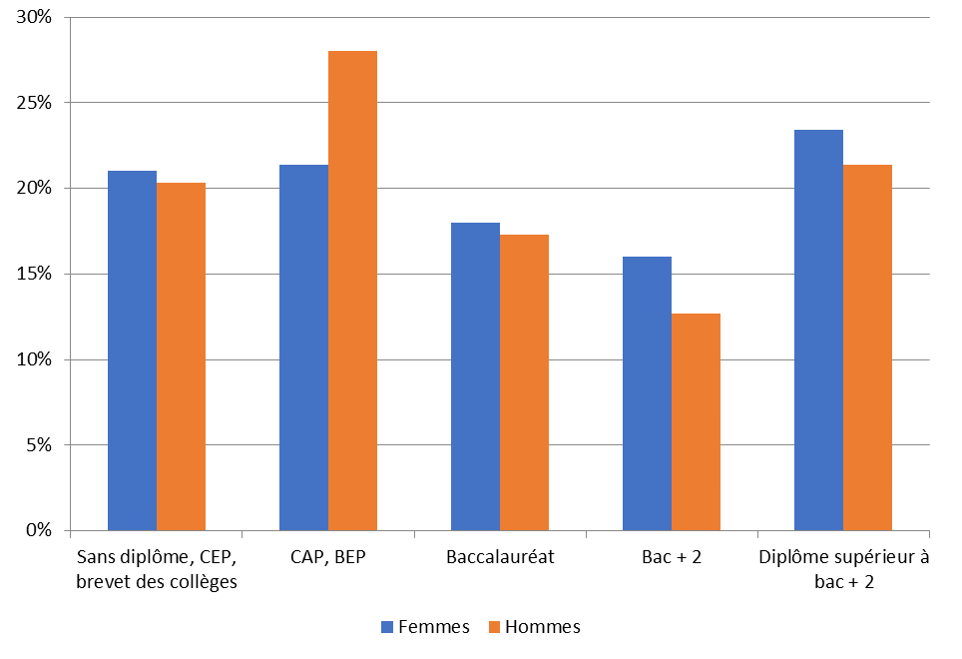
The human capital theory developed by G. Becker considers that wage gaps are due to differences in investment in human capital, particularly in education. In France, women have on average higher educational qualifications than men (Figure 2), which makes this explanation based on differences in education less credible.
However, as already pointed out in a previous BSI Economics article (see The gender gap: not so skewed), although women have higher educational qualifications on average than men, they are more likely to have followed different courses of study, which generally lead to professions in different sectors of activity that are generally less well paid. To see this, one need only look at the composition of higher education courses. Women are underrepresented in certain fields such as engineering, where they accounted for only 27% of students in 2017-2018. Conversely, they are overrepresented in paramedical and social sciences programs and in language, literature, and humanities programs, where they account for 85% and 70% of students, respectively.
Figure 2: Highest level of education by gender (25-64 years old) in 2018 in France
Sources: INSEE, BSI Economics
The sector of activity and job position angle
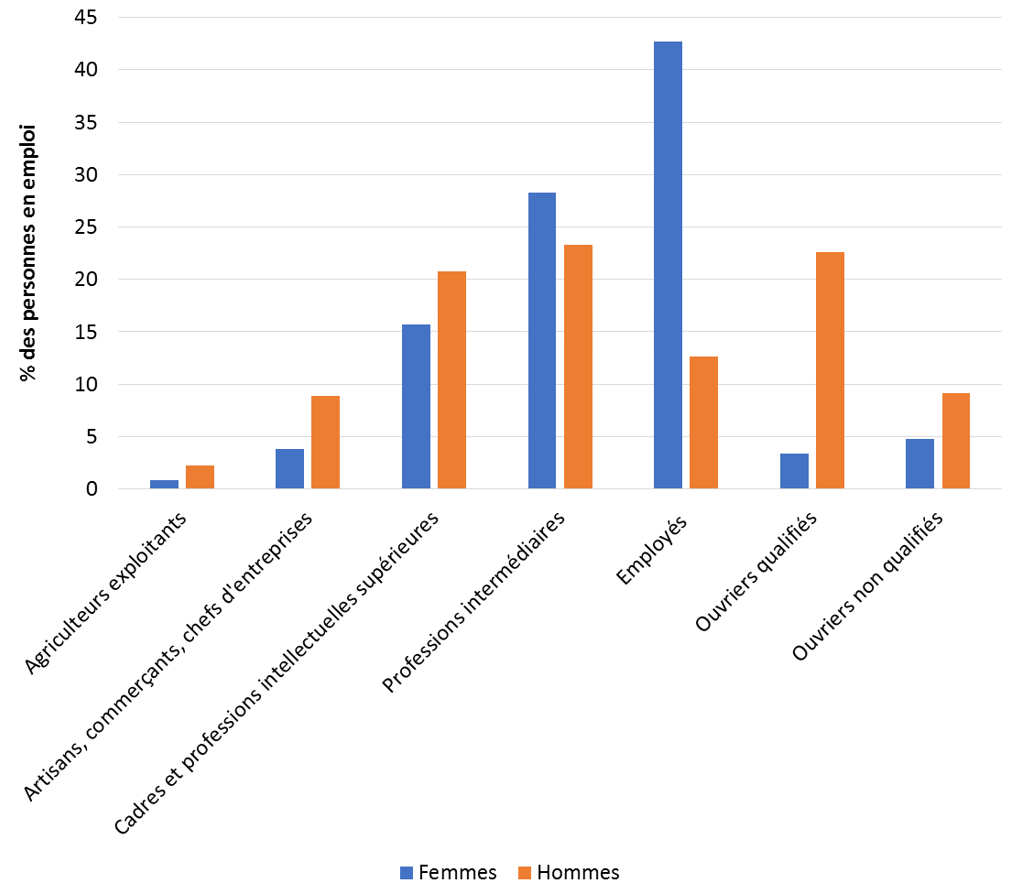
Although women are on average more educated than men, they are underrepresented among executives and higher intellectual professions (Figure 3).[3] Women find it more difficult to access the highest-level jobs, which are also the best-paid positions, a phenomenon known as the glass ceiling.
Figure 3: Socio-professional categories of employed people aged 15-24 in 2018
Sources: INSEE, BSI Economics
However, differences in socio-professional categories are not enough to explain the gender pay gap. According to INSEE, the average net monthly salary for female executives in the private sector was €3,561 in 2015, compared with €4,451 for men.[4]
Conversely, there are sectors with a high proportion of women, where women are overrepresented. These include the so-called social sectors: education, health, and social work (Figure 4). However, these are sectors that offer lower average salaries. A recent article (E. Coudin et al., 2018) showed that, in France, the overrepresentation of women in lower-paying companies accounts for 11% of the gender pay gap. This selection in specific sectors and companies is due both to gender stereotypes—with certain sectors of activity being considered masculine and others feminine—and to a tendency to choose different fields of study.
Figure 4 – Distribution of the working population by sector of activity in 2016 – focus on the tertiary sector

Sources: INSEE, BSI Economics
On average in 2018, 11% of women in employment worked in education.
Family structure, gender stereotypes, and other explanations
The gender pay gap can therefore be explained in part by different observable individual characteristics (in terms of education and experience, for example) and characteristics specific to the job held (working hours, socio-professional category, sector of activity, etc.). However, even when these differences are taken into account, they do not fully explain the pay gap. The International Labor Organization estimates that nearly half of the pay gap in France cannot be explained by these observable attributes (ILO, 2018).
Firstly, family structure plays a significant role. Motherhood can have indirect consequences on women’s future careers: part-time work, career breaks, slower career progression, etc. (see article http://www.bsi-economics.org/911-conges-parentaux-situe-la-france-mdt). A recent article (Wilner, 2016) shows that in France there is a loss of income associated with motherhood, even when taking into account the depreciation of human capital due to a possible career break and observable differences between individuals and between companies.
Motherhood may also explain certain forms of discrimination in hiring, with companies preferring to rely on male employees who will not take time off (or take less time off) following the birth of a child. This also helps to explain why women are concentrated in certain companies that are certainly less lucrative but offer other advantages such as more flexible working hours and/or proximity to home.
Beyond motherhood, what happens in the private sphere, particularly the distribution of domestic tasks within the household, which are primarily the responsibility of women, may also explain why women do not attain the same positions as their male counterparts or do not have the same careers. The latest data from INSEE (the French National Institute for Statistics and Economic Studies) from 2010 show that women devote more time to domestic tasks (housework, shopping, childcare, etc.) than men (3 hours and 26 minutes per day for women compared to 2 hours for men).[5]
The persistence of gender stereotypes may also explain the differences in career paths. For example, A. Boring (2017) showed that gender stereotypes still exist in the teaching profession. Students tend to evaluate the lessons they take based on certain gender stereotypes. Thus, even though the quality of teaching is equivalent (in terms of exam success) whether it is provided by men or women, students tend to evaluate male teachers more favorably, particularly with regard to criteria related to classroom management. These gender stereotypes mean that women and men are not evaluated in the same way and can lead to differences in terms of salaries.
Other explanations have been put forward to try to understand this pay gap, such as women’s lower tendency to negotiate salaries (Bertrand et al., 2011), a greater aversion to risk-taking, or a lower propensity to compete (Croson and Gneezy, 2009).
3. What public policies can reduce gender pay inequality?
Direct public policies (anti-discrimination laws, etc.) aim to ensure that salaries are the same for equal jobs, but they do not address the issue of selection in employment and career progression. However, today’s wage inequalities are also due to differences in educational orientation, sector of activity, and career progression (promotions). In this regard, in November 2018, the government presented an interesting initiative with the gender equality index, which will measure gender inequalities in companies with more than 250 employees. Four dimensions have been selected: differences in pay for comparable positions and ages, prospects for pay increases, prospects for promotion, pay catch-up in the case of return from maternity leave, and access to the highest pay.
Addressing these issues also means looking at what happens in the family and in the private sphere. Consequently, parental leave policies can be a factor that exacerbates or limits gender inequality. When parental leave is reserved for women (or mainly used by them), the effect of motherhood on gender inequality in the labor market is greater (see article: http://www.bsi-economics.org/939-conges-parentaux-efficaces-mdt). Introducing policies that guarantee compulsory paternity leave could reduce gender inequality and promote an equal sharing of domestic tasks. In this sense, the paternity leave introduced in France in 2002 is an encouraging step, but insufficient (11 days of leave).
Policies aimed at combating gender stereotypes in schools can also be considered if we want to diversify the paths taken by girls and ensure that they have access to fields that will later be more lucrative in the labor market.
Conclusion
Although women’s participation in the labor market has increased in recent decades, it still remains lower than that of men, and a significant gender pay gap persists. This gap can be explained in part by differences in education—particularly in terms of guidance—but also in working hours, sectors of activity, and positions held. The conditions in which women work are therefore very different from those of men (high proportion of part-time work), as are the positions they hold. Furthermore, even when individual and job characteristics are identical, a wage gap remains. This could be explained in part by motherhood and its impact on women’s career paths, but also by the existence and persistence of gender stereotypes and even discrimination.
Bibliography:
Bertand, M. (2011). New perspectives on gender. In Handbook of labor economics (Vol. 4, pp. 1543-1590). Elsevier.
Boring, A. (2017). Gender biases in student evaluations of teaching. Journal of Public Economics, 145, 27-41.
Christiansen, L., Lin, H., Pereira, J., Topalova, P. B., & Turk-Ariss, R. (2016). Gender diversity in senior positions and firm performance: Evidence from Europe. International Monetary Fund. Working Paper WP/16/50.
Croson, R., & Gneezy, U. (2009). Gender differences in preferences. Journal of Economic Literature, 47(2), 448-74.
Coudin, E., Maillard, S., & Tô, M. (2018). Family, firms and the gender wage gap in France. INSEE. Directorate of Demographic and Social Statistics. Working paper No. F1805
France Stratégie. (2016). The economic cost of discrimination.
International Labour Organization. (2017). World employment social outlook – Trends for women
International Labor Organization. (2018). Global Wage Report 2018/19: What are the causes of the gender pay gap?
Ostry, M. J. D., Alvarez, J., Espinoza, M. R. A., & Papageorgiou, M. C. (2018). Economic Gains From Gender Inclusion: New Mechanisms, New Evidence. International Monetary Fund. Staff Discussion Notes No. 18/06.
Wilner, L. (2016). Worker-firm matching and the parenthood pay gap: Evidence from linked employer-employee data. Journal of Population Economics, 29(4), 991-1023.
[1] The World Economic Forum’s Gender Gap Index combines several indicators, including an economic indicator that covers the gap in labor market participation, pay, and career advancement. It is this economic indicator that ranks France63rd.
[2]Statistical benchmarks and references on education, training, and research 2018 from the French Ministry of National Education.
[3] INSEE estimated that the average net monthly salary for a full-time executive/business manager in the private sector was €4,141 in 2015, €2,271 for intermediate professions, €1,739 for employees, and €1,765 for workers.
[4] This is the net monthly salary for a full-time equivalent.
[5]INSEE – Time use survey 2009-2010