Usefulness of the article: In this article, we seek to identify the players involved in reuse and solidarity-based reuse, their role in the development of a circular economy, and their economic model. We attempt to decipher the current challenges for the development of their activity: competition with second-hand markets, the development of partnerships with public and private players, and the new circular economy law.
Summary
- The main actors in solidarity-based reuse identified in this article are: Emmaus, resource centers and recycling centers, various integration structures working for reuse and recycling, and certain charities such as the Red Cross.
- These players have varied economic models, but all depend on access to sources of goods for their social and environmental projects.
- When it comes to this access, social and solidarity economy (SSE) organizations may find themselves competing with each other, but above all with second-hand markets, including online platforms, which can capture the highest-quality goods.
- Nevertheless, SSE actors can benefit from important partnerships: eco-organizations and public authorities, including local authorities.
- The government’s new circular economy law contains measures that could increase the potential supply to these SSE organizations, through access to waste collection centers and by prohibiting the destruction of new products.
- Finally, one measure places solidarity-based reuse at the heart of extended producer responsibility, which could lead to support for solidarity-based reuse/recycling by private actors responsible for managing their products at the end of their life.


One of the emblematic movements of the social and solidarity economy linked to the circular economy is the Emmaus movement, created in 1949 at the beginning of the Trente Glorieuses (the thirty glorious years of economic growth in France) by Abbé Pierre, which unconditionally welcomes people in precarious situations and offers them work in recovery and reuse activities (Fayard, 2019). The first Emmaus communities were built around the recovery of materials (scrap metal and cardboard), then, with the advent of the consumer society, around second-hand goods (ibid.).
With regard to waste, SSE structures seem to have emerged at the same time as the consumer society, and therefore waste, by taking up a subject of general interest that was then largely ignored by public services: providing shelter for the homeless and the most disadvantaged, and combating waste. Historically, « vagrants » and « beggars » have been subject to repression and criminal law, and it was only in the second half of the 21st century that they gradually became subjects of social law, eligible for certain forms of assistance (Damon, 2007).
Today, public authorities are increasingly addressing the issue of waste and refuse. The new law on combating waste and promoting the circular economy, enacted on February 10, 2020, is a step in this direction.
In this article, we aim to identify the actors in the social and solidarity economy (SSE) involved in the circular economy, and more specifically those involved in reuse and recycling; to understand their model and economic environment; and finally, to examine how the expansion of public legislation on the subject may impact their activities.
1. SSE actors working to promote reuse and recycling: a priority for the implementation of a circular economy, accompanying a social project
1.1 Reuse and solidarity-based reuse, at the crossroads of the social and solidarity economy (SSE) and the circular economy.
What isthe social and solidarity economy (SSE)? The concept of SSE can be broadly defined as a group of enterprises whose internal functioning and activities are based on the principles of solidarity andsocial utility.[2] Two previous BSI articles by Liza Lizarzaburu and Myriam Dahman-Saïdi discuss the polysemic vision of the SSE.[3] The economic activities of the SSE represent 10% of GDP and 12.7% of private sector jobs in mainland France and overseas, according to figures from the Ministry of Economy published in 2016[4].
The legal scope of the SSE is defined by the law of July 21, 2014 , known as the » Social and Solidarity Economy Law. » Article 1 defines the SSE as a mode of entrepreneurship and economic development characterized by democratic governance and profits mainly devoted to the development of the enterprise, which itself pursues a goal other than profit sharing. These organizations take the form of cooperatives, mutual societies, foundations, and associations. Commercial organizations are also considered part of the SSE if they meet the above conditions and explicitly aspire to social utility: helping people in vulnerable situations, fighting exclusion and inequality, and contributing to sustainable development.
In this article, we will focus on SSE actors working to promote reuse and solidarity-based reuse, and therefore the circular economy. To do this, we will begin by defining the concept of the circular economy, then reuse/solidarity-based reuse.
The concept ofthe circular economy is currently defined by the Ministry for Ecological and Solidarity Transition as « an economic model whose objective is to produce goods and services in a sustainable manner, limiting the consumption and waste of resources (raw materials, water, energy) and the production of waste. »[5] In practical terms, this means reducing waste of resources by respecting the hierarchy of waste treatment methods (reduce, reuse, recycle), in order to favor the most environmentally friendly option over the least environmentally friendly. It is therefore not just a question of recycling.
- The hierarchy of waste treatment methods
European Directive 2008/98/EC defines an order of priority for waste policies in terms of waste prevention and management, adapted into French law as:
- Prevention (including reuse)
- Preparation for reuse
- Recycling
- Other recovery (including energy recovery)
- Disposal
In particular, reuse is defined as any operation by which substances, materials, or products that are not waste are used again for the same purpose for which they were designed (ADEME, 2015). The reuse process, on the other hand, allows products that have already become waste to be reused. The operation to be carried out is therefore « preparation » for reuse, which consists of checking, cleaning, or repairing an object so that it can be reused (ibid.).
Those involved in reuse and solidarity-based reuse are therefore actors whose reuse and reuse activities fall within the legal framework of the social and solidarity economy (examples: non-profit, employment reintegration activities, donations to the most disadvantaged). These actors contribute to the development of a circular economy by working towards the priorities of the concept (reducing and reusing). Indeed, reuse and recycling are defined in the hierarchy as having higher priority in terms of environmental protection than recycling, as they are less polluting.
- Extended Producer Responsibility (EPR)
An important circular economy policy that has been implemented in France for various product categories is the application of the principle of Extended Producer Responsibility (EPR), which states that producers (marketers) are responsible (partially or totally) for financing or organizing the management of waste from their products at the end of their life. The first EPR sector established in France was household packaging in 1993. There are now 15 (examples: electrical and electronic goods; textiles, linen, and shoes, etc.).
Producers usually choose to organize themselves collectively to fulfill their obligations through non-profiteco-organizations approved by the public authorities. Eco-organizations are generally required to contribute to collection, reuse, and recycling targets and, increasingly, to promote reuse and recycling in order to comply with the waste treatment hierarchy. Thus, within the framework of EPR, eco-organizations are likely to create collection partnerships with SSE structures or support them financially.
1.2 Who are the players in reuse and solidarity-based reuse?
In the context of reuse and recycling, SSE structures generally enable consumers to equip themselves at a low economic and environmental cost, while promoting the integration of people who are distant from the job market. Here we present the main SSE actors identified:
- A resource center is an association[6] that collects all types of objects without selecting them, fulfilling four functions: collecting, revaluing, redistributing, and raising awareness (Bobel, 2019). Awareness-raising can take the form of zero-waste workshops or environmental conferences. Resource centers are structured around charters of commitment relating to the environment, solidarity, and raising public awareness of these issues, and are subject to specific specifications. They are grouped together under the Resource Center Network. A resource center is generally rooted in a specific area (neighborhood, village, city), seeking to position itself as a partner of the community in charge of waste management (ONR, 2016).
Unlike a resource center, a recycling center generally specializes in the recovery of a particular sector (e.g., toys, books, textiles). Although there are no specifications defining what a recycling center is (Bobel, 2019), these structures usually have environmental and/or social objectives.
As « ressourcerie » is a registered trademark, some structures similar to ressourceries are still called « recycleries, » as this term can be used generically (ADEME, 2015).
- Emmaus organizations. The Emmaus movement emerged around the Emmaus communities. The Emmaus network aims primarily to offer decent living conditions to people in precarious situations by providing them with work and housing (communities and shelters).
- Some charitable organizations, such as the Red Cross, provide goods at low cost or free of charge (ADEME, 2017).
- Integration structures[7] working for reuse and recycling. These networks offer employment and professional support to people who are distant from the job market in a legal context governed by an agreement with the State (Ministry of Labor, 2020). These structures receive public aid. One well-known network is Envie, which collects, repairs, and cleans household appliances. Recycling centers, Emmaüs, and the Red Cross are also often integration organizations themselves and/or use such organizations (ADEME, 2017).
1.3 Economic, environmental, and social impact of these actors and economic model
Table 1 lists data on the main actors identified, but is not exhaustive of all actors involved in solidarity-based reuse in France.
Table 1:Main SSE actors identified as actors in reuse and recycling
|
Organization |
Jobs (FTE) |
% of reintegration jobs |
Turnover (related to reuse/recycling) |
Tons of items collected |
% of tonnage used in reuse /reuse |
Year And source |
|
Network of Resource Centers |
3,079 |
76 |
€16.4 million |
40,800 |
36 |
2016 |
|
Desire |
3,000 |
75 |
€86 million |
200,000 |
2.5 |
2017 |
|
Emmaus structures |
4,369 |
22 |
€215 million |
270,000 |
47 |
2015 |
|
French Red Cross |
130 |
55 |
€15 million |
13,000 |
32 |
2015 |
Sources: * ONR (2017); ** ADEME (2017); *** Envie (2017)
Notes: ° 22% of employees are in integration programs, and 52% are journeymen[8]
FTE: full-time equivalent
We distinguish between two types of resources for SSE actors:
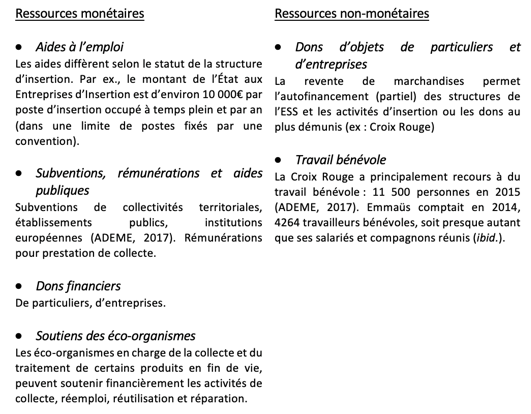
Various sources of funding are used, both monetary and « in kind » (donations of goods). Resource centers, which make extensive use of integration jobs, are dependent on employment assistance for their operation (ONR, 2017). The self-financing share of resource centers (sales, remuneration for collection and awareness-raising services) varies between 30% and 70% (ibid.). These figures are not available for other structures.
These actors have varied economic models, but all depend on access to sources of goods in order to carry out their social projects: reselling them at low prices (self-financing) or donating them. It is therefore on this access that SSE actors may find themselves in competition with each other, but above all with second-hand markets where consumers can resell their goods rather than donate them.
Several supply flows have been identified:
- Donations from individuals
- Donations from businesses and distributors, whether or not they are part of EPR
- Waste collection centers and collection partnerships with local authorities
Emmaüs sources most of its supplies from individuals, but also from waste collection centers and, to a lesser extent, from businesses (ADEME, 2017). The largest tonnages in the Envie network come via a partnership with the eco-organization Éco-systèmes: retailers are obliged to take back old electrical and electronic equipment under EPR, and Éco-Systèmes gives Envie access to these sources. In 2013, this flow represented 92% of the Envie network’s supply flow (ADEME, 2017). For Emmaüs, these flows are more sporadic (ibid.). Resource centers mainly source their supplies from households, via voluntary drop-offs and drop-offs by appointment, as well as via waste collection centers (ONR, 2016). In comparison, the flow of items from professionals is lower (ibid.).
2. What are the opportunities and threats for the economic model of social reuse actors?
- A new perspective on second-hand goods that could boost demand for them
A study by ADEME shows that French people are increasingly concerned about their waste production and that awareness of reuse has been growing over the last ten years (ADEME, 2014). More and more people consider reuse to be « fashionable, » and fewer and fewer believe that second-hand goods pose problems in terms of hygiene, quality, or reliability (ibid.). Demand therefore seems conducive to the expansion of social reuse organizations and second-hand markets in general.
- Developing partnerships with local authorities and eco-organizations
The development of resource centers/recycling centers is encouraged by partnerships with local authorities. Many resource centers have been created on the initiative of local authorities as part of departmental prevention plans, which can cover the construction or renovation of buildings that are then made available to resource centers (ADEME, 2017). The local authority therefore acts as the project leader and can include the recycling center/resource center in its overall waste management plan. The facility can also be paid by the city as a collection service provider. A partnership with the local authority can also provide access to a source of goods (collection at waste collection centers, collection by appointment; ONR, 2016). However, the ONR (2017) notes that increased dependence on public procurement weakens resource centers, particularly if the partnership is not renewed.
Finally, developing partnerships with eco-organizations helps secure supply and, potentially, funding for their activities. Under EPR, producers, represented by eco-organizations, are responsible for financing or organizing the management of their products at the end of their life. As part of this responsibility, actors in the reuse and solidarity reuse sector can establish partnerships with eco-organizations in order to gain access to these producers’ end-of-life goods and financial support.
- Decline in the quality of collected products: hypothesis of increased competition with second-hand markets
The Réseau des Ressourceries (ONR, 2017) and Emmaüs France (Fayard, 2019) note a decline in reuse in favor of recycling, despite an increase in collection. Valérie Fayard, Deputy CEO of Emmaüs France, talks about a deterioration in the quality of collected products, resulting in a decline in the share of reuse, which has fallen from 60% of tonnage 10 years ago to 47% today (Fayard, 2019). According to her, this decline can be explained by a decrease in the quality of products purchased on the one hand (e.g., fast fashion) and consumers’ use of second-hand markets for higher quality products on the other. In particular, internet platforms that could capture higher quality products (ADEME, 2017, p.111) represent a very strong threat to SSE actors, according to Valérie Fayard (Fayard, 2019).
It should be noted that some SSE actors are adapting to digital technology and developing their markets through diversification strategies. For example, Emmaüs is developing its online store, Le Label. The « Les Résilientes X Emmaüs Alternatives » project aims to develop the craft of reuse (Fayard, 2019): an approachto upcycling through design and creativity. The Envie network is expanding its offering to include small household appliances (ADEME, 2017), as well as smartphones and tablets (Envie, 2017). The Envie network is also growing online, on its own website and via Le Bon Coin (ADEME, 2017).
- The new law of February 10, 2020, on waste reduction and the circular economy: what changes could it bring for those involved in solidarity-based reuse/recycling?
Promoting access to new goods and goods from waste collection centers for social and solidarity economy actors
Article 35[9] prohibits the disposal of unsold non-food items. Producers, importers, and distributors of non-food products are now required to reuse their unsold items: by donating them to associations fighting poverty and SSE structures; or to reuse or recycle their unsold items, in accordance with the hierarchy of treatment methods. Reuse is therefore defined as a priority, ahead of recycling, for companies wishing to dispose of their unsold goods. Access to new unsold goods is a real challenge for SSE structures, which complain that it is difficult to access quality goods. It should be noted that these new goods would only be used for sales or donations by employees and volunteers.
Article 57 requires local authorities responsible for waste collection to allow SSE organizations to use waste collection centers as a place to recover items that are in good condition or can be repaired. This guaranteed access could represent an increase in supply for SSE actors who would not have had this access before.
EPR redirected towards reuse: partnerships between eco-organizations and SSE structures encouraged
The types of goods involved in the reuse/recycling activities of SSE actors are mainly those covered by an EPR sector (ADEME, 2015). It is therefore important for these actors to be fully involved in EPR. What does the new law provide for?
- Solidarity-based reuse is part of the EPR principle and reuse objectives for eco-organizations
Article 62 of the new law, relating to Extended Producer Responsibility schemes, enshrines solidarity-based reuse in the very principle of EPR. Producers subject to EPR may now be required to support reuse, recycling, and repair networks such as those managed by SSE structures or those promoting integration through employment. The article also states that eco-organizations will have explicit targets for waste reduction, reuse, and repair (where the nature of the products justifies it). These obligations will be defined specifically for each sector (e.g., for the furniture sector, the textile sector, etc.). With these objectives, eco-organizations will be encouraged to increase their partnerships with reuse and recycling operators, including those that are part of the social and solidarity economy. At the same time, it is planned that when eco-organizations enter into contracts with waste treatment operators, they will have to take into account the principle of proximity and the use of reintegration employment; the SSE structures concerned will therefore be favored.
- Creation of a fund dedicated to financing reuse and recycling
This fund will be financed bycontributions10 paid by producers to the eco-organization. SSE actors are likely to be among the beneficiaries of these funds, in view of their reuse and recycling activities.
The paradox of a waste reduction policy: does it not ultimately put SSE structures that depend on it in difficulty?
This is often the paradox faced by those involved in the circular economy of end-of-life products: their activity relies on a source of waste, or goods that are « no longer wanted. »
An effective waste reduction policy can therefore mean a decrease in the quantities of goods recovered for the most disadvantaged. However, a reduction in waste can also mean better quality products and higher value-added recovery activities. According to Emmaus France (Fayard, 2019), low-quality products, which can only be recycled, generate fewer resources and are more closely linked to international raw material prices than those used for reuse.
The challenge will then be to promote access to these higher-quality goods for SSE actors, even though consumers will have a greater interest in reselling them on their own behalf.
Conclusion
Since the dawn of the consumer society, SSE actors have taken up the issue of waste, turning it into an opportunity for the most disadvantaged to reintegrate into society through recovery work, donations, or low-price sales.These actors have a variety of economic models, but all are dependent on access to goods for their social projects and may find themselves competing for this access with second-hand markets, including rapidly growing internet platforms.
Today, the government is taking up the issue of waste and integrating these existing actors into its anti-waste policy in certain respects. Certain measures in the government’s circular economy law are designed to support SSE structures by promoting the supply of goods to these structures through access to waste collection centers; by prohibiting the destruction of new products that could increase the amount of goods potentially received; and by placing solidarity-based reuse at the heart of public policy on extended producer responsibility.
Useful terminology and definitions
Extended Producer Responsibility (EPR):The EPR principle states that manufacturers, distributors of their own brand products, and importers who place products on the market that generate waste must take responsibility, particularly financially, for the management of this waste.
For more information: Ministry of Ecological and Solidarity Transition, « General framework for extended producer responsibility sectors, » updated on January 31, 2020
http://www.ecologique-solidaire.gouv.fr/cadre-general-des-filieres-responsabilite-elargie-des-producteurs
Eco-organization: producers subject to EPR generally join together to form an eco-organization, which assumes responsibility on their behalf. In France, an eco-organization takes the form of a non-profit structure approved by the public authorities. A financial eco-organization collects financial contributions from producers and redistributes them to local authorities that organize waste collection and sorting. An organizational eco-organization uses the contributions to organize waste collection and treatment directly with service providers.
For more information: Ministry of Ecological and Solidarity Transition, « General framework for extended producer responsibility sectors, » updated on January 31, 2020
http://www.ecologique-solidaire.gouv.fr/cadre-general-des-filieres-responsabilite-elargie-des-producteurs
Emmaus companion: a person welcomed into an Emmaus community who works there, generally in the recovery, repair, and resale of goods, without an employment contract (ADEME, 2017).
Structures for integration through economic activity: Integration through economic activity (IAE) enables people who are distant from the job market to benefit from enhanced support aimed at facilitating their professional integration. In 2018, there were 3,803 structures for integration through economic activity (SIAE). These structures have various statuses: for example, integration companies, integration workshops and projects, intermediary associations, etc. Each status corresponds to a different type of assistance and legal framework.
https://www.ecologique-solidaire.gouv.fr/leconomie-circulaire