Abstract :
· In 2013, 52.4% of Latin American electricity came from renewable energy sources, thanks to the predominance of hydroelectricity.
· Most green energies are now competitive with oil, coal, and gas.
· The region is currently one of the most attractive: in 2015, tenders (with very low purchase prices) attracted a record number of participants.
· Dependence on fossil fuels and hydroelectric power, as well as lack of access to electricity, make it necessary to develop alternative energies.
· The sector is expected to continue growing in the coming years.
In recent years, the renewable energy sector has continued to grow in Latin America, despite falling oil prices and the economic crisis affecting the region. As a result, Latin America has become one of the most attractive areas in the world, attracting investor interest. Thanks to lower costs and abundant natural resources (wind, sunshine, etc.), renewable energies have become a credible alternative to fossil fuels. Their development is a major challenge in terms of energy diversification and security. The future of the sector therefore looks promising.
I) Key figures for the renewable energy sector in Latin America
In 2013, 52.4% of the electricity produced in Latin America and the Caribbean (LAC) came from renewable energies, compared with only 22% worldwide. This result can be explained by the predominance of hydroelectricity, which alone accounted for 47% of electricity generation (Figure 1). Intermittent renewable energies have also experienced a real boom. Between 2000 and 2013, solar photovoltaic and wind power grew by an average of 15.1% and 36.6% per year. This trend continued in 2015, with Latin America achieving one of the highest growth rates in the world in this sector. Despite growing faster than fossil fuels, intermittent clean energy sources accounted for less than 1% of the electricity matrix in 2013.
Figure 1: Electricity generation mix in Latin America and the Caribbean (2013)

Source: Inter-American Development Bank, BSI Economics
Furthermore, in 2015, LAC generated 5.9% of global investment in renewable energy, or USD 16.8 billion (+11.3% compared to 2014). Brazil, Mexico, and Chile are among the 10 countries in the world that have received the most investment. Although Brazil remains by far the main regional destination for green energy investment, investment there fell by 11.2% in 2015. Conversely, it more than doubled in Mexico and Chile. Other Latin American leaders include Uruguay and Honduras, which have thesecond andthird highest ratios of renewable energy investment to GDP in the world. Finally, Argentina, Colombia, and Venezuela attracted few investors in 2015.
Distribution of renewable energy investments in Latin America in 2015 (millions of USD)
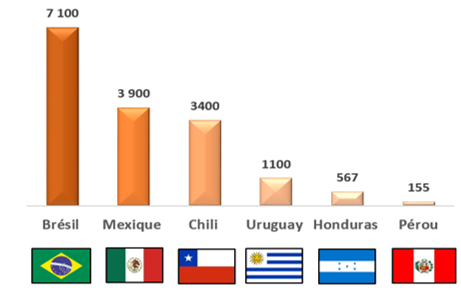

Source: Frankfurt School-UNEP Centre, BSI economics
According to Ernst and Young, Chile, Mexico, and Brazil are now among the seven most attractive nations in the world. They are followed by Argentina (18th), Peru (24th), and Uruguay (33rd). The consulting firm’s ranking is based on the « country attractiveness index for renewable energy, » which takes into account a range of criteria, such as: the macroeconomic and political environment, technological potential (natural resources, pipelines, etc.), energy requirements (renewable energy targets, security of supply, etc.) and the ease of implementing projects (contract security, etc.).
II) Latin America: a favorable environment for clean energy
· The competitiveness of renewable energies compared to fossil fuels
In recent years, the levelized cost of energy (LCOE) has fallen sharply[1]. According to the International Renewable Energy Agency, from 2013 to 2014, South America was the region with the lowest LCOE for new hydroelectric and solar photovoltaic installations (0.04 and 0.11 USD/kWh). Similarly, in 2014, renewable energies were generally competitive with fossil fuels in terms of electricity production in Latin America.
The abundance of natural resources such as water, wind, and sun, as well as the size of its territory, allows Latin America to achieve a faster return on investment for new facilities. Returns on investment are also higher. Green energy is therefore a credible alternative even without subsidies. In fact, Latin American tenders in the renewable energy sector have been very successful. In 2015, they attracted a record number of participants at some of the lowest purchase prices in the world.
· Electricity demand growth forecasts
The Latin American population is expected to grow by 20% by 2040, and regional GDP is expected to grow by an average of 3% per year over the next few decades. As a result, electricity demand is expected to increase by 91% between 2013 and 2040, compared with just over 70% globally. Demand would then reach 2,970 TWh. Among the region’s major economies, Colombia and Chile are likely to experience the strongest increases (145.8% and 139.5% respectively). Forecasts therefore point to a catch-up phenomenon, given that per capita electricity consumption in Latin America is around six times lower than in the United States.
However, according to the Inter-American Development Bank, the potential for renewable energy is so high that it could cover 22 times the electricity needs of LAC until 2050. The increase in electricity supply will therefore necessarily involve the exploitation of wind, solar, and other renewable energy sources. It should be noted that other avenues can be explored, such as energy efficiency. Each year, the region loses 17% of the electricity it produces due to theft, illegal connections to the grid, or technical problems, at an estimated cost of between $10 billion and $16 billion. These annual losses are equivalent to one year’s consumption in a country such as Peru.
· Towards universal access to electricity
In Latin America and the Caribbean, 34 million people do not have access to modern electricity services. These are generally people living in remote rural areas. In this context, small-scale renewable energy production systems could help complete the electrification of rural areas. Micro-loans have often served as the basis for starting these community projects. Latin America has seen the development of cooperatives, some of which have been very successful. This is the case in Costa Rica, for example, where four cooperatives have 180,000 members and account for 15% of the electricity market.
· Increasingly favorable legislation
All the major Latin American countries have adopted laws and quantitative targets to promote renewable energies and reduce greenhouse gas emissions (e.g., Costa Rica: 100% clean energy by 2030).The state is a key player in the sector in terms of regulation, project allocation (calls for tenders) and financing. Argentina and Peru, for example, have put in place stability guarantees to protect investors against possible changes in fiscal policy or the creation of additional taxes.
· The search for diversification of the electricity matrix
Latin America’s electricity matrix is mainly composed of hydroelectricity. However, the main disadvantage of this energy source is its seasonality. During periods of drought, power plants may not produce enough electricity. The northeast of Brazil, which is highly dependent on hydroelectricity, experienced eight months of power cuts between 2004 and 2014. In this context, intermittent renewable energies may appear to be an attractive alternative. Indeed, periods of drought are often the windiest and sunniest, allowing solar panels and wind turbines to play a countercyclical role.
Given these limitations, hydroelectric power is partially excluded from renewable energy development policies. As a result, many countries have decided to distinguish between small and large power plants, with the latter generally creating significant negative socio-environmental externalities. Coal, gas, and oil still accounted for 47% of the electricity matrix in 2013. However, not all Latin American countries have vast fossil fuel resources and therefore have to import a large proportion of their energy. This has led to a desire among some countries, such as Uruguay, to turn to green energy.
III) Challenges and prospects for the sector
· Challenges
Firstly, in theory, the fall in oil prices could have brought the rise of clean energy to a halt. However, although the drop in oil prices has led to the postponement of certain projects, particularly in Brazil, it has not weakened the green energy sector. Moreover, the threat seems to be receding, as Brent prices have already rebounded from less than $30 per barrel in January 2016 to around $50 at the end of September 2016.
Secondly, subsidies for oil, gas, and coal are complicating the spread of clean energy in some countries. These subsidies distort competition and skew investors’ decisions in favor of fossil fuels. Last year, they accounted for 46.2% of tax revenues in Venezuela, 11.4% in El Salvador, and 6% in Bolivia.
In addition to these obstacles, there are technical challenges. In many countries, electricity systems are not yet flexible and accessible enough to fully integrate intermittent renewable energy into the grid.
· Outlook
After two years of strong growth, the trend is expected to continue. At the same time, maintenance and operation of the existing grid are expanding, generating new opportunities for businesses and jobs for workers. In the coming years, the sector is expected to grow particularly strongly in Argentina and Mexico.
Today, less than 2% of Argentina’s electricity generation comes from renewable energies. This lag is due to a deteriorated business climate and significant legal instability. However, the new government has introduced numerous reforms and set a target of 20% renewable energies in electricity consumption by 2025. Argentina recently issued a call for tenders representing approximately 1,000 MW, or USD 1.5 to 2 billion in investments, according to the president. The total capacity of the projects proposed by the 123 bidders reached 6,346 MW, six times more than the ministry’s offer, confirming investor appetite.
In Mexico, recent reforms in the energy market have opened it up to private capital, leading to lower prices. In September 2016, the government awarded tenders mainly for wind and solar photovoltaic power, equivalent to 3% of the country’s annual electricity consumption.
Conclusion
Hydropower and fossil fuels each account for 47% of Latin American electricity production. This dependence has adverse effects (additional import costs, supply instability, lack of access to the grid). In this context, several Latin American countries have decided to promote the development of other renewable energies (wind, solar, etc.). Thanks to falling costs and abundant natural resources, clean energies are attracting more and more investors. The sector is therefore expected to continue growing in the coming years, even if many technical and tariff barriers remain to be overcome.
Bibliography
[1] This is an indicator used to assess the total expenditure associated with a given facility or system to produce 1 kWh of energy.