Summary:
- The legal provisions available to parents at the time of the birth of a child in terms of leave vary greatly between OECD countries;
- France is fairly average in terms of leave reserved for mothers, but offers better compensation for maternity leave;
- In terms of leave available to fathers, France is fairly generous compared to its neighbors.
- In practice, however, fathers take less advantage of the leave available to them and take it for shorter periods.
This article provides an overview and comparative analysis of paid leave policies in OECD countries and how they are used. In particular, it examines gender differences and potential reasons for the low take-up of leave by men.
For more than a century, many developed countries have adopted legislation to protect maternity at work, notably by introducing maternity leave. In a context marked by the growing participation of women in the labor market, the primary objective of these laws was above all to protect the physical health of these women and their children. More recently, a number of industrialized countries have also introduced parental and paternity leave. Beyond the supposed effect on the health of women and their newborns, these policies aim to ensure women’s productivity and promote gender equality in the workplace. France is no exception to this rule, having introduced 11 days of paternity leave in 2002. Currently, the European directive on « work-life balance, » which aims in particular to establish new minimum standards for paternity leave—10 working days paid at a level defined by the member state—and to update the minimum standard for parental leave, is under debate.
Arelegal provisions less generous in France?
The legal provisions to directly protect women during maternity leave consist of two types of leave:
- Maternity leave, which protects women’s jobs immediately before and after childbirth; and
- Parental leave, which often extends the period during which employment is protected. With the exception of the United States, all OECD member countries have introduced a period of paid maternity leave.
However, the leave available to women varies greatly between countries, not only in terms of duration but also in terms of wage compensation. Data provided by the OECD allows us to compare the paid leave available to women following maternity in different OECD countries by studying not only its total duration but also its equivalent in terms of full pay (Figure 1 (a)). With a duration of 16 weeks, France is just below the European average, even though in terms of remuneration, the French system is more generous than in many countries.
In addition to leave reserved for mothers, around two-thirds of OECD countries have introduced paternity leave, allowing fathers to take a few days off immediately after the birth of their child. This leave is generally short but relatively well paid. Portugal is the most generous OECD country in this regard, with 20 working days paid at 100%, half of which are mandatory (Figure 1 (b)). France is also a good performer in this area, with two weeks ofpaternity leave.
Figure 1: Paid maternity and paternity leave
Notes: 2016 data. The duration in equivalent 100% pay combines information on the total duration of leave and the replacement rate (proportion of net income compensated during leave) to estimate the duration of full-pay leave.
Source: BSI Economics, Author using OECD data.
In addition to maternity and paternity leave, there is often parental leave, which allows one (or both) parents to extend the leave period in order to care for their children for longer, sometimes until their second or third birthday. While this leave is often longer than maternity leave, it is generally less well paid (OECD, 2016). In France, for example, women and men can take 26 weeks of parental leave, and the average pay rate is 14.5%. While France is less generous than many OECD countries in terms of parental leave for women, the situation is different for men (Figure 2).
Figure 2: Paid parental leave
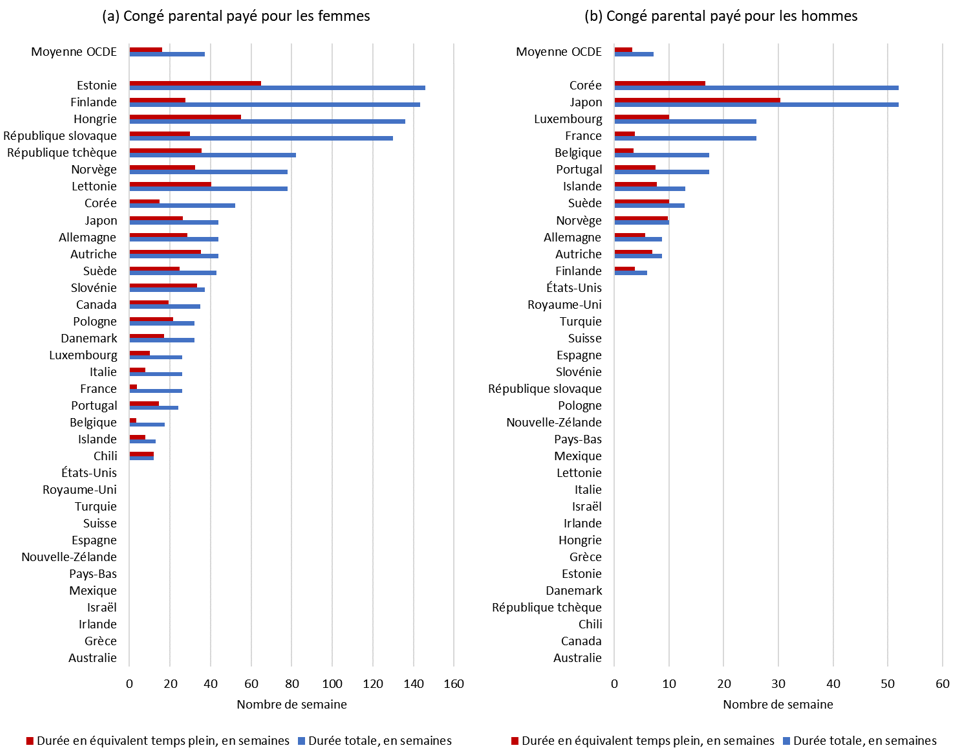
Notes: 2016 data. The duration in equivalent 100% pay combines information on the total duration of leave and the replacement rate (proportion of net income compensated during leave) to estimate the duration of full-pay leave.
Source: BSI Economics, Author using OECD data.
What is the reality?
Beyond legislative provisions, the proportion of mothers and fathers who actually take parental leave varies greatly from one country to another. Almost all mothers take maternity leave, at least immediately after the birth of their child (Moss, 2015). In fact, in some countries, such as Belgium and France, it is even mandatory to take a few days off after the birth of a child.
In countries where paternity leave exists and where adequate data is available, it is often taken by fathers, particularly in the Nordic countries (Figure 3).
Figure 3: Number of beneficiaries of paid paternity leave per 100 births
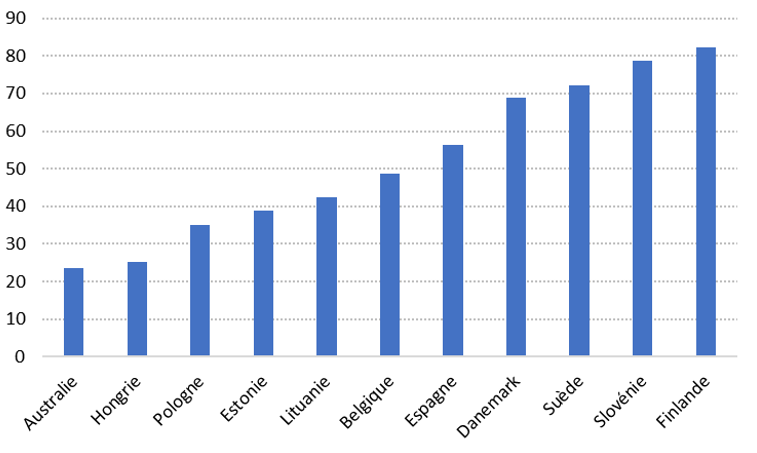
Notes: 2013 data.
Source: BSI Economics, Author using OECD data.
The situation is quite different when we look at the gender distribution of parental leave. Often taken by women, this leave is rarely claimed by men, particularly in France (Figure 5). Furthermore, when men do take this leave, it is often for a shorter period, even in Nordic countries (OECD, 2016).
Figure 4: Gender distribution of paid parental leave beneficiaries
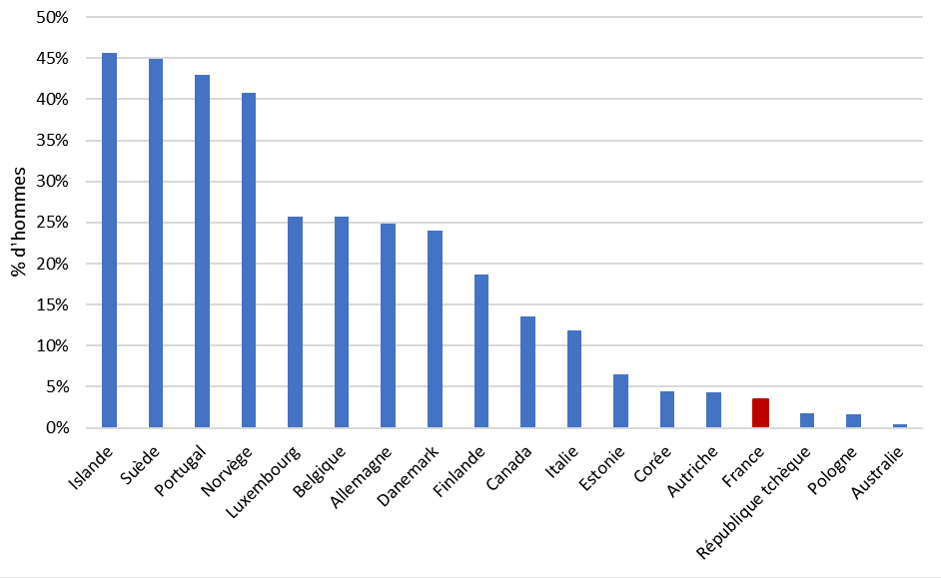
Notes: Data from 2013.
Source: BSI Economics, Author using OECD data.
There are many reasons put forward to explain these differences between countries, particularly those relating to take-up by fathers. Firstly, social norms concerning the expected roles of fathers and mothers partly explain why, even today, few men take parental leave (OECD, 2016). In 2012, with the exception of six countries, including France, more thanhalf of those surveyed as part of the International Social Survey Program also stated that paid leave should be taken entirely or largely by the mother. Another reason for this low participation rate is financial, as women generally earn less than their partners, including in OECD countries, where the wage gap averages 14%. In this regard, initiatives to reserve specific periods of parental leave for fathers, such as the « daddy quota » policy introduced in Sweden in 1995, appear to be effective (Duvander and Johansson, 2012).
Conclusion
The legal provisions available to parents at the time of the birth of a child in terms of leave vary greatly between OECD countries. While France is fairly average in terms of leave reserved for mothers, with better compensation for maternity leave, it is rather generous compared to its neighbors in terms of leave available to fathers. In practice, however, fathers make less use of the leave available to them and take less time off. This situation prompts us to ask ourselves about the effects of such policies, a subject we will address in our next article.
Duvander, A. Z., & Johansson, M. (2012). What are the effects of reforms promoting fathers’ parental leave use? Journal of European Social Policy, 22(3), 319-330.
OECD (2016). OECD Family Database. Use of childbirth-related leave by mothers and fathers
International Labor Organization, 2014, Report « Maternity and Paternity at Work: Legislation and Practice Around the World »
Moss, P. (ed.) (2015). International Review of Leave Policies and Research 2015
http://www.leavenetwork.org/lp_and_r_reports/
1Introducedin 2002, « paternity and early childhood leave » currently consists of eleven consecutive days, eighteen in the case of twins or triplets, plus three days of birth leave.
2Theseare individuals who declare themselves in favor of the existence of paid leave.