
Summary:
– The most recent study (2011) estimates that the population could vary between 70 million and 77 million inhabitants in France;
– France must achieve average annual GDP growth of +1.5% if it wants to avoid an increase in unemployment and social spending;
– In the long term, the working population will increase, which should contribute to a decrease in the dependency ratio (number of working people per non-working person) and boost the economy;
– However, with longer life expectancy, healthcare spending is expected to increase.
A country’s demographic situation and its evolution are important factors in the dynamism of its economy. They determine, in part, a country’s potential growth and help guide economic policy, particularly in terms of future social spending needs. In this context, INSEE published new information on population projections in 2011. Several factors emerge, but it is the implications of the working-age population projections that are most revealing in terms of France’s economic outlook. In this regard, it appears that France will have to contend with employment difficulties in the short and medium term, while in the long term the increase in the working-age population highlights opportunities for growth and the management of social spending.
Past and future population trends, based on an average scenario and six variants
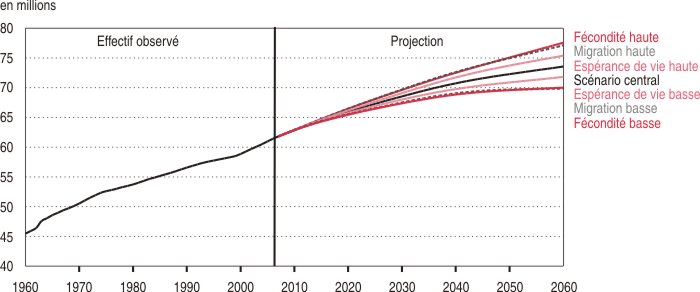
Sources: INSEE, estimates and projections for the population of metropolitan France from 2007 to 2060.
A stronger-than-expected increase in the working population
In the last study of this type published in 2006, INSEE predicted a total population of 70 million by 2060. The latest study from 2011 presents several scenarios (see graph above). Ultimately, the population could vary between 70 million inhabitants (in the case of low fertility) and 77 million inhabitants (in the case of high fertility). However, the central scenario is the most likely. It corresponds to an average of the six different scenarios and concludes that the total population of metropolitan France will be 73 million.
More than the increase in the total population between these two studies, it is above all the increase in the working population that has significant economic consequences. The working population increased by 9% between these two studies, or 2.4 million people. The reasons for this increase are demographic (increased immigration and fertility rates) and linked to the rise in activity rates caused mainly by the 2010 pension reform. Ultimately, of the 2.4 million additional people in the workforce in 2060, 0.7 million are due to demographic dynamics (immigration + fertility) and 1.7 million are due to the increase in the activity rate and the 2010 pension reform. The « Fillon » pension reform will encourage employees and employers to extend the length of time people remain in work.
Consequences that are difficult to manage in the short and medium term
In the short and medium term, the increase in demographics and the resulting increase in the working population will have the effect of increasing the labor supply. In other words, the number of people offering their labor in exchange for a salary will increase. When the population declines, the labor supply also declines and the return to full employment (low and minimal unemployment) is faster. Conversely, when the population increases, the labor supply increases and the return to full employment is slower and more complicated to achieve.
In the present case, as the labor supply increases, the return to full employment equilibrium will be automatically delayed. To prevent unemployment from rising, France would need to create enough jobs to absorb the surplus population in the labor market, thereby limiting unemployment and the burden of social spending associated with joblessness. The country will therefore have to create the conditions for improved economic growth, which is the only way to integrate nearly 150,000 new entrants to the labor market each year.
To do this, France must achieve average annual GDP growth of +1.5%. Under these conditions, the only solution to stimulate growth and avoid increasing the burden of social spending linked to unemployment is to thoroughly reform the labor market to make it more flexible and dynamic, and to encourage investment and innovation. Currently, potential growth, i.e., the average economic growth that the country is capable of generating, is at a level that does not allow this objective to be achieved: it stands at around 1% per year. Therefore, if nothing is done in this direction, unemployment is irrevocably destined to increase, thereby widening deficits and debt.
Potentially positive long-term consequences
In the long term, the terms of economic management are different. Indeed, the increase in the working population creates opportunities for long-term potential growth and improves the constraints on social spending, particularly pension spending.
From a longer-term perspective, an increase in the working population can improve a country’s economic dynamism. With productivity remaining unchanged, the larger the working population, the higher the potential for long-term growth, as the economy is not constrained by insufficient labor supply. As a result, companies benefit from an abundant labor force, meaning that their development is not limited by insufficient labor supply. Ultimately, this leads, on the one hand, to a surplus of tax revenues, which improves the public finance situation, and, on the other hand, to a gradual return to full employment and an automatic reduction in unemployment insurance expenditures.
In terms of social transfers, the effects are multiple and contrasting:
1) The return to full employment will automatically reduce the share of social spending related to unemployment insurance.
2) Population growth will go hand in hand with longer life expectancy. In 2050, people over the age of 80 will represent 11% of the total population due to lower mortality rates. As a result, healthcare spending will increase, as this population spends on average nine times more than the 20-24 age group. Social health care spending will increase and funding will need to be found.
3) The increase in the working population, particularly through the raising of the retirement age, will improve the conditions for financing pensions, without however resolving the issue. The dependency ratio (number of workers per non-worker) will continue to decline, but this decline will be less pronounced and less rapid than before.
Conclusion
Ultimately, in 2050, social protection expenditure should decrease as a percentage of national wealth created, and potential growth should increase. Nevertheless, it is necessary to create the conditions that will enable this to happen now. Furthermore, it should be noted that with the rise in the population’s activity rates and the increase in the fertility rate, strengthening family policy is essential to avoid disrupting France’s demographic dynamics. The risk would then be that the country could find itself in a situation of demographic decline, as in Germany, where problems related to an increasingly small working population relative to the non-working population will pose insoluble problems in the long term.