Summary:
– Residential segregation based on economic factors is a significant phenomenon that can be explained by the functioning of the real estate market.
– In this market, the poorest individuals cannot compete with the richest for the same housing. The latter will therefore choose to live in areas where amenities (i.e., the environmental and social characteristics that individuals value) are highest.
– Local politics, which determine local taxes and public services, tend to reinforce this economic segregation.
– Historical factors can also exacerbate residential segregation of economic origin, for example if they lead to a mismatch between the place of residence of the poorest and the location of jobs.
– Economic segregation can lead to (or exacerbate) social, ethnic, or religious segregation. However, the latter can also result from the « free play » of interactions between individuals.
In France, we observe a tendency for social groups to separate themselves spatially, particularly according to their wealth. This phenomenon is not new, but it has become more pronounced since the end of the Trente Glorieuses (the thirty glorious years of economic growth in France from 1945 to 1975). Indeed, this period was not only characterized by a reduction in economic inequalities, but also by a tendency for social groups to come closer together. Sociologist Jacques Donzelot writes, « There was a moment between the late 1950s and early 1970s when the game seemed so well won that, in France in particular, it was possible to conceive and implement a form of urban planning that would bring all classes together in a unified urban space because it was homogeneous. »
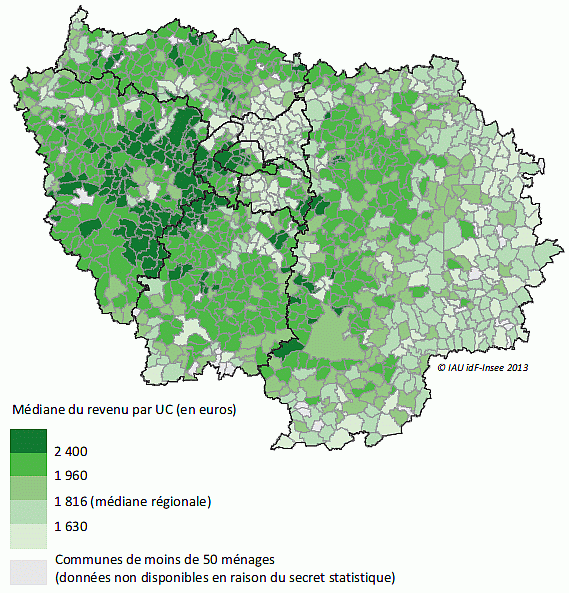
Today, the situation has reversed, and the map below (source: INSEE) illustrates this division of space between rich and poor. It shows the Ile-de-France region divided between the relatively affluent west and the less privileged east. This description can be further refined if we consider the poor suburbs to the north and northeast and the affluent area of western Paris.
Source: INSEE-DGFIP, localized household tax revenues 2010
How can this situation be explained? The real estate market obviously plays a role: people with modest incomes generally cannot afford to live in the wealthiest neighborhoods. But what exactly are the mechanisms at work? Furthermore, is the economic dimension the only factor contributing to segregation? Can ethnic or cultural segregation result from interactions between individuals? And how can these aspects be measured?
1 – The real estate market « spontaneously » produces segregation between rich and poor:
1.1 Monocentric models
The urban economy developed in the 1960s, driven by W. Alonso, R. Muth, and E. Mills, around the monocentric city model. This model offers a simple explanation for the formation of real estate prices and the concentration of individuals in cities (see Appendix). Furthermore, the model can be adapted to take into account differences in income between individuals (or groups of individuals) and thus offers an explanation for economic segregation. In this case, the intuition is as follows: for each dwelling, characterized in the model by its distance from the city center, it is possible to construct a maximum bid, i.e., the maximum amount that an individual is willing to pay to live in that location. The social group with the highest bid will occupy that dwelling. Note that this does not mean that a group could not pay more: the rich, by definition, can always outbid the poor. But if a dwelling is occupied by a « poor » person, it is because the « poor » person is willing to pay more than a « rich » person to occupy that dwelling.
One of the consequences of the model is that social groups will locate themselves in « rings » around city centers and will not mix. Indeed, it can generally be shown that the « bidding » functions of two distinct groups are different, and under classical assumptions, they will only intersect once. That is, in the case of two groups, A and B, up to a distance « x » from the city center, group A will be able to outbid group B, and the opposite will occur beyond this distance X. If there are rich and poor people, we will see either all the rich people in the center and the poor people on the outskirts, or the opposite, but not rich and poor people living in the same place. In their preferred area, rich people will always be willing to pay more than poor people, so real estate prices will be too high for the latter to choose to live there as well.
It is possible to generate more complex situations, with more groups than in the previous example (by introducing an average income between rich and poor or a continuum of incomes), or with historical and natural amenities that make city centers or the countryside more or less desirable, etc. However, under fairly broad assumptions, the « ring » structure and the separation between income groups will persist.
1.2 Spatial Mismatch
But can we rely on this purely mechanical logic? The INSEE map above shows both the relevance and the limitations of the monocentric model in explaining economic segregation. On the one hand, it would seem that the further away from Paris, particularly to the east, the lower the median income of municipalities becomes (for a more detailed discussion, see Brueckner, Thisse, and Zenou, 1999). On the other hand, these models do not explain local variations very well, particularly a large area of poverty geographically close to the center.
A historical detour helps explain the decline of certain neighborhoods. Sociologists have since John F. Kain(1968) developed the Spatial Mismatch model. The idea is as follows: during industrialization, a large population settled near industrial employment centers, generally in city centers in the United States and in large suburban housing projects in France. From the 1960s and 1970s onwards, the destruction of these industrial jobs and the shift to a service economy led to the disappearance of these large employment pools, which were replaced by jobs in other areas (often on the outskirts of large cities). The most mobile segment of the population (often the most affluent) was able to follow these new jobs, while the most vulnerable found themselves stuck in the areas where the industrial centers had previously been located.
Spatial mismatch reflects this idea of a gap between where the most vulnerable live and where the jobs that these individuals, who are generally low-skilled, could occupy are located. The result is that the cost (of transportation or information) of effectively searching for a job is too high, and these individuals remain in precarious situations.
Much remains to be said about spatial mismatch. For example, we might ask whether segregation in this case is purely economic or based on social benefit criteria. For example, Judith K. Hellerstein, David Neumark, Melissa McInerney(2008) propose the hypothesis of a spatial-racial mismatch inthe United States. We might also ask ourselves how poor populations find themselves trapped in this way. Is it solely due to economic factors?
However, the spatial mismatch has the advantage of introducing a historical perspective into the study of economic segregation. In the French case, Jacques Donzelot shows that the policy of large housing estates deliberately organizes a separation between places of living, working, and consumption, and thus the isolation suffered today by the most disadvantaged. Indeed, it was necessary to build a lot to accommodate the populations arriving from the countryside, while avoiding what was considered the « moral trap » of the city. It was therefore necessary to build in areas close to industrial employment centers, while isolating them from cities. Today, urban policies are no longer based on such paternalistic visions, but this historical perspective encourages us to be wary of good intentions and to question the objectives and real impact of urban policies.
1.3 Tiebout Sorting
The previous paragraph introduces the concept of policy, and it may be necessary to consider the interactions between policies and real estate markets, as well as their impact on economic segregation.
Political choices can have a crucial impact on the spatial organization of populations according to their wealth. This is all the more true when we also take into account the logic of suburbanization and urban sprawl. These two phenomena can have a « mechanical effect » on economic segregation: by definition, urban sprawl means larger urban areas and therefore potentially greater distances between low-income and affluent populations.
However, « political maneuvering » must also be considered in addition to a simple size effect. By multiplying the number of municipalities inhabitable by individuals working in large urban centers, it is possible to differentiate the supply of public goods and services, which in turn affects residential segregation by income. The theoretical constructs based on Tiebout’s (1956) initial insights on local governments ( in this case, regional councils) help to understand this part of the problem.
Tiebout explains that individuals choose the municipalities in which they live based on the goods and services offered by those municipalities. If a municipality provides public services that do not meet individuals’ preferences, either because it provides unwanted services or because it provides high-quality public services but at too high a price (i.e., too high local taxes), then the population of that municipality will want to move away or « vote with their feet, » to use the familiar expression.
This theory has many implications. The first concerns the efficiency of public service management. The local level would be more efficient than the « national » level. While this efficiency has been widely debated and sometimes questioned (see, for example, Calabrese, Epple, and Romano (2007 and 2012)), the other predictions based on Tiebout’s initial intuition are generally accepted.
In particular, they predict that real estate prices will be negatively correlated with the level of local taxes and that the population will be distributed across municipalities according to wealth. The first point stems from the fact that, all other things being equal, an individual will agree to move to a city with a higher level of taxation on condition that this is offset by lower real estate prices. The second consequence concerns the wealthiest individuals, who generally want lower taxes and less redistribution.[1]than lower-income households. This results in the emergence of municipalities where there is strong competition « among the wealthy » because local taxes are low. In these cities, real estate prices are high, making it extremely difficult for lower-income households to access them.
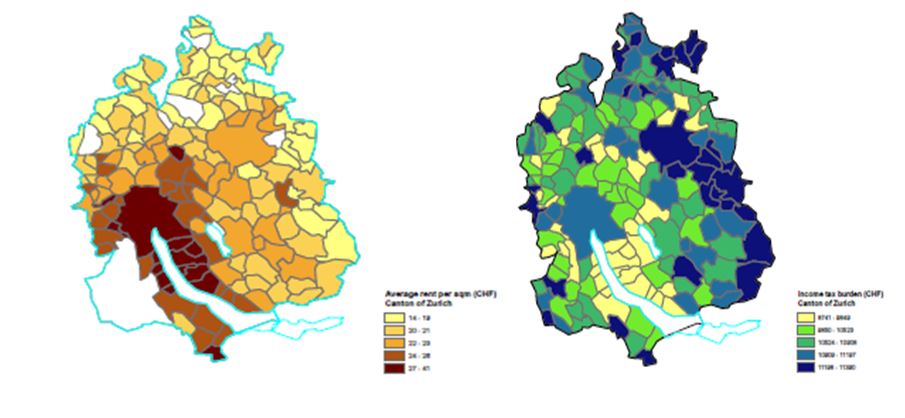
Map taken from Christoph Basten, Maximilian von Ehrlich, and Andrea Lassman, Income Taxes, Sorting and the Cost of Housing: Evidence from Municipal Boundaries in Switzerland
The map above illustrates this theoretical result with data from the canton of Zurich in Switzerland. There is a negative correlation between rents (left map) and income tax rates (right map). Furthermore, using the « boundary discontinuity design » methodology, which compares the values taken by variables on both sides of a boundary (in this case, the boundaries between municipalities), the authors show that the level of taxation has a causal effect on real estate prices (it is therefore not a simple correlation) and on the level of wealth of the population. Thus, Tiebout’s predictions are verified.
The fact that wealthy people want to pay less local tax does not mean that public goods and services will be poor: even with a low tax rate, it is possible to collect a significant amount of money in a « wealthy » community and thus provide high-quality public goods. However, in order to maintain the quality of public services, attempts must be made to control access to them. Indeed, individuals with « low » incomes relative to those of the municipality may be tempted to move there to take advantage of high-quality public services while contributing little to their maintenance. The « rich » may thus fear that the « poor » will free-ride on the maintenance of public services by moving to cities with high average incomes.
This fear of free-riding can lead to political equilibria where the wealthiest agree to pay to prevent the poorest from moving into their municipality. Calabrese, Epple, and Romano (2007) show that extremely restrictive housing construction policies can thus be supported by the « equilibrium » of the political game. Similarly, in France, some municipalities may agree to pay fines rather than meet the requirements of the SRU law on social housing. Similarly, sociologist Fabien Desage argues that mayors try to influence the allocation of social housing so that it is allocated to desirable people, such as young adults whose parents already live in the municipality. In this way, the municipality meets its social housing quota without attracting poor people from « outside. »[2].
Thus, the real estate market (aggravated by a possible mismatch between the housing market and the job market) would spontaneously produce economic segregation, with poor people confined to a few areas and wealthier people living in suburban or city-center neighborhoods. But can this economic segregation lead to cultural, social, or ethnic segregation?
2 – Towards cultural and social segregation?
2.1 An extension of economic segregation
Economic segregation, which tends to separate the « rich » from the « poor, » can lead to social, cultural, or ethnic segregation. Indeed, income distributions are rarely identical within cultural and ethnic groups. For example, in the United States, the African-American population is poorer than the « white » population, and in France, populations « of immigrant origin, » particularly non-European immigrants, are on average poorer[3]. In light of these facts and the mechanisms mentioned above, it is therefore not surprising to observe a certain form of ethnic or cultural segregation.
Furthermore, it is possible that two different social groups may have different preferences for certain public goods. For example, a group with « cultural capital » may prefer cities with public goods such as theaters, opera houses, etc., which another group may not wish to finance. In this case, Tiebout’s model can again be applied to explain a strong separation between these two social groups. Obviously, if the sorting of individuals is based on their preferences, we must ask ourselves whether these preferences are not the result of a difference in wealth (for example, an education in a wealthy environment encourages the development of a taste for the theater). In this case, segregation would once again be economic, although operating via a direct channel and also via the construction of preferences.
But can we believe that economics is the only factor? Let us suppose the existence of two groups (for example, following the American scientific literature, two different ethnic groups). Under what conditions will we observe segregation between these two groups?
2.3 Schelling’s model
Thomas Schelling became famous in part for his model of unwanted segregation. In this model, two groups of individuals, represented by colored tokens on a chessboard, have preferences for their environments. Each individual wants to live surrounded by tokens/individuals of both colors (there is therefore a preference for diversity), but with a slight preference for their own group. For example, we can imagine that each token wants to live surrounded by tokens, two-thirds of which are « its color » and the remaining third of the other color. In addition, Schelling allows the tokens to move successively in order to improve their environment.
By simulating the successive movements of the pawns, Schelling shows that we quickly tend towards very strong segregation. However, this result is dependent on sometimes restrictive assumptions. Nevertheless, Pancsa and Vriend (2007) show that Schelling’s result can occur even if all agents have strict preferences for integration.
It should be noted, however, that this rather pessimistic result depends on one assumption: the existence of two groups. Once again, sociology and history provide insight. The preferences considered as given in Schelling’s model may in fact evolve over time, so that individuals who once saw two populations may now see only one, and vice versa.
2.4 Some empirical evidence
But is socio-cultural or racial segregation really observable in the data? It is important to understand how, beyond theoretical explanations, social, cultural, religious, or ethnic segregation affects real estate markets. Two articles, using widely different econometric methods, illustrate this reality.
First, Card, Mass, and Rothstein (2008) study the « tipping points » associated with segregation. Most segregation models refer to critical points, i.e., thresholds in the proportion of minorities within a neighborhood beyond which the majority prefers to flee. Studying American cities, they find that neighborhoods in which the minority population exceeds a threshold, generally between 5 and 20%, subsequently experience a sharp decline in the « white » population. The existence of these thresholds is evidence of genuine segregation against minorities: the white majority leaves places where minorities begin to settle in too large numbers.
Bayer and McMillan (2012) propose a radically different methodology for directly estimating individuals’ preferences, allowing these preferences to depend on « endogenous variables, » such as the demographic composition of a neighborhood. This method makes it possible to estimate individuals’ willingness to pay (the rent they are willing to pay) to live in housing located in certain neighborhoods, particularly based on the demographic composition of those neighborhoods. Unsurprisingly, they find largely endogamous preferences: individuals are willing to pay to live with people who are similar to them and to pay to avoid neighborhoods populated by people who are different from them. For example, a person without a college degree has a willingness to pay that is $26 below the average to live in a neighborhood with 10% more college graduates. In contrast, college graduates are willing to spend $32 more than the average. Similarly, the African American population is willing to pay $98 more than the average to live in a neighborhood with 10% more African Americans. It should be noted that this result should be considered in comparison to the average, in this case the « white population, » which has a negative willingness to pay compared to the « black population » and is therefore willing to pay to avoid living near African Americans.
Furthermore, in another article, Bayer et al. (2013) show that Hispanic and African American populations pay more when they buy a home (around 3%) and that this premium is not related to their ability to finance the purchase. However, this difference is not necessarily due to an aversion between ethnic groups. The authors find no significant variation in this « premium » when the seller and buyer belong to the same group or to different groups. There is therefore segregation based on ethnic origin in the US real estate market, but this cannot necessarily be reduced to a preference for one’s own ethnic group.
Conclusion
The real estate market produces economic segregation. The monocentric city model can help us understand how individuals distribute themselves spatially according to their wealth. The wealthiest individuals want to settle where it is comparatively easier to obtain large homes, or where amenities (natural or historical) are most abundant.
However, to understand economic segregation, it is also necessary to study how gaps can form between employment areas and areas where the poorest people live, and how the latter can find themselves « stuck » in certain places, thus creating areas of extreme poverty (spatial mismatch theory).
Similarly, local politics, and in particular the level of local taxes and local public services, can be crucial to understanding the wide disparities in income between municipalities. This residential segregation of economic origin can also promote segregation of social and cultural origin, even if the latter can also result from interactions between individuals, even when they are conducive to integration (Schelling model).
Reference:
– Christoph Basten, Maximilian von Ehrlich, and Andrea Lassman, Income Taxes, Sorting, and the Cost of Housing: Evidence from Municipal Boundaries in Switzerland, working paper,July 2014.
– Patrick J. Bayer, Robert McMillan, Tiebout Sorting and Neighborhood Stratification, Journal of Public Economics, Volume 96, Issues 11–12, December 2012
– Patrick Bayer, Marcus Casey, Fernando Ferreira, and Robert McMillan, Estimating Racial Price Differentials in the Housing Market, NBER working paper 2013.
– Stephen M. Calabrese, Dennis N. Epple, Richard E. Romano, On the Political Economy of Zoning
Journal of Public Economics, 91 (1-2), February 2007; 25-49.
– Stephen M. Calabrese, Dennis N. Epple, Richard E. Romano, Inefficiencies from Metropolitan Political and Fiscal Decentralization: Failures of Tiebout Competition,The Review of Economic Studies, 79(3), July 2012; 1081-1111.
– David Card, Alexandre Masand Jesse Rothstein, Tipping and the Dynamics of Segregation, The Quarterly Journal of Economics (2008) 123 (1): 177-218.
– Robert Castel, Les métamorphoses de la question sociale, 1995.
– Fabien Desage, 20% minimum social housing, but for whom? The SRU law put to the test of « communal preference, » Savoir/agir, « housing policy » dossier , June 2013.
– Xavier De Souza Briggs, Civilization in Color: The Multicultural City in Three Millennia, City and Community, Volume 3 (I4), December 2004.
– Jacques Donzelot, The three-speed city: relegation, peri-urbanization, gentrification, Esprit, March 2004.
– Jacques Donzelot, La France des Cités (France of the Cities), Fayard, 2013.
– Masahisa Fujita, Urban Economic Theory, Land Use and City Size, Cambridge University Press, 1989
– Judith K. Hellerstein, David Neumark, Melissa McInerney, Spatial Mismatch or Racial Mismatch?,Journal of Urban Economics, Volume 64 issue 2, September 2008.
– Robert W. Helsley, William C. Strange, Gated Communities and the Economic Geography of Crime,Journal of Urban Economics,Volume 46, Issue 1, July 1999, Pages 80–105
– Kain, John F. (1968). « Housing Segregation, Negro Employment, and Metropolitan Decentralization. »Quarterly Journal of Economics 82(2): 175–197
– Laurent Mucchielli, The Invention of Violence, 2011.
– Romans Pancs, Nicolaas J. Vriend, Schelling’s Spatial Proximity Model of Segregation Revisited, working paper 2003.
– Powdthavee and Oswald, Does Money Make People Right-Wing and Inegalitarian, Study and Lottery Winner,working paper, 2014.
– Thomas Schelling, Dynamic Models of Segregation, Journal of Mathematical Sociology, 1971.
– Charles M. Tiebout, A Pure Theory of Local Expenditures, The Journal of Political Economy, Vol. 64, No. 5, (Oct., 1956), pp. 416-424
– INSEE report cited: http://www.insee.fr/fr/ffc/docs_ffc/ref/IMMFRA12_k_Flot5_con.pdf
|
Reminder: The Monocentric Model
In this model, a group of individuals « consumes » both housing and a composite good, representing all other consumer goods. Furthermore, the model assumes the existence of a point where individuals must go, for example to work or to purchase the composite good. Finally, travel to this point is costly. These few premises imply that an individual will want to live as close as possible to the structuring point (which in fact becomes the city center) and must be compensated for agreeing to move away from it. This compensation takes the form of lower real estate prices, which allow for larger homes. Thus, the monocentric model simply explains why housing prices and population density increase as one approaches city centers.
This model can be adapted to explain the phenomena of economic segregation. Let us assume the existence of two groups, the rich and the poor. Depending on their preferences for larger homes and their transportation costs (the latter is to be taken in the broad sense, including direct transportation costs but also opportunity costs, such as the value of time lost incommuting), the rich and the poor will prefer to live in different places. For example, if the rich have a stronger preference for larger homes and low transportation costs, they will all live in the suburbs, and the poor, unable to pay the same price as the rich in the suburbs, will be confined to the city center.
Brueckner, Thisse, and Zenou (1999) slightly modify this analytical framework to take into account the level of amenity offered by cities, i.e., the characteristics of the environment (the beauty of historic city centers or the countryside surrounding the city, etc.). According to them, by incorporating these factors, it is easier to explain why the poor are more concentrated in city centers in the United States (they use the example of Detroit) while in Europe (for example in Paris) it is the rich who live in the centers. |
Notes:
[1] The main reason is that, on average, « rich » people contribute more to the financing of these public goods and services than low-income households. They want less of them comparatively. On this point, see the study by Powdthavee and Oswald, Does money make people Right-Wing and unequal, Study of lottery winners, 2014, which analyzes lottery winners’ appetite for redistribution.
[2] A similar argument can be found in Jacques Donzelot. According to him, municipalities want to allocate housing to low-income households that are useful, for example, capable of providing personal care or education services that the wealthiest are fond of.
[3] An INSEE report opens with: « In 2010, immigrants living in an ordinary household in metropolitan France reported a median monthly income of €1,400, compared with €1,550 for non-immigrants, » with the gap being most pronounced for immigrants of non-European origin. The descendants of immigrants also suffer from an income gap, but it is more modest. http://www.insee.fr/fr/ffc/docs_ffc/ref/IMMFRA12_k_Flot5_con.pdf