Convenience: This article presents three issues faced by the Brazilian state in order to (re)launch economic growth: control of public expenditure, tax reform, and infrastructure improvements. The pension reform recently approved will allow the government to save substantial amounts of fiscal resources in the coming years, thanks to the introduction of a minimum retirement age. The tax reform aims to unify similar taxes and reduce distortions in the current system. The current government is trying to encourage private investment in large infrastructure projects.
Summary:
- Brazil is struggling to emerge from its recent economic crisis.
- In order to (re)launch economic growth, it should, among other things, stabilize public spending, reform its VAT system, and improve infrastructure.
- The government and Parliament passed a pension reform, are debating a tax reform, and are trying to stimulate investments in infrastructure projects.
For many people around the world, Brazil is seen as one of the fastest-growing economies in the world. Indeed, the country enjoyed an annual average of 7.3% real GDP growth between 1950 and 1980, and after two « lost decades, » it grew annually by 3.5% in the 2000s. However, the past 10 years were marked by the deterioration of economic conditions that led the country to a 2-year economic recession from 2015 to 2016. Once again, a familiar chapter unfolded in Brazilian history: political crisis, high public debt, public deficit. But this time it was different, indicating that the country may have learnt some lessons from its turbulent past.
This time there was no coup d’état, a common solution to political turmoil in Brazilian history. Instead, Parliament impeached the sitting president Dilma Rousseff in 2016 and held regular elections in 2018. Corruption investigations led to the imprisonment of several high-ranking businessmen and politicians, including former president Lula. This time there was no default on public debt, an all-time classic as Argentina demonstrated several times, including last year. Instead, Parliament passed a constitutional amendment in 2016 to freeze public spending for 20 years in order to control the trajectory of public debt, currently at 85% of GDP, which is tremendously high for an emerging economy. This time there was no printing of money to cover the public deficit, which in the past had led the country into a death spiral of hyperinflation. The Central Bank, although not formally independent, has remained a sanctuary of technical decision-making and serious economic research.
Despite this apparent positive note, the country’s economic and financial issues are not being resolved at an acceptable pace, and much needs to be done to protect the country from falling into another economic crisis. In the war against economic slowdown, there are three main fronts that must be tackled by the current administration:
- Budget balance;
- The tax structure; and
- The country’s transportation infrastructure.
1. Budget balance
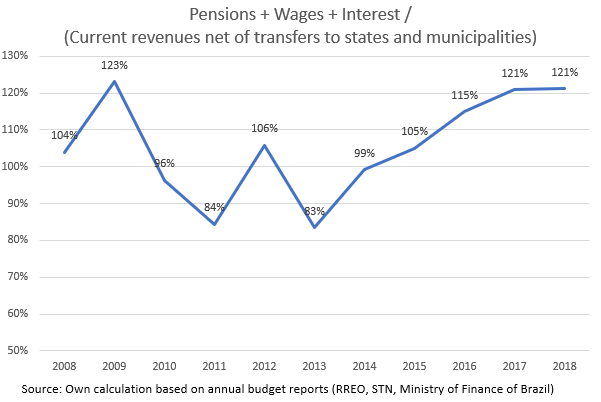
In terms of public spending, Congress passed a constitutional amendment in 2017 that freezes real government spending, as mentioned above. For the next 20 years, the government faces a ceiling on all public expenditure, except for servicing public debt. The objective is to allow Brazil’s debt-to-GDP ratio to start falling and stabilize. The rule was lauded by its supporters as a smart and effective mechanism to control public expenditures without forcing drastic short-term cuts in expenditures. However, it hides a “ticking bomb”: government expenditure on pensions has been rising steadily, currently consuming 1/3 of federal spending or 7% of GDP[1]. As they continue to rise, they will squeeze out other (important) items of spending, since the ceiling must be respected. If total expenditure is fixed and pensions rise, other expenses ought to fall: investments, defense, and others. If things continue as they are, the government will just become a bank cashier that raises money and gives it out as salaries and pensions, without any ability to decide its allocation. For more than a decade, current revenues (taxes, contributions, fees) have not been sufficient to pay salaries, pensions, and service the federal government’s debt, as the graph shows. The government relies heavily on debt issuance, privatizations, and other capital revenues.
Fixing pensions is crucial to allow the government to breathe. In 2019, Congress voted on a pension reform that is expected to reduce the pace of increase in government spending and save about EUR 200 billion (BRL 800 billion) over the next ten years. The main innovation of the reform was the institution of a minimum retirement age of 62 for female and 65 for male workers. Previously, workers could retire only based on a minimum contribution period.
The reform was widely welcomed as an important step in fixing federal public finances, but it fell short of solving the problem more broadly, as state and municipal civil servants were left out of the reform. Subnational public finances in Brazil are in dire straits. The expenditure ceiling also applies to them, and payments to state civil servants are paid out of their treasury funds. Fortunately, most states have already passed their own state pension reform, but large states such as São Paulo and Rio de Janeiro have not yet done so. The danger of subnational finances going bust is that it may ultimately require a bailout by the federal government, jeopardizing federal efforts to contain its own fiscal mess.
2. Tax structure
The second major reform under discussion fixes the Brazilian tax system to reduce some of its most severe distortions. The main proposal focuses on the Brazilian VAT (Value Added Tax). Brazil was among the second country in the world to put in place a VAT, only after France. However, Brazilian VAT is shared among municipalities, states, and the national government in an inefficient way: services are taxed by a municipal VAT, transactions with goods are taxed by a state VAT and by a federal VAT, and industrial processes are taxed by a federal VAT. There are several VATs and none of them generate credits against each other, whereas tax credits are the very essence of VAT. In short, the proposed reform aims to abolish all these taxes and create an « actual » VAT, where any transaction involving services, industrial goods or any other cost may generate credits for the next phase.
But this is still far from happening. At one point, the current government considered simplifying only its own federal VATs, without touching the subnational ones. The problem is that any changes in subnational taxes will entail revenue redistributions both on the vertical axis (between federal, state, and municipal spheres) and on the horizontal axis (among states, or among municipalities). Winners will be pleased, losers will want compensation, and the resources will have to come from somewhere. This fundamental problem has been more prominent in blocking tax reforms than in pension reforms.
It is hard to stress enough the importance of a tax reform in Brazil. The inefficiencies driven by this VAT are obvious: the inability to deduct taxes leads to cascade taxation, increasing prices and hurting sectors with more complex process chains. Brazil is not even able to guarantee, to this day, that all its exports are really tax free. This happens because some inputs, like services, cannot generate credits for the taxes on goods. The current tax system dampens the ability to aggregate value, at low cost, in potentially multiple phases of a production chain. The hope is that fixing this will liberate a potential that has been suffocated by the current system.
3. Infrastructure
The third Herculean task for the Brazilian government is infrastructure. Roads, railways, airports, waterways—everything is needed and in short supply. Add in the fiscal issues that governments have been facing, and the conclusion is obvious: there are simply not enough resources to build or manage these public facilities. Following an international trend and in response to another fiscal crisis in the 1990s, the Brazilian governments—federal and state—have signed contracts conceding transportation facilities to private companies. The current paucity of funds has revived interest in similar deals, and Parliament is debating a new regulatory framework to encourage private investors to join infrastructure projects in concessions and public-private partnerships.
In 2019, the operation of several airports was concessioned to the private sector for 30 years, usually with the obligation to make expansion investments. Several of the airports were awarded to international operators such as Aena (Spain) and Zurich (Switzerland). The French group Vinci has been operating the Salvador airport since 2018. In 2019, the government also successfully held an auction for a large railway project connecting the north of the country to the main export ports in the south.
Conclusion
How hopeful can we really be about change? This will depend, of course, on how the current government navigates the domestic political turbulence as well as the increasing uncertainty in the international arena. The current government, led by President Jair Bolsonaro, wants to steer the country towards a more free-market oriented economy: cut regulation, open markets (including public procurement), and privatize public companies. However, unless macroeconomic risks related to public finances are resolved, all the free-market rhetoric will not make GDP growth great again. The pension reform was an important achievement, but the government still faces a sizable budget deficit. Moreover, there is just too much uncertainty about how Jair Bolsonaro can manage the political unrest that helped him get elected.
Meanwhile, other relevant topics occupy the government’s agenda: violence, education, and environmental protection. Although these topics may be technically independent of the economic reforms that are desperately needed, they consume the political capital that will get them approved. Even on the economic agenda, there are a number of other reforms, more at the microeconomic level, being discussed and proposed: in particular, reducing taxes for low-skilled labor and opening the country to international trade. It is unclear whether the government will put its economic agenda ahead of other political battles. But to unleash much-needed economic growth, there is more than enough for a four-year term.
[1]According to the National Treasury summary report (RREO), in 2018 the federal government spent BRL 590 billion on pensions, which represents 25% of the total expenditure of BRL 2.2 trillion. If one excludes constitutional transfers to subnational governments and payments of interest on public debt from the total, pension benefits reach 37% of federal expenditure. These figures do not include subnational expenditure by states and municipalities with their own pension systems for state employees.
[2]France introduced VAT in 1957 and Brazil in 1965.
[3]The proposal was put forward by a tax think-tank, and is gaining support by members of Parliament and government. The website of the think tank is http://ccif.com.br/