Summary:
– Monetary poverty, at the 60% threshold, increased in all EU15 countries except the Netherlands, Finland, Ireland, the United Kingdom, and Austria.
– Within countries, the number of poor people has not changed in the same way across all age groups.
– Older people are protected from the economic downturn, while the number of working-age people and children living in poverty is increasing.
– Along with Luxembourg, France stands out from other European countries in that the number of people living in poverty has increased most sharply among children.

Since 2008, European countries have been experiencing a crisis unprecedented since the end of the Second World War. This crisis, which began as a financial crisis, gradually spread to the real economy and then to society as a whole. Today, it is reflected, among other things, in sluggish economic growth, high unemployment, public mistrust of the political sphere, and a rise in extremism.
The deterioration in living conditions is another area in which the crisis is having a significant impact and which is linked to those mentioned above. A growing number of people have been plunged into poverty, leading to increasingly complex situations. In light of this, it is important to examine the evolution of poverty and identify those most affected by it. This is essential in order to understand the current situation and take appropriate measures to combat poverty.
Poverty is on the rise in almost all European countries
Since 2008, European countries have alternated between periods of weak growth and recession, and even depression in some years. This has led to an increase in unemployment rates in all European countries, with the notable exception of Germany. For example, the unemployment rate in Spain rose from 8.2% of the working population to 24% between 2007 and 2014 (September figures). While this country is one of the most affected by the crisis, it clearly shows the impact of the crisis on the European economy.
Furthermore, by damaging the labor market, the economic crisis has deprived part of the population of income from work, leading to an increase in poverty. Indeed, among the fifteen richest European countries, only four (the Netherlands, Finland, Ireland, the United Kingdom, and Austria) did not experience an increase in monetary poverty between 2007 and 2012 (Figure 1). It should be noted here that the decline in poverty rates in the United Kingdom and Ireland seems to be explained more by a decline in median living standards than by an improvement in the living conditions of the poorest people. Among the other countries, the increase in poverty was highest in Greece (+3 percentage points), Sweden (+2.6 points), and Luxembourg (+2.5 points). With an increase from 12.5% to 13.7% between 2007 and 2012, France experienced the fifth largest increase in the poverty rate. However, its poverty rate remains low compared to other European countries. With a poverty rate of less than 14% in 2012, France is one of the least affected countries, along with the Netherlands, Finland, and Denmark. In contrast, the Mediterranean countries (Portugal, Italy, Greece, and Spain) are the most affected by poverty, with rates above 14%. Finally, although Germany is the only country to have seen a decrease in unemployment between 2007 and 2012, it experienced an increase in poverty during this period (+0.9 points) and reached a relatively high level (16.1%).
Figure 1: Monetary poverty rate at the 60% threshold in 2007 and 2012
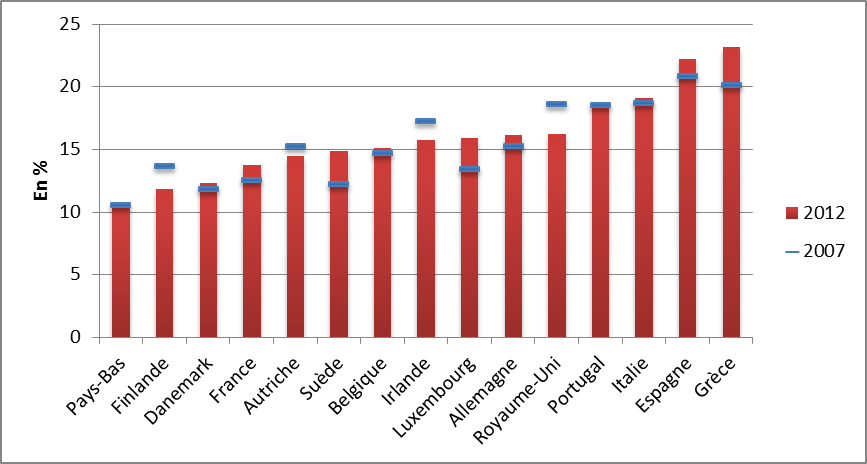
Reading: In 2012, the monetary poverty rate at the 60% threshold reached 13.7% in France.
Note: These are 2011 data for Spain and the United Kingdom.
Source: Eurostat [ilc_li02], date of extraction 11/14/2014, Bsi-Economics.
In France, children are particularly affected by the increase in poverty
While European countries have not all experienced the same trends in poverty during the crisis, the same is true within countries when we look at changes in the number of poor people by age group (Figure 2). The number of people in working age (15-64) living in poverty increased in twelve of the fifteen countries surveyed, while it decreased in all countries for those aged 65 and over, with the exception of Greece and Sweden. This can be explained by two phenomena:
- The increase in the poverty rate is mainly due to the deterioration of the labor market, which leads to a loss of income for people of working age. It is therefore people of working age who are most affected by the decline in living standards.
- People retiring have increasingly long and full careers, which ensures them a higher retirement pension. This is known as the noria effect.
The change in the number of people under the age of 18 living in poverty varies greatly from one country to another. Six countries have seen an improvement (Finland, the United Kingdom, Denmark, Germany, the Netherlands, and Ireland), three countries have seen virtually no change (Austria, Italy, and Portugal), and six countries have seen an increase (Belgium, Spain, France, Sweden, Greece, and Luxembourg).
Along with Luxembourg, France stands out from the other countries in that poverty has increased most among children. The effects of the economic crisis are therefore being felt more by children than by the rest of the population. Between 2007 and 2012, nearly 420,000 more children were affected by poverty, representing an increase of 20.5%. This worsening of child poverty can be explained by the fact that poverty is more pronounced among single-parent families and large families than among the rest of the population.[1]. With an increase from 27.4% to 34.9% between 2007 and 2012, France experienced the third largest increase in the poverty rate among single-parent families within the EU15. For households with at least three children, the poverty rate rose from 19.8% to 23.1%, placing France fourth in the EU15 in terms of increase. Statistics on unemployment rates by household type are lacking to understand whether the change in poverty for single-parent families and large families can be explained by greater sensitivity to labor market conditions. However, it can be said that single-parent families have a higher unemployment rate than other types of households (18.9% compared to 10.9% for single people in 2013).[2].
This situation is all the more worrying given that children’s standard of living has a direct impact on their development and living conditions in adulthood[3. Indeed, a recent study in the United States showed that increasing family income by $1,000 leads to a 6% standard deviation increase in math and reading test scores[4. This effect seems to be even more significant for children living in low-income families. Furthermore, children’s standard of living appears to have an impact on their living conditions in adulthood. It has been shown that an increase in standard of living during childhood leads to a higher standard of living in adulthood and better integration into the labor market[5]. There also appears to be a positive relationship between standard of living during childhood and physical health. The same is true for the development of social, emotional, and behavioral skills[6]. Ensuring a certain standard of living for children is therefore essential to ensure their best possible integration into society as adults. While this strategy may seem costly in the short term, it is likely to be profitable in the longer term. By improving the health of the population, its level of education, and its integration into the labor market, many « repair costs » can be avoided.
Figure 2: Rate of change in the number of people living in monetary poverty by age group between 2007 and 2012
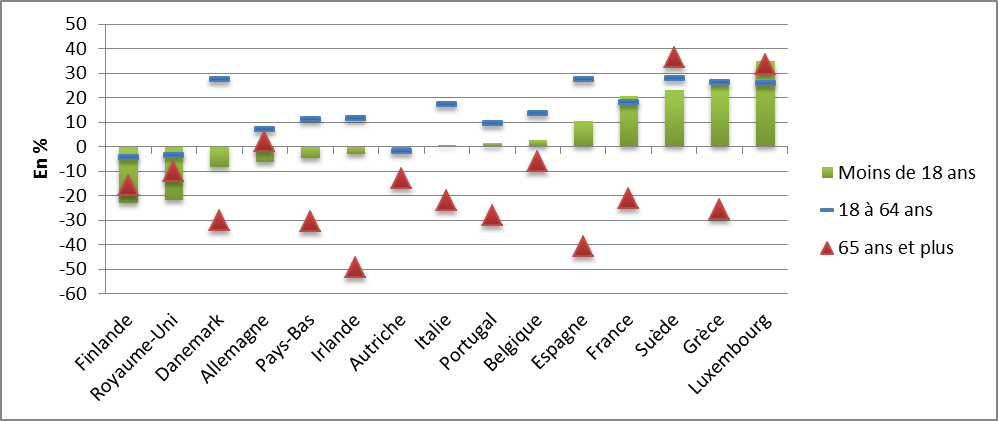
Reading: The number of people under the age of 18 who are monetarily poor at the 60% threshold increased by 20.4% between 2007 and 2012 in France.
Note: This refers to the period 2007-2011 for Spain and the United Kingdom.
Source: Eurostat [ilc_li02], date of extraction 11/14/2014, Bsi Economics.
Conclusion
Almost all EU15 countries have seen an increase in poverty rates since the start of the crisis in 2008. However, this increase in poverty has not been experienced equally among members of the same country. While older people seem to be protected from the effects of the economic downturn, people of working age and children are on the front line. This is particularly true in France, where the number of poor people has increased most among those under the age of 18. This French specificity is worrying when we consider the importance of living conditions in childhood on living conditions in adulthood.
In 2013, the government launched a five-year plan to combat poverty and promote social inclusion. This plan includes some 60 measures designed to reduce the overall poverty level of the population and, ultimately, that of children. However, we may question the lack of clear objectives specifically targeting child poverty.
Indeed, unlike the United Kingdom and Belgium, which have clearly enacted plans to combat child poverty, France seems to be turning a blind eye to the situation it is facing. For example, the vote on the introduction of modulated family allowances should have been an opportunity to redistribute more family benefits to low-income families. In October 2014, parliamentarians voted to introduce the modulation of family allowances. As a result, family allowances would be halved for households with incomes above €6,000 for a household with two children and quartered for incomes above €8,000. One might have thought that the money saved by reducing allowances for wealthy households would have been used to finance an increase in allowances for the most low-income households. Such a measure would have led to a reduction in the monetary poverty rate among children. However, the government used the savings to reduce the public deficit. Nevertheless, the childhood commission, set up by the Prime Minister in January 2014 at France Stratégie and due to report shortly, will be able to propose ways of curbing child poverty or, at the very least, highlight France’s difficulties in this area.[7].
Notes:
[1] Marguerit D. (2014), « The effects of a long-term economic crisis, » Annual Report of the National Observatory on Poverty and Social Exclusion, 120 p.
[2] Lê, Le Minez, and Rey (2014), « Long-term unemployment: the crisis has hit hardest those who were already most vulnerable, » France, social portrait, 2014 edition, INSEE.
[3 Gibb S.J., Fergusson D.M & Horwood L.J. (2012), « Childhood family income and life outcomes in adulthood: Findings from a 30-year longitudinal study in New Zealand, » Social Science & Medicine, vol. 74(2), pages 1979-1986.
[4] Dahl G.B. & Lochner L. (2012), « The Impact of Family Income on Child Achievement: Evidence from the Earned Income Tax Credit, » American Economic Review, vol. 102(5), pages 1927-1956.
[5] For a review of the literature, see: Mayer S. (2010), « Revisiting an old question: How much does parental income affect child outcomes? », Focus, vol. 2(2), pp. 21-26.
[6] For a review of the literature, see: Cooper K. & Stewart K. (2013), « Does money affect children’s outcomes: a systematic review, » Joseph Rowntree Foundation.
References:
Dahl G.B. & Lochner L. (2012), » The Impact of Family Income on Child Achievement: Evidence from the Earned Income Tax Credit, » American Economic Review, vol. 102(5), pages 1927-56.
Cooper K. & Stewart K. (2013), « Does money affect children’s outcomes: a systematic review, » Joseph Rowntree Foundation.
Gibb S.J., Fergusson D.M & Horwood L.J. (2012), » Childhood family income and life outcomes in adulthood: Findings from a 30-year longitudinal study in New Zealand, » Social Science & Medicine, vol. 74(2), pages 1979-1986
Lê, Le Minez and Rey (2014), « Long-term unemployment: the crisis has hit hardest those who were already most vulnerable, » France, social portrait, 2014 edition, INSEE.
Marguerit D. (2014), « The effects of a long-term economic crisis, » Annual Report of the National Observatory on Poverty and Social Exclusion.
Mayer S. (2010), « Revisiting an old question: How much does parental income affect child outcomes? », Focus, vol. 2(2), pp. 21-26.