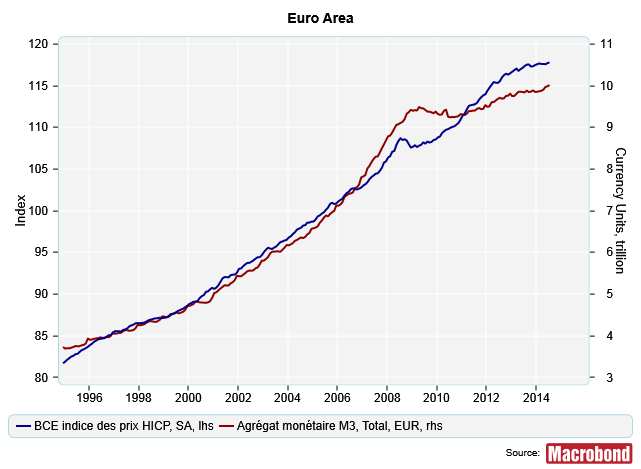
Economic analysts often monitor changes in the money supply because, over the long term, it correlates with a country’s inflation rate. In practical terms, what factorsaffect money supply figures?
Let’s take the example of one of the simplest monetary aggregates, M2, which includes bank deposits and banknotes in circulation. In this sense, the money supply consists of these two components. So how does it increase from one year to the next?
Let’s focus on the simplest element, which also represents the largest part of the money supply (more than 90%): bank deposits. How do bank deposits increase? At first glance, this question may seem strange: your deposit at your bank increases because you put money into it, you might say. However, the money you put into your account comes from someone else who gave it to you, or, for example, from your employer who paid you, in which case they made a transfer from another bank (or the same bank as yours) to yours. So there is no money creation: your deposit increases because someone else’s has decreased. At the global level, there has been a transfer, not a creation of money. We must therefore look at cases where the total amount of demand deposits increases in order to understand how the amount of money in circulation is determined.
The previous illustration helps us understand a very simple fact: the amount of money in circulation is not determined by transactions between non-banking agents (households, businesses, etc.), but by transactions between the banking sector (banks and the central bank) and the non-banking sector[1]. Several types of transactions will lead to an increase or decrease in the money supply. These mainly include:
– Bank credit. When a bank grants a loan to an individual, it credits their account with a certain amount, thereby creating a new deposit. The money supply then increases. But at the same time, some agents repay their bank loans, thereby reducing the amounts in their deposits: the money supply decreases. The more credit is created in relation to loan repayments, the more money is created.

– Purchases/sales of assets[2] from the banking sector to the non-banking sector: when a bank buys an asset from a financial company, for example (a hedge fund/insurance company), it will make a transfer to that company’s bank account: the money supply increases. At the same time, the bank may sell an asset to a non-banking agent, thereby reducing the money supply. What ultimately matters is the net balance of asset purchases by banks from non-banking agents: if banks as a whole buy more assets than they sell to non-banking agents, the money supply increases.

– The central bank’s purchases/sales of assets when it bypasses the banks (such as the Bank of England with its QE). As before, when a central bank buys securities from non-bank agents, it increases their deposits: the money supply increases.
– Purchases/sales of long-term capital or debt by banks[3] by a non-bank agent following their issuance. In the case of a purchase, the non-bank agent substitutes a debt for a deposit, and the deposit is not transferred to another non-bank agent: money is destroyed.
These main operations explain why the money supply increases or decreases in a given period. In general, credit always plays a key role.
Julien P.

Notes:
[1] Excluding government.
[2] We could specify « long-term assets » to avoid potential confusion, as some short-term assets are included in the M4 aggregate.