DISCLAIMER: The opinions expressed by the author are personal and do not reflect those of the institution that employs him.
Usefulness of the article: This paper shows the latest developments in development following the ambitious commitments made by the international community on climate and development in 2015. This analysis provides an overview of the current state of public financing in this area and demonstrates that, without an improvement in international policy, the SDGs cannot be achieved.
Summary :
- Since the 2015 international commitments of the Paris Agreement and the adoption of the 2030 Agenda to achieve the Sustainable Development Goals (SDGs), global Official Development Assistance (ODA) has declined slightly.
- Furthermore, proportionally, ODA is increasingly less directed towards the countries and sectors that need it most, namely the Least Developed Countries (LDCs) and non-productive sectors such as education and health.
- As a result, there is a lack of funding to meet the 2015 commitments, especially as the political context has deteriorated with the emergence of widespread suspicion regarding ODA.
According to the definition of the Development Assistance Committee (DAC) of the Organization for Economic Cooperation and Development (OECD), « official development assistance » (ODA) refers to aid provided by states with the aim of promoting economic development and improving living conditions in developing countries. The figures show a decline that began in 2016. However, in 2015, two international agreements on development were signed: the Paris Agreement and the adoption of the 2030 Agenda. Their objectives were ambitious and called for an increase in funding of more than USD 2 trillion per year, particularly for the energy transition of developing countries and the development of the poorest countries.
However, trends in recent years show that funding is insufficient to achieve the Sustainable Development Goals (SDGs) of Agenda 2030, in an international context that is increasingly unfavorable to ODA.
1) Global trends: ODA has been declining since 2016 and is increasingly less directed towards the countries that need it most and priority development sectors
1.A) A decline in global ODA since 2016 due to a decline in the reception of refugees
OECD figures for 2018 confirmed the decline in global ODA since 2016, although it remains at around its historic highs. Net global ODA fell from USD 147 billion in 2016 to USD 143 billion in 2018. This decline is mainly due to a decrease in aid allocated to refugee reception, as a result of the decline in the number of arrivals, as well as stagnation in ODA in other sectors.
Figure 1 shows that, excluding refugee reception costs, ODA is stagnating. It should be noted that a small part of this decline can also be explained by the reform of the accounting of ODA loans in grant equivalent, which amounts to accounting only for the subsidy or concessionality of loans in the year they are granted. In order to be eligible for ODA, the concessionality of a loan increases with the poverty of the recipient country: a loan to LDCs is only eligible if it is more than 45% concessional. However, more specifically, analysis of the data shows that it is emerging countries that have benefited most from ODA in recent years.
Graph 1– Evolution of global Official Development Assistance since 2010
1.B) Least developed countries still receive too little ODA
The OECD classifies developing countries according to a list that is redefined every three years based on the wealth of the country’s inhabitants, measured by their GNI per capita[1]. There are four categories of developing countries: least developed countries (LDCs), which include the poorest countries in the world; low-income countries (LICs), which include countries such as North Korea that do not want to be classified as LDCs; and middle-income countries, divided into two categories: lower middle-income countries (LMICs), with GNI per capita between $1,046 and $4,125, and upper middle-income countries (UMICs), with GNI per capita above $4,125, which represent the major emerging economies.
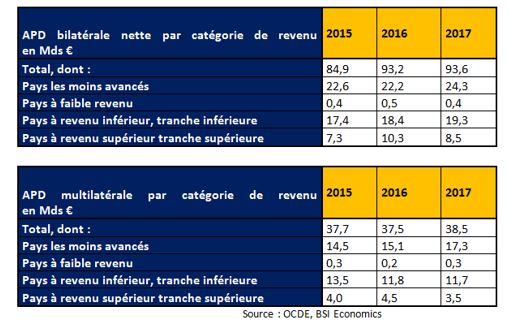
LDCs are therefore the countries most in need of this financing, particularly in sub-Saharan Africa. However, according to OECD data, bilateral ODA from DAC donors to these countries most in need has fallen from 27% to 25%, while financing to middle-income countries has exceeded 30%. The conditions for access to ODA for LDCs are indeed difficult: first, there is the Lagarde doctrine, which states that loans should not be made to countries that are already heavily indebted. Second, in the case of loans, the concessionality must be greater than 45% in order to be eligible: LDCs are therefore mainly recipients of grants or multilateral aid. Middle-income countries consequently receive large loans from development agencies.
Table 1 – Geographic distribution of global ODA by channel (bilateral or multilateral) and country type by income category
1.C) Global ODA directed primarily toward productive sectors rather than developmental sectors
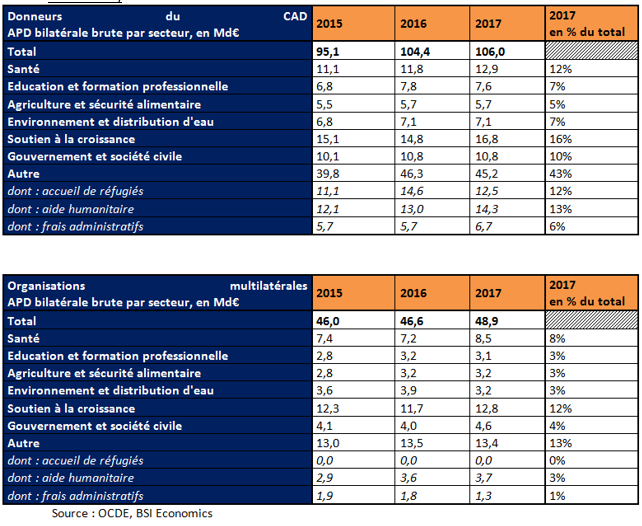
From a sectoral perspective, global ODA leaves little room for the most developmental and social sectors, namely health, food security, and education. According to OECD data, the leading ODA sector remains that dedicated to production and growth, which accounts for between 12% and 16% depending on the channel through which the aid is delivered (multilateral and bilateral, respectively).
In 2017, education and health together accounted for 11% of the activities of international development organizations and 19% of bilateral activities. At the same time, activities related to the environment and water accounted for only 3% and 7% of multilateral and bilateral activities respectively, representing stagnation in these sectors.
In this context, the question of achieving the SDGs is becoming increasingly pressing. In particular, OECD Secretary-General Angel Gurria stated that « DAC countries are not meeting their 2015 commitment to increase development financing, which does not bode well for our ability to achieve the Sustainable Development Goals by 2030. »
Table 2 – Sectoral distribution of global ODA by channel (bilateral or multilateral)
2) Towards a funding gap to meet the international commitments of the 2030 Agenda and the Sustainable Development Goals, and more generally the Paris Agreements, in a fragile political context
2.A) The 2015 international commitments mark a turning point for sustainable development
The 2030 Agenda was adopted on September 25, 2015, by heads of state and government gathered at the UN Special Summit on Sustainable Development. The 2030 Agenda sets out 17 Sustainable Development Goals (SDGs). The SDGs present a cross-cutting vision of sustainable development: first, they combine the fight against poverty with the preservation of the planet in the face of climate change; second, the challenges of sustainable development encompass all countries on the planet; and finally, they are the result of a broad consultation with a range of stakeholders, including researchers, civil society, the private sector, and local authorities.
The 2030 Agenda also confirms the priority given to sustainable development in the Paris Climate Agreement, which aims to limit global temperature rise to 2°C. More specifically with regard to ODA, the OECD’s DAC has repeatedly reiterated the target of 0.7% ODA/GNI for donors on development financing, a target that has not been collectively achieved.
It now seems difficult for countries to meet their collective commitments.
2.B) Towards an ever-widening financing gap, which increases the demand for private financing
The UNDP estimates that the annual requirement to achieve the SDGs is USD 4 trillion in developing countries[2], of which only USD 1.4 trillion would be honored, suggesting a funding gap of more than USD 2.5 trillion today. International organizations are therefore calling for increased private financing support for development, but this part, which is much less transparent, is also declining. According to Angel Gurria, « The decline in official development assistance is particularly worrying because it follows data showing that private contributions to development are also declining. »
With both public and private investment declining, it would appear that the « political climate » has changed, and that ODA and development in general have now entered a new era, no longer being a priority for the leaders of the world’s major donors.
2.C) Towards a new political landscape that increasingly neglects development financing
Indeed, as explained by Alexander Thier and Douglas Alexander, two development thinkers[4], beyond the current crisis of multilateralism and coinciding with the rise to power of nationalist parties among the major donors (notably the United States, the United Kingdom, and Italy), the negative impacts of global climate change no longer seem to be among their concerns. The new political landscape since 2015 appears to take less account of the interdependencies between countries in terms of global public goods (water, air) and climate. The tensions surrounding the recent fires in the Amazon illustrate this new political landscape.
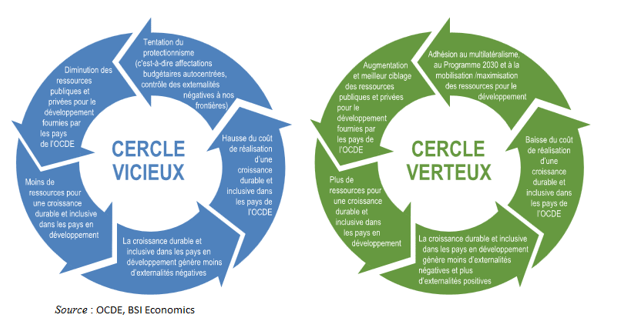
With the power of international organizations declining and multilateral forums such as the G7/G20 showing less interest in development and climate issues, there is a risk that funding for developing countries will decrease further in the coming years. The OECD is even calling for the vicious circle—where the temptation of protectionism hinders external financing for development, reducing sustainable and inclusive growth, which in turn leads to a decline in external financing—to be transformed into a virtuous circle. This effect would quickly dash hopes for efforts to achieve the SDGs and bodes ill for countries’ ability to comply with the Paris Agreement.
Graph 2– Transforming the vicious circle into a virtuous circle for development financing
If private actors are not supported, for example through « SDG » labeling of their financing or through public financial leverage, there is a risk that the SDGs will not be achieved and will be replaced by a third agenda with similar objectives (after the Millennium Development Goals or MDGs).
Conclusion
Beyond simply noting a decline in global ODA and private flows to developing countries, two main ideas are worth remembering.
First, ODA alone will not be enough to achieve the SDGs by 2030. These will only be partially achieved, given that ODA represents a minimal share (3-4%) of the financial needs of developing countries, that the performance indicators used to measure achievement have not been calculated for two-thirds of the goals, and that the financial gap from the private sector amounts to USD 2.5 trillion per year.
Secondly, the current political climate, with the decline of the agendas of nationalist parties in power in the United States, Italy, and the United Kingdom, among others, could prove fatal to the achievement of international commitments on development and climate.
Finally, the very role of ODA could be called into question if, as 2030 approaches, countries collectively fail to achieve the SDGs and limit global warming.
[1] https://www.oecd.org/fr/cad/financementpourledeveloppementdurable/normes-financement-developpement/DAC_List_ODA_Recipients2018to2020_flows_Fr.pdf
[2]https://www.undp.org/content/dam/undp/library/Sustainable Development/2030 Agenda/Financing_the_2030_Agenda_CO_Guidebook.pdf