Purpose: The purpose of this article is to analyze the main macroeconomic effects expected from the Grand Paris project for economic agents, in particular to understand how this project, which will span 20 years and mobilize nearly €22 billion, will make the Île-de-France region more attractive.
Summary:
- The Grand Paris project promotes the development of strategic concentrations of firms (clusters), enhancing the attractiveness of the metropolis and thus revitalizing its growth.
- The Grand Paris Express, the backbone of this project, encourages interaction between these clusters and the creation of jobs and housing.
- Improvements to the transport network would enable better allocation of employment and housing prices across the region.
Announced in 2007 during a speech by former President Nicolas Sarkozy, Greater Paris is motivated by the gradual integration of the cities of the Paris suburbs to form a metropolis with international influence. The law of June 3, 2010 sets out the main objectives and seeks in particular to enhance the capital’s attractiveness in order to compete with other global metropolises such as London and Tokyo, and to support growth that is both inclusive and sustainable.
Defined in January 2016, the metropolis, which now includes the capital and 130 municipalities, contributes nearly 30% of the national GDP and 23% of jobs, according to INSEE. Revitalizing competitiveness clusters, particularly those in the metropolitan area, would therefore be crucial for the nation to revive economic growth, which is currently stagnating at below 2%. To achieve this, policymakers are relying in particular on the development of the Grand Paris Express (GPE) transport network. Three major macroeconomic effects of this project have been identified and will be analyzed.
Source: Grand Paris JLL, Société du Grand Paris, infographic by BSI Economics
The attractiveness of Greater Paris boosted by clusters whose interactions are facilitated by the GPE
The environment in which businesses in the Paris region operate is linked to their expansion and the attractiveness of the capital. In the 1990s, economist Porter highlighted this by introducing the concept of clusters. Clusters geographically concentrate companies and research institutions from the same industry. This grouping of activities facilitates access to information, technology, and existing specialized employees. Competition is based on the productivity of companies and the degree of sophistication of the tools, methods, or technologies used. However, this sophistication is particularly linked to the environment in which the company operates. The more conducive the environment is to the employment of skilled people, the more the company will be able to develop its competitiveness in more complex products or services. It is in this sense that clusters improve the productivity of companies. They thus enable a country to specialize in these high-productivity industries, improving the country’s comparative advantage and attractiveness.
With this in mind, the then Secretary of State Christian Blanc, who was in charge of this project, identified seven strategic economic hubs:
- La Défense, the financial hub, is home to nearly 2,500 companies, including 1,500 head offices;
- Le Bourget, the aeronautics hub, includes Le Bourget Airport, the European leader in business aviation, the Paris Air Show, and the Parc des Expositions exhibition center;
- Pleyel, the creative hub;
- La Cité Descartes, the sustainable city hub, brings together 142,000 jobs and deploys technologies for sustainable urban development;
- Roissy Charles de Gaulle and Orly, the international trade and events hub, where nearly 170,000 people work. More than 70 million passengers were welcomed in 2018;
- Paris Biotech Vallée, the health hub located in Villejuif/Evry, is home to 21 research laboratories and more than 70 companies in the health sector;
- Paris-Saclay, the innovation and research hub, currently accounts for 15% of French research and employs nearly 8% of the region’s working population. The concentration of universities and grandes écoles in this hub encourages large companies to develop their R&D centers there.
The seven clusters of Greater Paris linked by the GPE
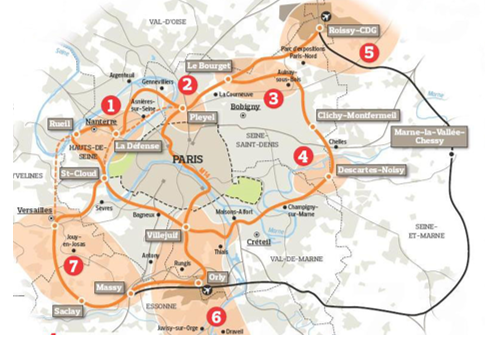
Source: Le Figaro, infographic, the seven hubs of Greater Paris
The interactions between these urban economies are further enhanced by the Grand Paris Express, an additional 200 km network that also serves as a lever for regional and national attractiveness. On the initiative of the Société du Grand Paris, the LIEPP (Interdisciplinary Laboratory for the Evaluation of Public Policies) at Sciences Po shows that the development of the transport network has a positive effect on the attractiveness of cities in the location choices of multinational companies. This attractiveness is measured by the number of foreign direct investment (FDI) projects. The results reveal that cities with a metro system attract more FDI. In the case of the GPE, based on the fact that it would double the size of the metro system, the study suggests that it would lead to an increase of between 10 and 20% in the number of projects, representing an annual increase of around 17 projects per year.
The Grand Paris Express would therefore make the Ile-de-France region, and France as a whole, more attractive by improving exchanges between the main centers of competitiveness. Currently ranked7th among the most attractive cities and with a 220 km network, the metropolis attracts 1,461 projects, compared with 3,149 for London, which has twice the size of network.
As Europe’s leading R&D hub, this sector is a major asset in competing with other global cities and enhancing France’s attractiveness. Investment projects in the Ile-de-France region are mainly concentrated in R&D and the establishment of decision-making centers for multinational groups. The creation of clusters, which bring businesses and university research closer together through the GPE, is particularly conducive to the development and establishment of new research centers and makes the city more attractive. In 2018, the region attracted nearly 31% of investment in these activities nationwide, according to Business France. The activities of decision-making centers reinforce this attractiveness by promoting the creation of R&D laboratories in the same area: the metropolitan area currently accounts for 62% of these investments.
In addition to the investment projects concentrated in these hubs, they are also a source of job creation. R&D is benefiting from growing employment, up 22% between 2017 and 2018, according to Business France. Although employment growth is stagnating, decision-making centers account for 14% of jobs created by investment projects.
Households: new jobs and a redesigned real estate market
Taking into account both direct jobs (on GPE construction sites) and indirect jobs (such as the establishment of multinational companies) linked to the GPE, the Société du Grand Paris estimates that 115,000 jobs will be created by 2030. Beyond the creation of additional jobs stimulated by the development of these clusters, the new transport network directly influences households’ choice of housing and place of work. Until now, significant disparities between municipalities have been observed, with jobs concentrated in the center and high real estate prices.
Concentration of jobs in Paris and the inner suburbs (Seine Saint-Denis, Hauts-de-Seine, Val-de-Marne), representation of job density in 3 dimensions
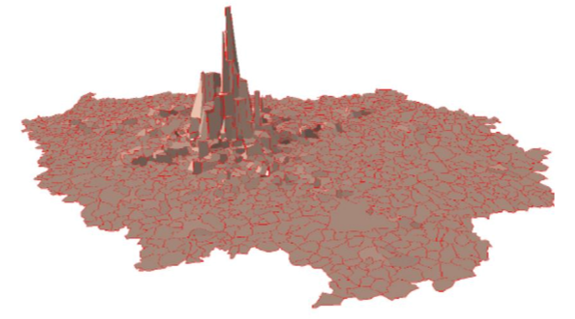
Source: Impact of the Grand Paris Express on the labor market and the housing market, 2017, LIEPP Sciences Po
Distribution of jobs in the Ile-de-France region
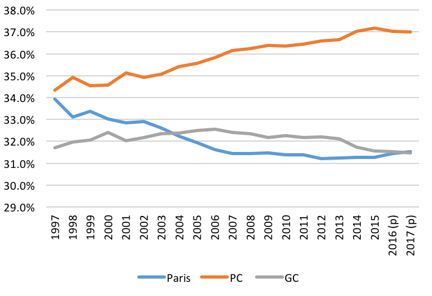
PC: inner suburbs / GC: outer suburbs
Sources: INSEE, BSI Economics
Until now, employment has tended to relocate to the inner suburbs at the expense of Paris, and more recently to the outer suburbs. The development of the transport network could harmonize this distribution and make the best use of the territory. The GPE would limit households’ travel time and thus encourage them to move to competitive hubs, which are sources of employment.
In a similar study for the SGP, LIEPP researchers examined the impact of the GPE on employment and the real estate market. The main finding was a 3% reduction in transportation costs, measured in terms of user discomfort, time spent, and ticket prices, thanks to the metro extension project.
In the short term, the GPE can effectively correct disparities by allowing households to move further away from the center while improving their well-being by reducing their travel time and benefiting from lower rents.
However, in the medium to long term, these effects are incorporated into housing prices. As economic hubs become more attractive, more jobs are created, but housing that offers the greatest travel time savings becomes more expensive. The creation of new housing could then limit this price increase: Greater Paris has therefore set itself the goal of creating 70,000 homes per year by 2030.
Conclusion
Given the metropolitan area’s significant contribution to national growth, revitalizing this territory is becoming a priority for policymakers. The creation of strategic concentrations of activities and additional metro lines makes the region more attractive to businesses, investors, and households. The implementation of this new infrastructure is also conducive to international events such as the 2024 Olympic Games and the 2025 World’s Fair, which contribute to the reputation of the City of Light and its surroundings.
Bibliography:
Clusters and the New Economics of Competition, 1998, Michael Porter
Impact of the Grand Paris Express on the labor market and the housing market, 2017, LIEPP Science Po
Impact of the Grand Express on the location of foreign direct investment, 2017, LIEPP Science Po
The Grand Paris Express, Investment for the 21st Century, 2015, Société du Grand Paris
Analysis of the diversity of the spillover effects of the Grand Paris Express on the Île-de-France region, 2018, Carré, Levratto, Ngudam Ntouko, SGP
Regional summary, Economic activity in the Paris region loses momentum but remains generally positive at the end of the year, Conjoncture Ile-de-France, INSEE
Employment estimates for 2017 updated on 24/04/2019, INSEE Results