Usefulness of the article: Finding solutions to reverse biodiversity loss and restore our ecosystems is essential. This article presents ideas for offset banks, which are based on a market mechanism and aim to halt the net loss of biodiversity.
Summary:
- The idea of offset banks originated in the United States and has spread to several countries around the world, including France.
- Although these banks have economic advantages over traditional regulations, their ecological effectiveness is nevertheless being questioned.
- Offset banks help preserve natural resources while providing compensation for the restoration of natural sites.
- Despite this potential, empirical studies show a lack of ecological effectiveness in existing offset banks.

Biodiversity represents the totality of living variations at three levels of organization: ecological (ecosystems), specific (species), and genetic (genes). The collapse of biodiversity is a well-documented phenomenon, which is likely to worsen with climate change (IPBES, 2019). Several solutions are available to decision-makers to stem this degradation. Regulations can be adopted to prohibit development in certain areas by establishing nature reserves, for example, or standards can be put in place through specific technologies. However, such policies are often more expensive for society than market-based solutions such as taxes or permit markets (based on the model of the European Union’s Emissions Trading System (ETS)).
Market-based solutions have been applied to the problem of biodiversity loss in the form of offset banks. The aim of these banks is to prevent a net loss of biodiversity. The idea behind offset banks is quite simple: as with our bank accounts, it is possible to make debit or credit transactions. If a developer damages a habitat with their project, this is a debit that they must pay. On the other hand, if an organization restores a habitat, it is a credit that it can sell to the bank. One of the main challenges is to find credits that are equivalent to the debits. Given that the « value » of one habitat generally differs greatly from that of another, these exchanges via credit/debit transactions are almost never in balance.
This article looks back at the history of clearing banks and also details the advantages and disadvantages of clearing banks from an ecological and economic perspective.
1) The history of clearing banks
1.1 In the United States
Environmental disasters in the 1970s, such as the Cuyahoga River in Ohio catching fire several times, ushered in a new era of environmental policy in the United States. The Clean Water Act of 1972 established the framework for federal water regulation. In addition, the 1971 Ramsar Convention established an international treaty for the conservation and sustainable use of wetlands, particularly as habitats for birds. Wetlands are ecosystems that are flooded with water either for a long period of time (even years or decades) or seasonally (for weeks or months). These wetlands provide important services such as water filtration, flood management, and aquifer recharge.
The first wetland offset banks were developed in the United States in the 1970s after several studies showed a rapid and increasing decline in wetland area in the country, often due to land use changes for urban development and agriculture (Burgin 2010, Dahl 1990).
In 1987, at the Wetland Policy Forum, the principle of no net loss of biodiversity was introduced (de Muelenaere, 2011). This led to the compensation hierarchy, which lists the steps to be taken to achieve the goal of no net loss: avoid, reduce, compensate (ARC). Consider a plan for a development project that will damage at least part of a wetland. First, the developer must avoid as much damage as possible, for example by relocating the project or reducing its size. Next, if damage remains, it must be limited as much as possible, using pollution abatement technologies or other methods. And finally, if some damage remains, there are two possibilities: either restore a similar wetland, on site or at another location, or purchase credits from a compensation bank.
The agency that issues development permits is also responsible for determining the number of credits for each offset bank, based on the value of the species or habitat types on the land owned by the bank. The bank then negotiates with developers to determine the price at which the bank will sell its credits. As a result, the price of offset credits is determined by supply and demand, and supply depends on the quality of the land conserved by the bank. If the supply of credits is low, their price is high, which encourages the creation of new credits by restoring new sites. In 2016, the price of a credit ranged from $1,500 for a credit for the conservation of a species of turtle to $325,000 for a credit for the conservation of a temporary water habitat( Department of the Interior, 2016).
While the creation of thousands of hectares of wetlands has been attributed to compensation regulations, doubts remain as to whether the goal of no net loss has been achieved (Burgin, 2010), as biodiversity continues to decline. Furthermore, the ecological quality of the new wetlands is often inferior to that of the destroyed ones (Burgin, 2010). The American experience with wetland banks shows that improvements are needed to achieve the goal of no net loss. Nevertheless, the principle of offset banks has spread to other countries.
1.2 In France
In France, biodiversity conservation policies are based more on a « traditional legal framework » of rules/controls/sanctions, whereby the state sets the rules, monitors their application and, where necessary, sanctions offenders (Thiévent and Quenouille, 2008). However, the founding law for Nature Protection of 1976 also introduced the ERC compensation hierarchy, the effectiveness of which is measured through impact studies[iv], which are required to obtain a permit for development projects likely to affect protected species or habitats (Bigard, 2018; Levrel, 2020). Nevertheless, this regulation has remained largely unenforced due to a lack of expertise in ecological engineering in the construction industry and limited oversight by prefectures. The 2016 Biodiversity Law makes the implementation of the ERC sequence much more restrictive, requiring the same duration of results as the impact. To achieve this, in 2016 the legislator introduced a new mechanism: natural compensation sites (SNC), modeled on the American compensation banks.
Bigard et al. (2018) analyzed 42 impact studies for projects between 2006 and 2016 in the Montpellier metropolitan area and neighboring municipalities. In 60% of cases, the ERC measures described in the impact study did not correspond to the national reference definitions.For example, the measures referred to as avoidance measures in the impact studies were more like reduction measures according to national reference definitions. They also found that this confusion had negative consequences on the ecological effectiveness of the ERC hierarchy.
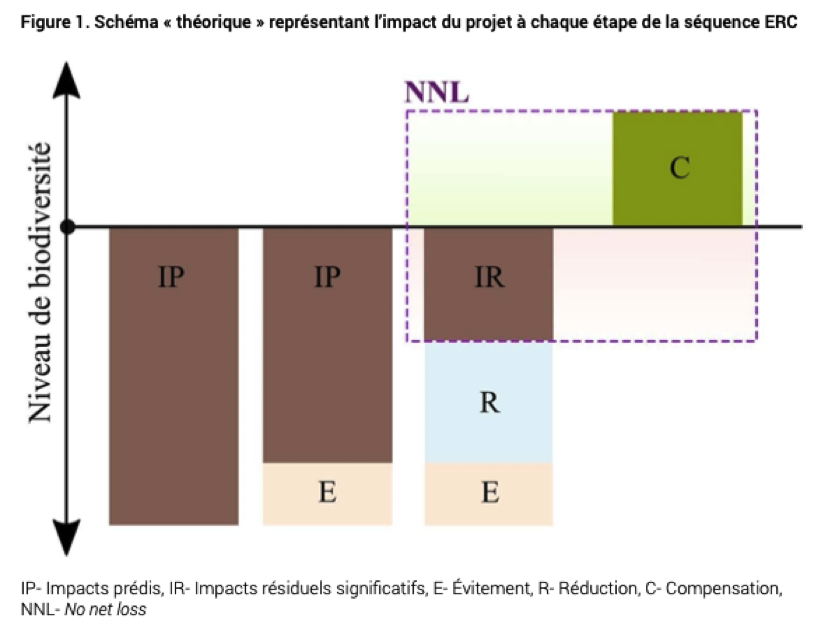
Source: Bigard (2018). Illustration of the ERC hierarchy, the idea of avoiding and reducing as many impacts as possible before offsetting residual impacts by purchasing credits. The impact study assesses the predicted impacts (IP) on biodiversity levels. The ERC sequence aims to reduce these impacts by: avoiding impacts that can be avoided (E), then reducing them (R). Significant residual impacts (IR) must finally be offset (C) by at least the same magnitude to ensure that there is no net loss.
It was during the Grenelle Environment Forum negotiations in 2007 that the idea of a « supply policy » for compensation was launched, which « consists of financing actions that promote biodiversity in order to anticipate future compensation demand » (de Muelenaere, 2011). Actions that promote biodiversity can include, for example, the preservation, improvement, creation, restoration, and/or rehabilitation of a natural site. The idea is to create « Natural Asset Reserves » that generate offset credits that future developers can purchase to offset the residual damage of their projects. This contrasts with demand-side policies that require compensation only after damage has occurred. The supply policy allows for the creation of larger reserves that can be used to offset multiple future damages. In addition, with the supply policy, the results of compensation can be observed before deciding on the number of credits, unlike the demand policy, where credits are often based on the size of a compensation area and where it is necessary to wait and see the results.
As a result, in 2008, the Ministry of the Environment, in collaboration with the CDC-Biodiversity, local authorities, and the scientific community, set up a pilot project in the Crau plain, in the Provence-Alpes-Côte d’Azur region, to assess the potential of compensation banks for habitats in France (de Muelenaere, 2011). The Crau plain was chosen in particular because it is the only steppe biome[v] in Western Europe and therefore a priority habitat within the meaning of the European Union’s Habitats Directive (de Muelenaere, 2011)[vi]. A study by Dutoit et al. (2018) found that « rehabilitation has indeed led to the creation of vegetation conducive to the return of steppe birdlife, » but long-term success remains unknown.
2) What are the effects of compensation banks?
2.1 Ecological
One of the main challenges of offset banks is to define what constitutes an area of compensation equivalent to the damaged area (de Muelenaere, 2011). To do this, it is necessary to determine the magnitude of the damage, which environmental services and natural resources are impacted, and what level of compensation is needed to achieve no net loss (de Muelenaere, 2011). It is also necessary to choose at what level biodiversity should be defined: at the genetic level, at the species level, at the level of roles in an ecosystem (such as pollinator, predator, prey, etc.), at the habitat level, etc. The choice of biodiversity units will then determine what is protected by offset banking. As ecosystem services are difficult to measure, it is not possible to take into account all the services of a damaged area, and it will be difficult to find a compensation area with exactly the same services. In addition, there are information asymmetries at each stage. First, the project owner is responsible for the impact assessment of their project, and it is in their interest to minimize the impacts. On the other hand, the compensation operator can increase the ecological added value achieved in the absence of a single scientific evaluation methodology. In practice, the unit of exchange is often the area of the damaged zone, with the possibility of requiring a larger compensation zone.
One possible advantage of offset banks over the demand-driven system is that habitat restoration activities are carried out by specialists rather than developers, which can improve the environmental quality of offset sites. Offset banks require and promote the structuring of an ecological restoration ecosystem, which is much more developed in France than in the United States. In addition, credits are normally created before the development project, thus avoiding temporary losses as the offset actions take place before the project.
In some circumstances, regulation is more appropriate than offset banks. For example, there are very old habitats, such as ancient forests, where it will take hundreds or even thousands of years to create an equivalent habitat, and therefore it makes more sense to prohibit development in these areas. Governments designate protected areas and environmental agencies that grant (or deny) development permits in unprotected areas, with the risk of making controversial decisions. For example, since the 1980s, there has been controversy on the west coast of the United States surrounding the deforestation of old-growth forests, which is very important for rural economies but has also led to the disappearance of a species of owl. Ultimately, a study showed that the value of protecting the owl, in terms of willingness to pay, justified banning logging in the owl’s habitat. This protected area was temporarily reduced by the Trump administration before being restored by the Biden administration. As a result, there is always a risk of losing natural areas, and some losses are irreversible.
2.2 Economic
The most frequent criticism of offset banks is the lack of strict ecological equivalence between damaged areas and offset areas, with this flexibility having advantages from an economic point of view. Adding stricter requirements on ecological equivalence would reduce supply, potentially to the point where there is not enough activity to make trades. Being flexible with equivalence requirements allows for a larger market, which in turn leads to less price volatility and more certainty for agents on both sides (de Muelenaere, 2011).
Under the right conditions, clearing banks offer other theoretical advantages. For example, the supply-side approach makes it possible to pool the financing of several developers whose projects impact the same types of habitat, « to carry out large-scale actions that are spatially and ecologically coherent » (Thiévent and Quenouille, 2008). This can also have ecological benefits by preventing habitat fragmentation. In addition, landowners with lower restoration costs are encouraged to restore their land in order to sell credits, which is not the case with regulations. The ability to purchase offset credits also allows developers to reduce the time it takes to obtain permits and avoids the burden of having to implement mitigation measures themselves. In addition, the price of credits allows habitat damage costs to be incorporated into a project’s investment plans.
Parkhurst and Shogren (2003) conducted a comparative analysis of several incentive mechanisms for biodiversity conservation. They classified the mechanisms, including conservation banks, according to three main criteria:
(1) the biological needs of the land and species,
(2) the interests of landowners, and
(3) government or regulatory concerns.
Conservation banks were rated as very effective or effective in terms of the first two criteria. However, they were rated as less effective in terms of the third criterion, mainly because of the high administrative costs associated with processing permit applications and establishing markets to connect buyers and sellers of offset credits.
Conclusion
There are several ways to prevent biodiversity decline. Regulations prohibiting development in sensitive areas can certainly be used, but market mechanisms, which are supposed to be less costly, can also be exploited, even if these mechanisms are far from perfect and need to be supplemented.
It is essential to continue to seek solutions to address the decline in biodiversity and other ecosystem services. While technological progress has been able to partially compensate for the scarcity of certain natural resources, there is no substitute for ecosystem services: it is unlikely that technology alone can solve this problem (Krautkraemer, 2005).
Anneliese Krautkraemer
References
Bigard, C., Regnery, B., Pioch, S., & Thompson, J. D. (2020). From theory to practice of the Avoid-Reduce-Compensate (ARC) sequence: avoiding or legitimizing biodiversity loss? Sustainable Development and Territories. Economics, Geography, Politics, Law, Sociology, 11(2).
Burgin, S. (2010). ‘Mitigation banks’ for wetland conservation: a major success or an unmitigated disaster? Wetlands Ecology and Management, 18(1), 49-55.
CDC Biodiversity. (2020, September 10) Press release dated September 10 on Cossure: France’s first natural compensation site. https://www.cdc-biodiversite.fr/wp-content/uploads/2020/10/2020.09.10-CP-SNC-Cossure-CDC-Biodiversite%CC%81-Version-finale.pdf
Dahl, T.E. (1990), Wetland Losses in the United States, 1780s to 1980s, Department of the Interior, Fish and Wildlife Service, Washington D.C., United States.
De Muelenaere, L. Tradeable permits, a credible alternative to biodiversity conservation policies.
Department of the Interior (2016). « Endangered and Threatened Wildlife and Plants; Endangered Species Act Compensatory Mitigation Policy. » Federal Register. 81 (171)
Dutoit, T., Jaunatre, R., Alignan, J. F., Bulot, A., Wolff, A., & Buisson, É. (2018). Ecologists’ perspectives on France’s first natural compensation site. Natures Sciences Sociétés, 26(2), 215-222.
IPBES (2019): Summary for policymakers of the global assessment report on biodiversity and ecosystem services of the Intergovernmental Science-Policy Platform on Biodiversity and Ecosystem Services. S. Díaz, J. Settele, E. S. Brondízio E.S., H. T. Ngo, M. Guèze, J. Agard, A. Arneth, P. Balvanera, K. A. Brauman, S. H. M. Butchart, K. M. A. Chan, L. A. Garibaldi, K. Ichii, J. Liu, S. M. Subramanian, G. F. Midgley, P. Miloslavich, Z. Molnár, D. Obura, A. Pfaff, S. Polasky, A. Purvis, J. Razzaque, B. Reyers, R. Roy Chowdhury, Y. J. Shin, I. J. Visseren-Hamakers, K. J. Willis, and C. N. Zayas (eds.). IPBES secretariat, Bonn, Germany. 56 pages.
Krautkraemer, J. A. (2005). Economics of natural resource scarcity: The state of the debate (No. 1318-2016-103362).
Levrel, H. (2020). Ecological compensation. Paris, France: La Découverte.
Parkhurst, G. M., & Shogren, J. F. (2003). Evaluating incentive mechanisms for conserving habitat. Natural Resources Journal, 1093-1149.
Thiévent, P., & Quenouille, B. (2008). CDC Biodiversity: A means of compensation to maintain biodiversity. Liaison énergie francophonie, (SEPT), 53-57.
[i] Regulations are legal measures, rules, and requirements for specific actions to be taken, unlike market mechanisms, which aim to set prices to encourage certain decisions without requiring them. In the context of biodiversity conservation, these regulations aim to designate protected areas.
[ii] Pollution abatement technologies aim to reduce pollution or its impact on the environment, such as scrubbers that remove sulfur from coal-fired power plant emissions to prevent acid rain. They often take the form of filtration.
[iii] Temporary waters include shallow lakes, ponds, marshes, floodplains, and streams that contain water only for a limited time and are dry when necessary. These semi-aquatic habitats have no fish, allowing insects or amphibians to thrive without predators.
[iv] An impact study is a technical study aimed at identifying all the consequences, particularly environmental, of a development project in order to try to limit any negative consequences.
[v] A steppe is a large area of grassland and non-wooded land in a semi-arid climate, characterized by grasses and shrubs.
[vi] This pilot project was approved in 2020 as the first French Natural Compensation Site by the Ministry of Ecological and Solidarity Transition (CDC Biodiversité, 2020). The first acquisition of a compensation unit for this site took place in October 2021.
[vii] Willingness to pay is a measure of the value of non-market goods that is often calculated from surveys of a representative sample of a population.