The benchmark US oil price (WTI) ended Monday evening at a negative price of around -$36.98, an unprecedented event in this market. While the mechanisms linked to a fall in oil prices are generally well understood, recording a negative price for a physical commodity is more difficult to comprehend. This article attempts to provide some initial insights into this phenomenon.


COVID-19, oil war, high stocks: the fall in prices
The Covid-19 pandemic is having a profound impact on oil markets. The global recession anticipated by leading forecasting institutes, the contraction in world trade, the decline in activity in the transport sector, etc. are all factors contributing to the decline in global oil demand, even though supply remains at high levels (100.1 million barrels per day). In this context, oil prices are automatically adjusting downward.
This downward trend accelerated in early March 2020, when the countries of the Organization of Petroleum Exporting Countries (OPEC) and other countries such as Russia (united within OPEC+) failed to reach an agreement to reduce their production. Russia was unwilling to make further cuts to its production. This strategy could have supported prices, increased tax revenues, and thus facilitated the financing of policies to support economic activity in countries whose public finances rely heavily on the hydrocarbon sector (such as the Gulf countries).
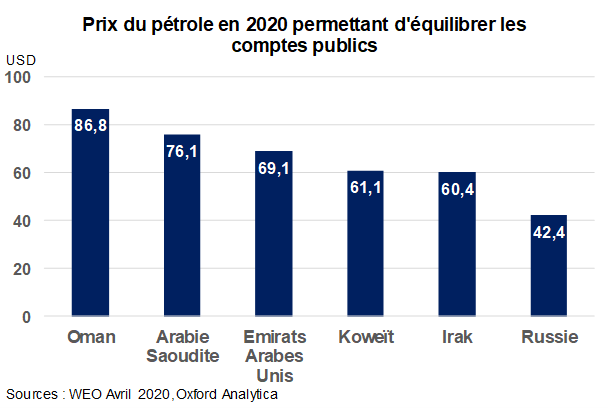
The lack of agreement therefore led to a fall in prices (the price of a barrel of Brent crude fell from nearly $52 on March 2 to $22.7 on March 31). This strategy was intended to enable producing countries, which do not need high oil prices to be profitable, to bankrupt producers with higher operating costs (typically in the United States) and thus gain market share. Saudi Arabia finally broke with its policy of reducing production and simultaneously increased its output significantly (reaching a record 12.3 million barrels per day) and sold at bargain prices to its Asian customers, also to strengthen its market share. This strategy ultimately proved unsuccessful (the price of Brent crude reached $34.1 per barrel on April 3 before beginning a new decline throughout the month) and very costly at a time when countries need maximum financial resources to support their economies, prompting OPEC+ members to finally « change tack. » On April 10, OPEC+ members agreed on an initial series of production cuts of 10 million barrels per day (10% of global production) starting in May 2020 (Mexico, however, chose to remain outside this agreement).
Until May, the oil market remains marked by a significant oversupply. In addition, this surplus supply is leading major producers to increase their stocks, with the underlying objective being not to sell at a loss now in order to sell their production later when prices have recovered. However, this strategy has its limits, with significant physical storage constraints in the United States and high costs associated with storing these surpluses. Furthermore, by maintaining high production capacities (100 million barrels per day), these strategies tend to keep downward pressure on prices.
While these factors alone shed light on recent price dynamics in the oil markets, they do not explain how WTI prices fell into negative territory. The reason is more likely to be found in the futures markets.
Mistrust in the US futures market: the imbroglio of negative prices
These downward pressures, leading to a negative WTI price per barrel, are closely linked to the functioning of the futures markets, which are essential to the functioning of buying and selling operations on the oil market. To better understand the underlying mechanisms behind the decline in the price of WTI per barrel, a quick overview of futures seems necessary.
An oil buyer generally has the choice between buying oil at the current price (spot price) or making a purchase with deferred delivery (usually one month later). This decision may be motivated by physical storage difficulties at the time the buyer wishes to carry out the transaction, but also for financial reasons. However, a deferred purchase necessarily exposes the buyer to fluctuations in oil prices, which may work against them. To protect against this risk, the buyer can then purchase a forward contract, known as a future, which acts as an option. The idea behind this option is that the buyer and seller agree in advance on a price for delivery one month later. If conditions are favorable[4] to the buyer, they will then have the option to exercise this option to validate the transaction and the barrels will be delivered to them.
These futures are financial products whose value depends on the price per barrel (spot price). Over short maturities, the spot price and the futures price tend to move in tandem, but over longer maturities, a difference between the spot price and the futures price may occur.
When a buyer chooses to purchase a futures contract, the barrels are normally delivered when the contract expires (usually one month later), if the buyer exercises their futures contract (i.e., exercises the option). In practice, there is a certain period of time during which the option can be canceled, ending after the so-called liquidation period. Beyond this period, the option is automatically exercised and the buyer’s position is then considered « closed » and the barrels are physically delivered. However, if the buyer does not wish to take physical delivery at the contract’s expiration date and the aforementioned period has not yet passed, they can « roll » their futures contract. This involves the buyer paying to retain their option, which remains valid for a further period of one month. They may also decide to sell their futures contract.
The expiration date for May WTI futures was Tuesday, April 21. However, on Monday, April 20, the price of WTI collapsed and futures contract holders were desperate to sell their option before expiration. By retaining their futures, they were exposing themselves to substantial losses. They would either be forced to exercise the option, incur losses, and end up with an unwanted stockpile of oil, or « roll » their futures contracts at significantly less favorable terms, given that futures contracts for June are trading at around $20.4. On Monday, April 20, there were few buyers willing to purchase such contracts, and the supply/demand mechanism caused futures prices to plummet into negative territory (they even reached a low of -$40.3 during the day before closing at -$37.6), which also pushed the price of a barrel of WTI into negative territory.
Conclusion
The collapse in WTI prices will have quite negative consequences in the short term for both WTI futures contract holders and US producers[7] (even though the latter are currently benefiting from prices that guarantee the profitability of their wells, which is significantly more advantageous than before, according to the Dallas Fed Energy Survey), but also for OPEC countries.
This type of event may be a short-lived or very sporadic phenomenon each time futures contracts expire and the context of excess supply remains unchanged.
[1] It fell by 5.6% year-on-year in the first quarter of 2020, according to the Energy Information Administration, which anticipates a 12.2% decline in the second quarter to 88.5 million barrels per day, and a 5.2% decline over the year to an average of 95.5 million barrels per day.
[2] According to Reuters, more than 160 million barrels are currently stored at sea on tankers, with the cost of leasing storage capacity at sea rising sharply.
[3] The buyer does not necessarily intend to hold the barrels but to take advantage of opportunities on the futures market, hoping in particular to make a financial gain by, for example, selling their futures at a favorable price shortly before the contract expires.
[4] For example, the spot price rose during the past month and exceeds the price negotiated a month earlier.
[5] This generally results in a futures price that is higher than the spot price (due to the risk premium paid, linked to uncertainty about oil price trends due to geopolitics, or variable storage or delivery costs).
[6] Linked to the difference between the return on the futures contract and the spot price.
[7] According to Reuters: « U.S. crude futures have fallen around 130% to levels well below break-even costs necessary for many shale drillers. »