Abstract :
- Parental leave available to parents when their children are born has a positive impact on children’s health but also, in the case of maternity leave, on mothers’ health.
- Taking maternity leave can have a positive effect on women’s wages and their participation in the labor market, provided that it does not last too long.
- If leave is reserved for mothers, or mainly used by them, it may increase gender inequalities in the labor market.
- This leave is relatively inexpensive for employers.
This article reviews the expected and proven effects of leave available following the birth of a child. It examines not only the impacts on the health of children and their mothers, but also on the labor market and employers.
In many countries, parents can take leave, often paid, following the birth of a child (see the BSI Economics article: Maternity, paternity, and parental leave: where does France stand?). Originally, maternity leave was introduced to protect mothers in the labor market. Subsequently, some countries also introduced parental and paternity leave. These legal provisions are not only intended to protect mothers, but also to ensure the well-being of children and promote gender equality in the labor market. However, all these policies come at a cost, as paid leave has to be financed. This raises the question of the impact of these laws and their relevance.
Does this leave improve the health of children and mothers?
In theory, leave available following childbirth, especially when it is paid, is supposed to allow parents to spend more time with their newborn without fear of a significant drop in income. This time spent with the child is supposed to have a positive effect on its development and health. On this subject, the literature is fairly unanimous and agrees that this is the case. More generous leave policies lead to a decrease in infant mortality, among other things. This leave frees up time that can be used for postnatal care (vaccinations and other things) or, in the case of maternity leave, for breastfeeding for longer.
Beyond the health of children, maternity leave is supposed to protect women and allow them to recover from childbirth before returning to the labor market. There is therefore a potential link between maternity leave and maternal health. This relationship seems to be validated by the facts, as mothers who have taken leave are less likely to suffer from postpartum depression and enjoy better physical health (Heymann et al.; 2017).
Does this leave really protect women in the labor market?
The initial objective of maternity leave was to facilitate women’s return to the labor market after giving birth by guaranteeing them a job and a salary. We would therefore expect to see a positive impact on women’s wages and labor market participation. There are numerous studies on this issue in developed countries that support this view: women protected by maternity leave are more likely to return to the labor market and earn higher wages. Some of these studies are summarized in the article by Heymann et al. (2017). By increasing women’s participation in the labor market[2], these policies can therefore stimulate growth, an important aspect to consider when looking at the costs of such measures.
However, it is necessary to qualify this statement. Long periods of absence can lead to a loss of skills and undermine women’s employability and career prospects. Rossin-Slater (2017) shows that while maternity leave of less than one year ensures continuity of employment for mothers, longer periods of leave can actually harm their careers. This raises the question of the optimal length of leave.
Does this leave reduce gender inequality?
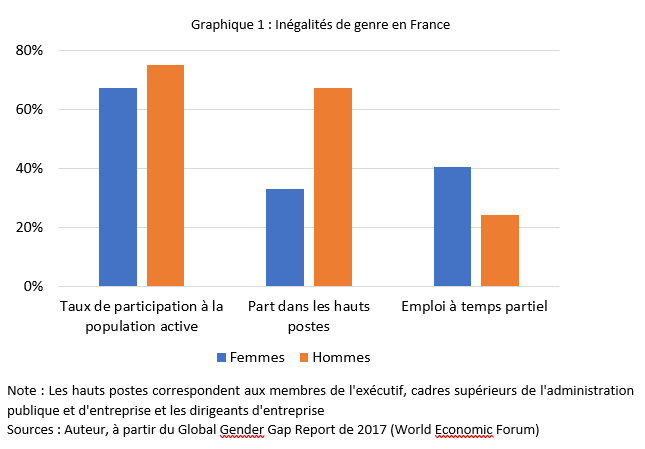
While maternity leave can improve women’s situation in the labor market by ensuring a certain degree of continuity, it can also have a selection effect on the labor market that exacerbates gender inequalities. Indeed, if only women can take parental leave, employers may favor male candidates when recruiting. This potential selection or employment discrimination effect could therefore mitigate the potential positive effects outlined above. Furthermore, if only women take leave, this can reinforce gender stereotypes by implying that mothers are responsible for children and fathers for earning a salary. The way parental leave policies are designed therefore has a significant impact on gender inequality. This is a particularly important issue in France, where gender equality in the labor market is still far from being achieved. In 2017, the World Economic Forum ranked France64th in terms of gender equality in the labor market. Among the variables that pose a problem are the employment rate, gender parity in top positions, and part-time work (Figure 1).
The paternity leave introduced in France in 2002 could therefore be a step towards greater gender equality. However, it is not enough to allow men to take parental leave, as even when it is available, few fathers take it (see the BSI article, Maternity, paternity, and parental leave: where does France stand?). This is mainly due to wage inequalities, which often continue to disadvantage women. Since parental leave results in a loss of income (replacement rate below 100%), it is rational for the lower-paid member of the household, often the woman, to take it. To ensure that leave is shared between both parents and thus avoid exacerbating gender inequalities, a proven solution is to reserve part of the parental leave for fathers (« use-it-or-lose-it »). In 1993, Norway introduced a « daddy quota » guaranteeing fathers four weeks of leave out of the 52 weeks available. Recent studies have shown that such policies can reduce gender inequality. For example, the Norwegian « daddy quota » has promoted an equal sharing of domestic tasks between men and women (Kotsadam & Finseraas, 2011).
Isleave expensive?
Obviously, paid leave means financing that leave. If these costs are borne by employers, there could be a negative impact on employment. However, in developed countries, these policies are not financed by employers but mainly by social security, the aim being to avoid placing the cost of these policies on employers in order to limit discrimination against women (ILO, 2014).
In France, all leave—maternity, paternity, and parental—is financed by social security. Employers therefore do not bear the direct cost of these measures. Nevertheless, there may be indirect costs. For example, it can be difficult to find a temporary replacement and train them. Few studies have looked at this aspect of the issue. However, a few studies, cited by Rossin-Slater (2017), have looked at the impact of the introduction of parental leave in certain US states such as New Jersey and California. They find no negative effect on worker productivity or company profitability. Nevertheless, it should be noted that more empirical evidence on this issue would be welcome.
The corollary of this method of state funding is, of course, a cost in terms of public finances. The OFCE estimates that daily maternity allowances cost €3 billion (€274 million for paternity leave and €2 billion for parental leave). Reforming paternity leave with a view to gender equality would therefore come at a cost. For example, if current paternity leave in France became mandatory, the additional cost to public finances would be €129 million (OFCE, 2017). Nevertheless, it remains to be seen whether the benefits, particularly through women’s participation in the labor market, would outweigh the costs of a possible reform. In addition, one possibility would be to transfer part of the postnatal maternity leave to the father, which would be neutral for public finances.
Conclusion
Many countries have introduced maternity, parental, and paternity leave with a view to improving the situation of women in the labor market. While these policies have a cost in terms of public finances, their effects on major variables such as health and the labor market situation are far from negligible. They appear to improve the health of children and, in the case of maternity leave, that of mothers.
With regard to the labor market, maternity leave can improve the situation of women, provided that the duration of such leave is not too long. To avoid a potential effect of discrimination in employment, it is necessary for leave to be shared between both parents and not taken solely by women. This result implies the implementation of specific policies (e.g., « daddy quota ») to ensure that this is the case. In this sense, the paternity leave introduced in France in 2002 seems to be a step in the right direction, even if barriers remain (e.g., gender stereotypes).
Leave available to parents upon the birth of a child can therefore have positive effects, although it is important to ensure that it is properly implemented and structured.
Heymann, J., Sprague, A. R., Nandi, A., Earle, A., Batra, P., Schickedanz, A., … & Raub, A. (2017). Paid parental leave and family wellbeing in the sustainable development era. Public health reviews, 38(1), 21.
International Labor Organization. (2014). Maternity and paternity at work: law and practice across the world. International Labor Office. Geneva: ILO.
Kotsadam, A., & Finseraas, H. (2011). The state intervenes in the battle of the sexes: Causal effects of paternity leave. Social Science Research, 40(6), 1611-1622.
OFCE, Périvier, H. (2017) Reducing professional inequalities by reforming paternity leave. Policy brief
Rossin-Slater, M. (2017). Maternity and family leave policy (No. w23069). National Bureau of Economic Research.