⚠️Automatic translation pending review by an economist.
Summary:
– The immigrant population now accounts for 8.9% of France’s total population.
– It has grown moderately in recent years.
– France does not take in more immigrants than its European neighbors.
– The profile of immigrants has changed, and immigrants are increasingly well-educated.
– Immigrants are more affected by unemployment than native-born citizens.

In the midst of the migrant crisis in Europe, much is being said about immigration and its presumed impacts. In order to understand the issues surrounding immigration, it is essential to look at the reality of this phenomenon and its consequences, based on reliable figures and studies. In this first article, we look at the evolution of immigration in France in order to respond to preconceived ideas that are often contradicted by the facts.
First and foremost, it is necessary to clarify what we mean by immigrant. According to the official definition of the INSEE, an immigrant is any person born a foreigner abroad. The immigrant population is therefore defined by nationality at birth, and anyone born abroad will remain an immigrant even if they subsequently acquire French nationality. Given that data on illegal immigration is by definition unknown, this article focuses exclusively on legal immigration. For information, various sources estimate that between 200,000 and 550,000 people are living in France illegally (Chojnicki and Ragot, 2012).
A massive increase in immigration in France?
A common misconception is that there has been massive immigration to France in recent years. However, the reality revealed by the data paints a very different picture. According to the latest data available from INSEE, the immigrant population increased by 700,000 between 2006 and 2014. In 2014, immigrants represented 8.9% of the total French population. Compared with the situation in 2006, immigration has increased by a reasonable 0.8 percentage points. Even when looking at the very long term, over 91 years, the share of immigrants in the total population has increased by only 5 points (Figure 1). However, it is important to note that the official data ends in 2014 and that the migrant crisis took a major turn in 2014-2015.
Graph 1: Immigration as a percentage of the total population in France
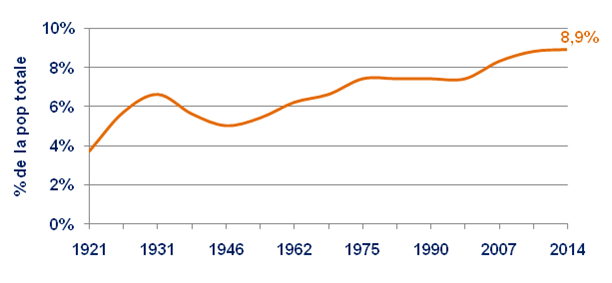
Sources: Author, INSEE data, BSI Economics
Does France take in more immigrants than its neighbors?
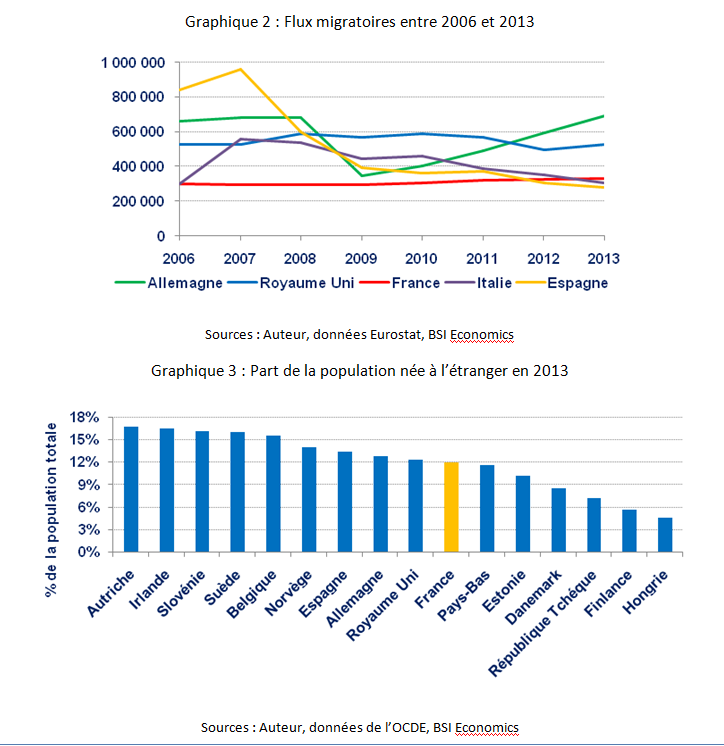
There has therefore been no dramatic increase in immigration to France in recent years. This is particularly true when French data is compared with that of other countries (Figure 2). The number of people who have immigrated to France is lower than in the United Kingdom and Germany. In fact, the proportion of the total population born abroad is lower in France than in many of its neighbors (Figure 3). France therefore does not take in more migrants than its European neighbors.
Are immigrants underqualified?
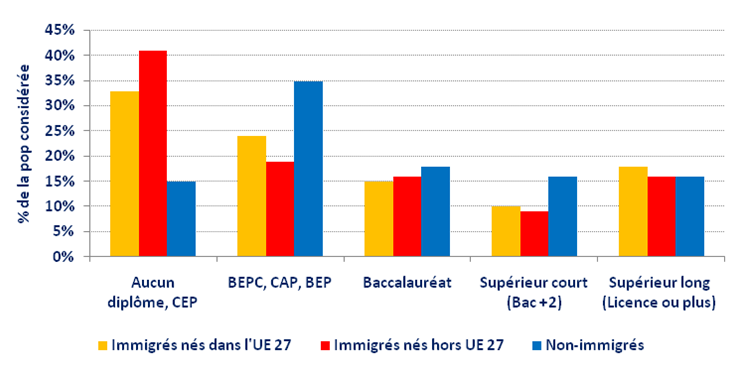
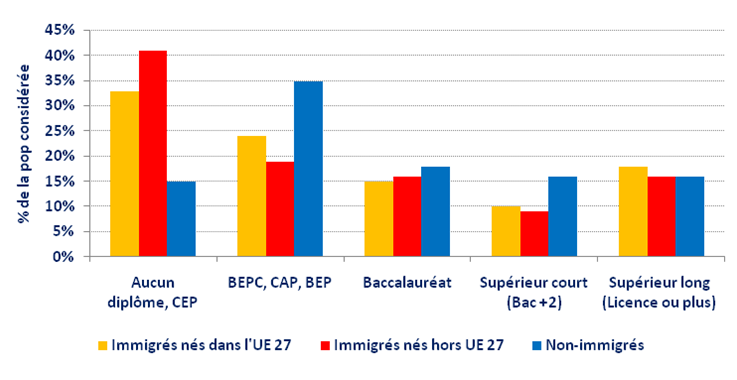
Immigrants are often accused of being underqualified and more likely to be unemployed than native-born citizens, which generates fear about the budgetary costs of immigration. While immigrants have, on average, a lower level of education than native-born citizens, many of them also have a long-cycle degree (Figure 4). Furthermore, just like non-immigrants, immigrants are becoming increasingly educated. In 1990, more than 60% of immigrants had no qualifications or only a CEP (Certificate of Primary Education), whereas in 2008 this figure was less than 40%.
Figure 4: Distribution of the population aged 30-49 by degree in France
Are immigrants more affected by unemployment?
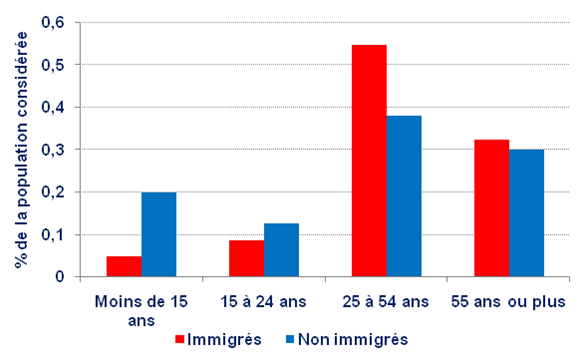
The labor force participation rate among immigrants is similar to that among native-born French citizens. In 2012, 59% of immigrants were employed or unemployed, compared with 58% of native-born French citizens (INSEE, 2012 census). This can be explained by differences in age structure. Immigrants are on average younger and overrepresented in the most active age groups (Figure 5).
Figure 5: Age distribution of the population in France in 2012
Sources: Author, INSEE data from the 2008 population census, BSI Economics
Among the working population, however, immigrants are overrepresented in unemployment. In 2012, 22% of working immigrants were unemployed, compared with 12% of native French citizens (INSEE). Immigrants from countries outside the European Union are more affected by unemployment, which may explain why the debate often focuses on the cost of immigration.
Conclusion
Immigration is a widely discussed phenomenon in public debate, yet it is often poorly understood. First, the figures contradict the idea of a massive increase in immigration to France in recent years. Furthermore, France does not take in more migrants than its European neighbors. While immigrants have, on average, a lower level of education than native-born French citizens, the fact remains that they are just as likely as non-immigrants to have a university degree and are becoming increasingly well-educated. Finally, immigrants are more affected by unemployment, which can generate additional budgetary costs. In a future article, we will return in detail to the effect of immigration on the labor market and the national budget.
Bibliography
– Chojnicki, X., & Ragot, L. (2012). Immigration is costly for France. Editions Eyrolles.