Summary:
· The exponential growth of digital technology is having an impact on all sectors of activity
· These transformations will have « creative destruction » effects across all sectors of the economy by directly impacting how markets operate
· Digital disruptions are generating profound changes among economic actors and accompanying disintermediation
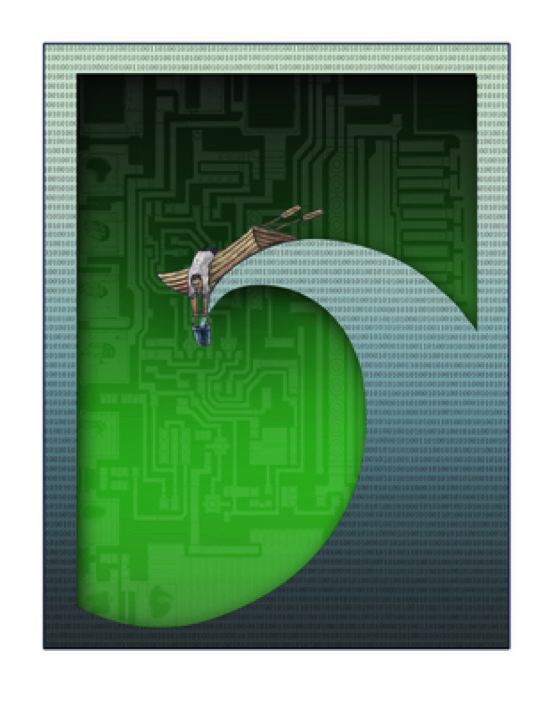
The dynamism of the digital economy has creative destruction effects[1]. Indeed, innovation and its dissemination enable productivity gains, the creation of new activities and therefore new jobs, which are synonymous with growth. However, with the advent of innovation, certain jobs may disappear, as may certain companies that are not prepared for the digital transition and whose old technologies are becoming obsolete, thus jeopardizing their place in the market and their future.
Nevertheless, this phenomenon of creative destruction benefits innovative entrepreneurs who are able to restructure their businesses, adapt their processes, and improve their procedures in order to reap competitive advantages and become market leaders.
The Digital Economy: Disruptive Innovation
The theory of creative destruction primarily expresses a process of change in economic and industrial activities, giving rise to a new economic model. This is an impact of the digital economy known as digital disruption.
The digital economy is evolving at a rapid pace and the number of players is growing daily. As mentioned in the article » Digital Economy: Definition and Sectoral Composition, » the exponential growth of digital technology is having an impact on all sectors of activity, and its horizontal diffusion is transforming the global economy.
The digital economy revolution has led to a break with historical models, not only through the improvement of production processes with the introduction of NICTs in the business world and the resulting change in the value chain of companies, but also through the development of new strategies, the emergence of new intermediaries (mainly legal distribution platforms and search engines), the design of new models, thus causing sectoral reorganization and, finally, the « near destruction » of certain historical sectors.
The benefits of digital transformation are numerous for companies of all sizes and in all sectors: improvement of value chains (through the integration of new intermediaries such as search platforms, information brokers, and social networks), financial gains linked to innovation and the improvement of internal processes (production, distribution, communication, management), increased productivity, the elimination of barriers to entry and, therefore, massive access to new opportunities, new markets, and new customers.
Nevertheless, the emergence of digital technology can be destabilizing for certain sectors and, in particular, for a large number of companies that are unprepared to adapt to digital changes and are likely to suffer from a huge gap in terms of productivity, efficiency, and innovation. Traditional industries are increasingly affected by these technological upheavals.
Digital disruption will bring a new performance attribute that will replace old technologies. It is therefore a disruptive phenomenon that is cracking traditional models and « ousting » certain players from the market who have failed to reinvent themselves, innovate, respond quickly to (new) technological upheavals, and consequently do not survive.
Indeed, « disruptive innovations » are those that, far beyond technological progress, bring value that is likely to redefine our models. For companies, these innovations pose a problem: should they take the risk of investing in order to survive and meet the expectations of the market and consumers? Or should they wait, at the risk of being left behind and ousted by other, more innovative companies?
Digital disruption or disruptive innovation is considered a process of market transformation. This transformed market will be open to all players (reducing geographical boundaries) and will provide widespread and easy access to products and services that were previously considered expensive and inaccessible (consumers are better informed). It opens the door to opportunities for certain players[2] who are more dynamic, flexible, and responsive and who will be able to capture the benefits of traditional value chains (Bpifrance study)[3].
These « disruptive » players have become the kings of disintermediation, integrating traditional value chains and economic models, controlling and appropriating data from historical players, and eliminating their direct link with the end customer.
Figure 1. Disruptive innovation
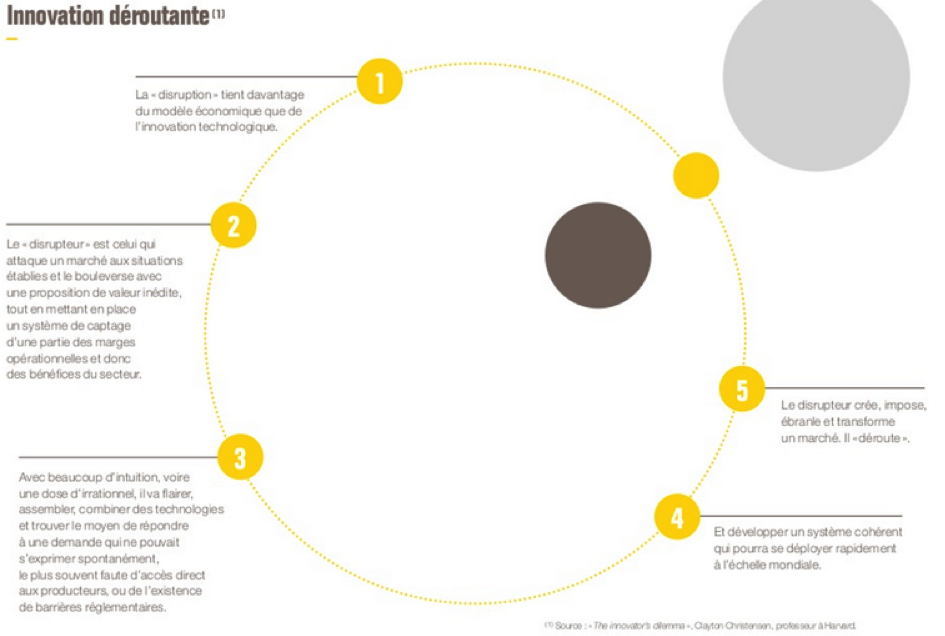
Source: « Le numérique déroutant » (Disruptive digital technology) Bpifrance le LAB (February 2015).
For a long time now, we have been seeing examples of innovative disruptions that have given rise to new services and new ways of organizing work, transforming consumer behavior (changing expectations and customer experience), the environment and business models , and the functioning of sectors and markets. Given its broad scope, the phenomenon of disruption imposes a new economic model rather than a new technology.
Digital technology provides greater access to information (reducing information asymmetries). Better-informed consumers are revising their expectations in terms of goods and services and changing their consumption patterns and decision-making processes, which is having an impact on business models and the economy in general.
Economic crises are at the root of changes in the thinking of economic agents. Every crisis brings with it a series of questions about the social and economic model. The collaborative economy was born out of these questions, and its development has been driven by the digital economy.
Indeed, the digital revolution has accelerated the development of the collaborative economy and the evolution of new relationships between economic agents. The internet has helped to break down the historical boundaries between producers/creators and consumers/the public, as well as the boundaries between professionals and amateurs. It has enabled the creation of numerous platforms dedicated to the collaborative economy (for selling, bartering, renting, financing, or peer-to-peer donations), whose evolution, development, and importance would not have been the same without digital technology.
According to Olivier Salesse, Director of Strategy at PwC, « the collaborative or sharing economy was born from the convergence of several major trends that emerged mainly as a result of new technologies, declining resources, and social changes. »
Sectoral impacts: Some illustrative examples
Tourism, particularly in the hotel industry, is an example of a traditional sector that has been disrupted by the digital revolution. Its model has become more focused on designing « tailor-made » offers because digital technology has made access to information easier and more comprehensive, giving consumers decision-making power over offers. Its value chain has been significantly altered with the emergence of new intermediaries that exploit available data according to consumer preferences and capture the margins of traditional players, as well as the growth of digital systems in tourism (booking platforms, online prospecting, applications, new products such as smartphones and tablets available to customers/consumers). In fact, networking platforms are gaining a position of strength and dictating their terms to traditional players who have become dependent on these new players, which have integrated the sector and deprived the traditional players of their customer data, thus cutting off direct access to their customers. This sector is also impacted by the emergence of new players in the collaborative economy, which, thanks to digital technology, are becoming increasingly influential in this industry, e.g., Airbnb.
Another example is the banking sector. Changes in consumption patterns, the emergence of new players, and growing demand for online services have led to the development of remote banking sites. It has also been influenced by the growth of participatory finance, or crowdfunding, whose online platforms continue to develop.
The light transport and parcel delivery sector: the development of e-commerce has been accompanied by increased competition between parcel delivery companies. More and more online platforms are entering the sector and offering more efficient services such as shorter delivery times and atypical delivery schedules. The customer base in this sector used to be concentrated among businesses, but now individuals have taken on a more important role. Online services tend to increase the costs borne by companies in the sector, while increased competition between old and new players is driving prices down, affecting companies of all sizes. Other trends, such as delivery between individuals with the development of the collaborative economy, are disrupting the sector’s value chain.
The most representative example is undoubtedly that of the taxi sector with the arrival of players offering chauffeur-driven car services or private hire vehicles. The system is simple: thanks to the development of digital technology (both tangible and intangible), it is now very easy and quick to order a private hire vehicle at any time of the day, avoiding the sometimes long waits for a taxi service. With the arrival of players such as UBER, for example, the taxi sector has been significantly impacted, not only in terms of financial margins, but also in terms of the decline in the value of their licenses. Their customer base has shrunk, as consumers have been quickly attracted to the service offered by VTCs: ordering a VTC via an app, tracking the driver and the route via GPS, and paying directly via smartphone.
The sharing economy also plays a role in the sector with the development of carpooling services. More economical, faster, and easier to access, digital technology has transformed the transportation sector. Less focused on ownership and financial gain and more on the services provided, these new models challenge the traditional models of the sector, affecting all its players, regulations, and overall activity.
The cultural sector is another example. Not only because of the dematerialization of content (the book, printing, music, press, publishing, and audiovisual industries, which have been heavily affected by the acceleration of the digital economy), which has impacted their value chain and, in particular, their distribution processes and media. This industry has also been impacted by the emergence of new services providing access to culture, learning, etc. New free or paid goods and services provided by new intermediaries via online platforms have disrupted an entire industry. For example, the development of MOOCs[4] provides access to free training courses where teachers and students can be scattered all over the world, connected by the internet.
The latest example among thousands is the healthcare sector. The development of apps, devices, and connected objects now makes it possible to track vital statistics (mostly related to sports training): number of steps, distances traveled, durations, and heart rate. These gadgets for individuals have given rise to a new trend that affects everyone: e-health. More and more start-ups financed by crowdfunding or venture capital are positioning themselves in the development of digital services, connected objects, applications, and artificial intelligence, which continue to revolutionize the healthcare sector.
Conclusion
Major innovations in the digital economy have brought about profound changes in the behavior of producers and consumers. They have led to a widespread movement of disintermediation in the economy and mass access to information. The cost of entry is all the lower as the generations entering the labor market are proficient in these new tools, enabling not only their development but also their application in all businesses.
All sectors are thus impacted, and the economic landscape is evolving in a broad movement of creative destruction that must be properly understood by economic actors. Understanding the new levers is essential to ensuring the viability of models and maintaining one’s position in the value chain.

Bibliography:
« The Impact of the Digital Economy, » Philippe Lemoine, Benoît Lavigne, and Michal Zajac, Sociétal magazine No. 71 (1st quarter 2011).
« The Digital Economy and Growth: Weight, Impact, and Challenges of a Strategic Sector, » Antoine Arlandis, Stéphane Ciriani, Gilles Koleda, Working Paper No. 24 – COE-Rexecode (May 2011).
« Accelerating the digital transformation of businesses: a source of growth and competitiveness for France, » McKinsey France (September 2014)
« The confusing digital world, » Bpifrance le LAB (February 2015). http://www.bpifrance-lelab.fr
« From catching up to transformation: The digital adventure, an opportunity for France, » Roland Berger – Strategy Consultants in collaboration with cap-digital (September 2014)
« The Information Society, » Nicolas Curien, Pierre-Alain Muet, Report for the Economic Analysis Council, La Documentation Française (2004).
« ICT and the digital economy: macroeconomic aspects, theoretical foundations, » François Moreau, CNAM.
« Support for the economy and innovation, » Pierre Hausswalt, André Siné, Cédric Garcin, Report by the General Inspectorate of Finance, (January 2012).
« Digital Economy: What Will Be the Impact of Disruptive Technologies, » Yannick Hello, Les Echos, (April 2015)
Measuring the Digital Economy: A New Perspective, OECD, (December 2014).
« Four Ways to Survive Digital Disruption, » Jérôme Buvat, Les Echos, (May 2015).
« Digital Disruption: Five Ways Companies Are Being Disrupted, » Jean-Philippe Querard, Les Echos, (March 2015).
« The Uberization of the Economy and the Great Vertigo of the Elites, » Sabine Delanglade, Les Echos, (February 2015).
« Digital transformation: the best initiatives of the CAC 40, » Claude Vincent, Florance Bauchard, Isabelle Lesniauk, Stefano Lupieri, Les Echos (September 2014).
« When disruptive innovation imposes its law on the economy, » Erick Haehnsen, La Tribune (March 2013)
« France on the road to a new production model, » Olivier Passet, Xerfi-Precepta (May 2015). http://www.xerficanal-economie.com
« Strategy and digital transition: the Warner Bros experience, » Emmanuel Durand, Vice President of Marketing, Warner Bros, Xerfi-Precepta study, (May 2015).http://www.xerficanal-economie.com
http://www.economie.gouv.fr/nouvelle-france-industrielle
« Industry 4.0: acquisition systems & wireless sensor networks, key elements of tomorrow’s industry » http://www.hikob.com/
http://www.observatoire-du-numerique.fr/
« CeBIT 2015 celebrates the ‘d!conomy’, the digitization of society, » Frédéric Therin, Le Point (March 2015)
« Industry of the Future: transforming the industrial model through digital technology » http://www.economie.gouv.fr/lancement-seconde-phase-nouvelle-france-industrielle, (May 2015).
http://www.lesusinesdufutur.com
« D!conomy: the winning trifecta of exponential growth, » Céline Bonniot, Les Echos (March 2015).
[1]In his book Capitalism, Socialism and Democracy, Joseph Schumpeter explains the dynamics of economic cycles: a major innovation leads to a phase of growth, synonymous with job creation; then certain companies go bankrupt because their techniques or products have become obsolete, causing a phase of depression that destroys jobs; However, this phase of economic hardship stimulates the creative imagination of new entrepreneurs, leading to new innovations that replace the old ones and usher in a new phase of growth. Source: www.citedeleconomie.fr
« Creative destruction. » This is « the fundamental principle of capitalism, and all companies must adapt to it, whether they like it or not. » Growth is a continuous process of creation, destruction, and restructuring of economic activities. Indeed, « the new does not emerge from the old, but alongside the old, competing with it until it harms it. » This process of creative destruction is at the root of economic fluctuations in the form of cycles. Source: the economy and finance portal of the Ministry of Economy, Industry, and Digital Affairs. http://www.economie.gouv.fr
[2]This is particularly the case with GAFA (Google, Apple, Facebook, and Amazon), which dominate the digital market in the broadest sense.
[3] « Le numérique déroutant » (The confusing digital world) Bpifrance le LAB (February 2015).http://www.bpifrance-lelab.fr
[4] MOOC: massive open online course or open online training for all (FLOT)