Summary:
– Women earned on average €500 less per month than men over the past decade (at constant purchasing power).
– The rate of inactive women of working age is 10 points lower than that of men, although this rate is tending to decrease.
– Wage inequalities arise within the first 10 years after graduation.
– These inequalities can be explained largely by differences in investment in human capital, different psychological factors, but above all by specific job mobility, which is greatly affected by childbirth.

The issue of gender inequality is heavily colored by activism and prejudice, which stifle discussion and distort reality. Unfortunately, it is not uncommon to see manipulated statistics (not falsified, but presented in a way that deliberately favors one thesis over another) or partial information aimed at accentuating or, conversely, smoothing out gender differences. For example:
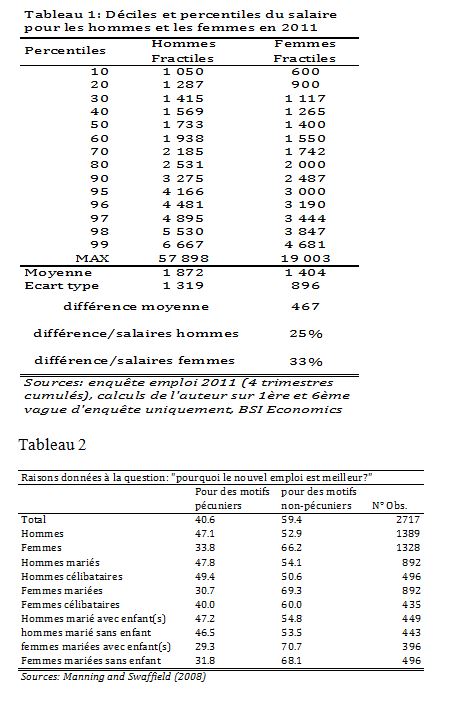
In 2011, men earned an average of €1,871 net per month and women €1,404, i.e., €467 less (see Table 1 in the appendix). The cash difference is significant, but a percentage is still easier to understand… So, we can rightly say that women earned on average 25% less than men in 2011 (467/1871), and that men earned on average 33% more than women (467/1404). This statistical subtlety is so simple (we change the reference) that it is crude. Yet some people sometimes write—a little hastily—that the gender pay gap is 25%… or 33%.
This short introductory example is intended to encourage readers to be cautious when presented with poorly documented statistics. In the rest of this article, we will characterize the extent of the gender gap in France in terms of employment and pay and analyze its causes from an economic perspective.
The Gender Gap in France from 2002 to 2011
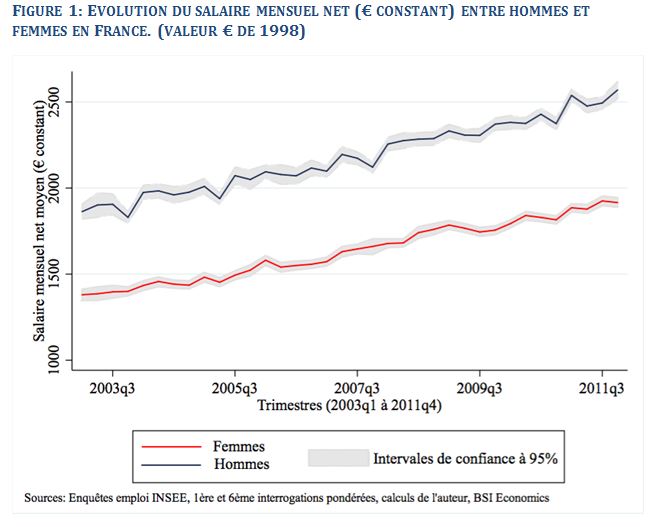
An analysis of average salary trends reveals a striking fact: women earn roughly €500 (at constant purchasing power) less per month than men, with no improvement in the last 10 years. Figure 1 clearly shows the parallel evolution of the average net salary of men and women over the period. By definition, this data is only available for the working population (which explains why, on average, the 2008-2009 recession had almost no impact on average salaries) and therefore does not take into account differences in employment rates.[1].
However, these differences are considerable, as Figure 2 shows. Over the period, the employment rate (in blue) for men remained 10 points above that for women. This gap can be explained by a much higher rate of inactivity among women. The « housewife, » regrettably, is therefore far from being a myth in France, and her role in the construction of income and employment inequalities is not negligible. We will see this later.
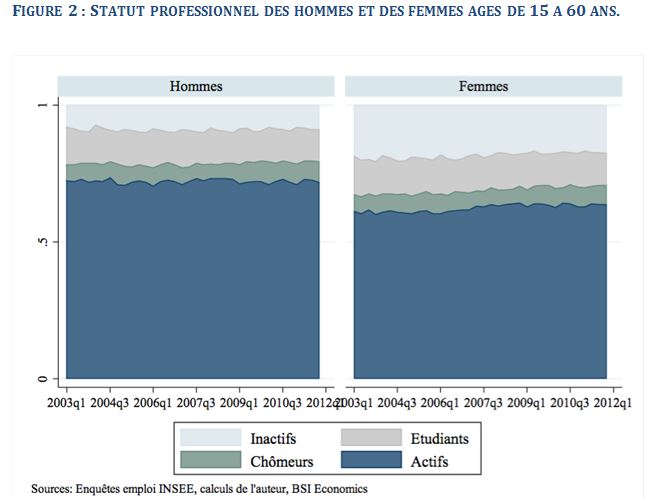
The main change in the decade studied obviously stems from the 2008 crisis, which, by affecting women less severely, brought the unemployment rates of both sexes closer together (and high, between 9 and 10%). However, the unemployment rate for women was 1.5 points higher until 2007…

Ultimately, the distribution of women’s salaries in 2011 was much more concentrated and at a lower level than that of men, as shown in Table 1. Thus, 50% of women earned less than €1,400 net per month in 2011, compared with 30% of men. Only 5% of women earn more than €3,000 per month…
The construction of inequalities
The previous section showed us how significant gender inequalities are in terms of pay and employment rates. We must therefore ask ourselves at what point in life these inequalities arise or worsen.
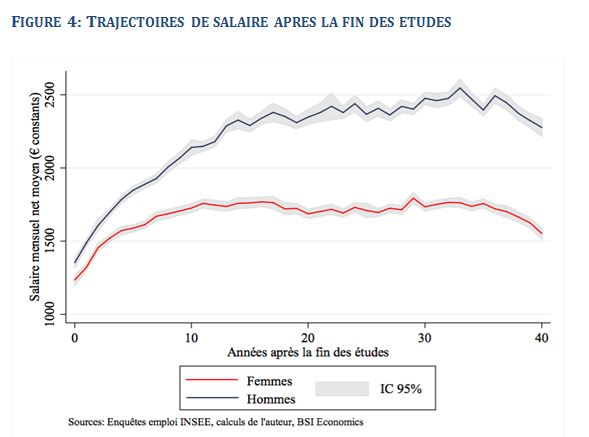
We can find part of the answer in Figure 4, which shows the salary trajectories of men and women based on their potential experience, i.e., the number of years after completing their initial studies. Across all levels of education, men and women have starting salaries of €1,320 and €1,220 (constant), respectively, which increase at a comparable rate during the first three years. From thefourth yearonwards, women’s salary growth slows down and stops increasing from thetenth yearonwards. Men’s salaries continue to increase until 30 years after the end of their studies, even if this growth slows down after 15 years. Two important observations can therefore be made:
– Pay inequalities exist from the moment workers enter the labor market.
– These inequalities increase significantly between thefifth and15th yearsof experience.
The trajectories we obtain from the employment survey are very similar to those described in the remarkable article by Manning & Swaffield (2008), except that in England there are no initial differences between men and women.
When broken down by level of education, the phenomenon we described is particularly true for higher degrees. Lower levels simply have different slopes from the outset.
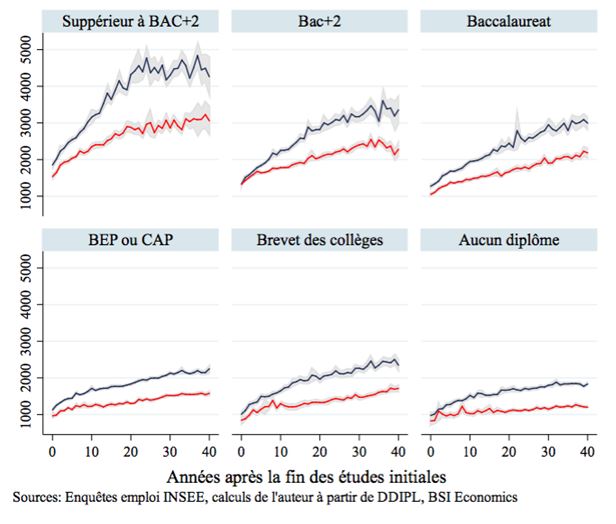
Thus, gender inequalities are present from the moment of entry into the labor market and increase significantly with experience, regardless of level of education.
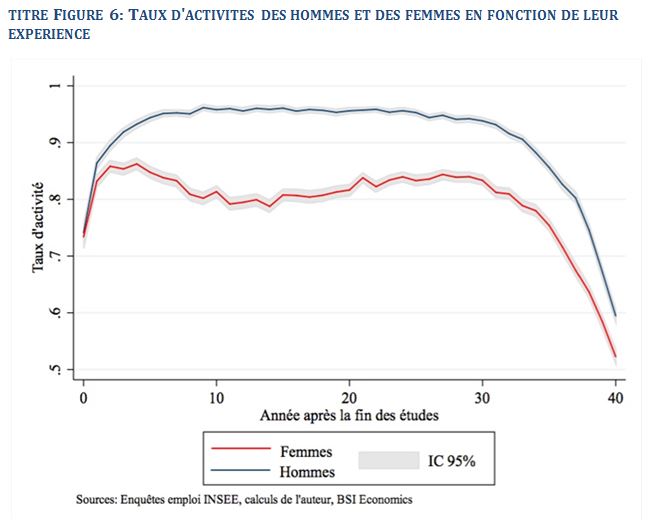
In terms of employment, Figure 6 shows the activity rate of men and women according to their potential experience, i.e., the number of years since completing their initial studies. We thus see the same gap in activity rates observed in Figure 2, but there is a sharp divergence between 5 and 20 years of experience. While the activity rate for men remains stable at around 95%, the curve for women is U-shaped. Fifteen years after completing their studies, 80% of women are economically active, which is 15 points lower than for men.
What could be the causes of these inequalities?
Economic analysis of gender inequalities
In the « classical » literature, there are three main causes for the gender pay gap.
– Differences in human capital;
– Different preferences ;
– Discrimination.
Discrimination has no economic basis (by definition) and is, in a sense, the residual factor that remains after taking other models into account. Job search/job matching models provide new explanations for these three factors, which we will detail below.
Differences in human capital accumulation
Human capital theories explain gender differences by differences in investment (in time and energy) in human capital, i.e., in accumulated experience, skills, and knowledge, which determine an individual’s productivity in particular.
Some researchers believe that differences in human capital can virtually explain 100% of the wage gap between men and women (O’Neill (2003), Polachek (2004)), while others find that a significant portion of the gap remains unexplained by differences in human capital (Altonji & Blank (2004), Blau & Kahn (2006)).
One reason for this divergence is that there are many forms of human capital, and it is often difficult to take them all into account. First, women tend to accumulate less professional experience than men (particularly due to pregnancy). However, as this experience is valued in the labor market, part of the pay gap can be explained by these differences in experience (Mincer and Polacheck (1974), Light and Ureta (1995)). It should be noted, however, that experience depends in particular on the choice to participate in the labor market, which is endogenous. In other words, experience depends on salary, and salary depends on experience. Thus, the statistical link between experience and salary does not reflect the causal influence of experience on salary. The correlation is distorted by this two-way causality, which can only be removed using more sophisticated econometric methods (instrumental variables in particular).
On the other hand, differences in human capital accumulation may exist in the labor market. Men may undertake more vocational training because they expect to work more or wish to change jobs more frequently. Similarly, men may choose initial training courses that generate higher future income than women (who, for example, choose more social science courses, etc.). However, the increase in women’s educational attainment today makes this latter explanation less credible.
Differences in personality and psychology between men and women
Differences in preferences and personalities stem from behavioral psychology theories. According to these theories, men and women have different attitudes and preferences in the labor market, particularly with regard to risk, negotiation, and competition. Numerous studies have highlighted such differences in an experimental context (notably Gneezy, Niederle, and Rustichini (2003), Gneezy and Rustichini (2004)).
In particular, Croson and Gneezy (2009) identify several areas in which men and women appear to have different preferences:
– Risk-taking: men seem more inclined to take risks, probably because they are less risk-averse and their assessment of risks is affected by their higher self-esteem.
– Self-esteem: men tend to have a more positive view of their performance and competence than women.
– Attitude toward competition: Women seem more reluctant than men to put themselves in situations of intense competition, and their performance is affected differently when they do so.
– Attitude toward others: Women appear to be less selfish than men in many ways and are more concerned about what others think of them.
Babcock and Laschever (2003) (p. 23) note that men believe more strongly that their fate depends on their actions and are more ambitious in their careers than women (p. 30). However, it is difficult to translate these findings into a proportion of the explained wage gap.
The contribution of job search/job matching models to explaining the gender gap
Job search/job matching models add new factors to the list of possible determinants of wages. In particular, they predict rapid wage growth if job offers come in more regularly and slow wage growth if job separations occur frequently.
With these two predictions, it is immediately clear that if there are differences in job findings and job separations between men and women, then there will be differences in wages. In particular, if the majority of new hires are among people already in employment among men and among unemployed people among women, then there are systematic differences in transition rates between men and women, leading to differences in wage trajectories. A model such as Burdett-Mortensen’s shows that the higher the proportion of hires among the unemployed for a group, the more monopsony-like[2]the market becomes and the lower the average wage. However, this proportion is particularly high for women with between 10 and 20 years of experience… which corresponds to the years of pregnancy…
Furthermore, not all job changes are comparable, and there may be systematic differences between men and women. Job search/job matching models such as Burdett-Mortensen’s (Mortensen 1998) assume that all job changes are motivated by wage gains. However, there are many other factors that influence labor market mobility (commuting, number of hours worked, family constraints). If men and women value these factors differently, a wage gap between men and women may persist.
Manning and Swaffield show that in the United Kingdom, half of men change jobs for economic reasons, compared with only one-third of women (see Table 2 in the appendix).
Ultimately, the authors’ findings indicate that these differences in mobility account for a 1.5-point difference (in logarithms[3], differences in human capital account for 50% of the gap. The remainder (one-third of the total gap) remains largely unexplained.
The effect of gender at the top of the wage distribution
These few explanations are sufficiently telling to give us an idea of their importance in the average effect. However, we might expect these explanations not to apply to very specific groups, such as graduates of leading universities. Yet…
Bertrand, Goldin, and Katz (2010) studied the salary trajectories of young MBA graduates from the most prestigious American universities. When entering the job market, there is only a small difference in salary between men and women (8%), but 10 years later, the gap reaches 60 logarithmic points (i.e., more than an 80% difference!). To give an idea, the gender gap 10 years after graduation is around 30% on average in the US. Once controlled for education, this gap narrows to 10%. However, in the case of this study, education is already factored into the difference since the subjects are MBA graduates. Gender inequality is therefore six times greater for Harvard graduates than for the average worker !
However, the authors are able to explain the entire gender pay gap based on three factors:
- Differences in coursework during the MBA (men take on average half a finance course more than women).
- Differences in working hours (women work an average of 52 hours per week, men 58).
- Women have more career breaks (with 10 years of experience, women are 22 percentage points more likely to have had at least one career break).
In reality, the arrival of children is perhaps the most important factor in explaining the wage gap between men and women. First, this factor affects points 2 and 3 above. Second, more detailed analyses of the effect of childbirth lead to the following results:
After giving birth, women are more likely to be in a job chosen for family reasons (15 to 20 pp) and less likely to have chosen their job based on their career (10 to 18 pp). These effects persist for up to 5 years after the birth.
Changing jobs for family reasons is associated with a significant negative change in salary. Income decreases by about 90% when the new job is chosen for its flexible hours, by 22% for the possibility of working remotely, and by 7% for limited commuting.
The authors also find a striking difference in the change in salary associated with mobility. While mobility has no effect on the income of men and women without children, mothers lose 18 log points of income when they change jobs.
Conclusion
Statistics describing the differences between men and women in terms of pay and labor market participation reveal significant differences that remain stable over time. Women earn on average nearly €500 less per month than men and are 10% less likely to participate in the labor market. Pay inequalities are established during the first 10 years of working life.
These inequalities can be explained largely by differences in investment in human capital, different psychological factors, and, above all, specific job mobility that is greatly affected by childbirth.
Appendices:
Notes:
[1] We could have proposed an expected wage indicator that would weight earned income by the probability of having a job and replacement income by the unemployment rate. We chose to keep this indicator because it reflects the reality of earned income.
[2] The labor market now has only one type of applicant.
[3] For such low rates, 1.5 log points corresponds to 1.5%.
References:
– Altonji, Joseph G., and Rebecca M. Blank. « Race and Gender in the Labor Market. » IPR working papers (http://ideas.repec.org/p/wop/nwuipr/98-18.html), 2004.
– Babcock, Linda, and Sara Laschever. Women Don’t Ask: Negotiation and the Gender Divide.Princeton University Press, 2003.
– Bertrand, Marianne, Claudia Goldin, and Lawrence F. Katz. « Dynamics of the Gender Gap for Young Professionals in the Financial and Corporate Sectors. » American Economic Journal: Applied Economics (http://ideas.repec.org/a/aea/aejapp/v2y2010i3p228-55.html) 2, no. 3 (July 2010): 228-55.
– Blau, Francine D., and Lawrence M. Kahn. « The U.S. gender pay gap in the 1990s: slowing convergence. » Industrial and Labor Relations Review (http://ideas.repec.org/a/ilr/articl/v60y2006i1p45-66.html) 60, no. 1 (October 2006): 45-66.
– Croson, Rachel, and Uri Gneezy. « Gender Differences in Preferences. » Journal of Economic Literature (http://ideas.repec.org/a/aea/jeclit/v47y2009i2p448-74.html) 47, no. 2 (June 2009): 448-74.
– Gneezy, Uri, and Aldo Rustichini. « Gender and Competition at a Young Age. » American Economic Review (http://ideas.repec.org/a/aea/aecrev/v94y2004i2p377-381.html) 94, no. 2 (May 2004): 377-381.
– Gneezy, Uri, Muriel Niederle, and Aldo Rustichini. « Performance In Competitive Environments: Gender Differences. » The Quarterly Journal of Economics (http://ideas.repec.org/a/tpr/qjecon/v118y2003i3p1049-1074.html) 118, no. 3 (August 2003): 1049-1074.
– Light, Audrey, and Manuelita Ureta. « Early-Career Work Experience and Gender Wage Differentials. » Journal of Labor Economics (http://ideas.repec.org/a/ucp/jlabec/v13y1995i1p121-54.html) 13, no. 1 (January 1995): 121-54.
– Manning, Alan, and Joanna Swaffield. « The gender gap in early career wage growth. » The Economic Journal (http://ideas.repec.org/a/ecj/econjl/v118y2008i530p983-1024.html) 118, no. 530 (2008): 983-1024.
– Mincer, Jacob, and Solomon Polacheck. « Family Investments in Human Capital: Earnings of Women. » In Economics of the Family: Marriage, Children, and Human Capital, by Jacob Mincer and Solomon Polacheck, edited by Inc. National Bureau of Economic Research, 397-431. http://ideas.repec.org/h/nbr/nberch/2973.html 1974.
– Mortensen, D.T. « Equilibrium Unemployment with Wage Posting: Burdett-Mortensen Meet Pissarides. » Papers, Centre for Labor Market and Social Research, Denmark (http://ideas.repec.org/p/fth/clmsre/98-14.html), 1998.
– O’Neill, June. « The Gender Gap in Wages, circa 2000. » American Economic Review (http://ideas.repec.org/a/aea/aecrev/v93y2003i2p309-314.html) 93, no. 2 (May 2003).
– Polachek, Solomon. « How the Human Capital Model Explains Why the Gender Wage Gap Narrowed. » Institute for the Study of Labor (IZA) (http://ideas.repec.org/p/iza/izadps/dp1102.html) 1102 (2004).
Notes:
[1] We could have proposed an expected wage indicator that would weight earned income by the probability of having a job and replacement income by the unemployment rate. We chose to keep this indicator because it reflects the reality of earned income.
[2] The labor market now has only one type of applicant.
[3] For such low rates, 1.5 log points correspond to 1.5%.