Summary:
• Over the past few decades, France has reduced greenhouse gas (GHG) emissions on its national territory (direct emissions from France, linked to the production and use of personal vehicles);
• In order to continue this decline, it faces two main challenges: increasing the share of electric transportation and increasing the share of renewable energy (RE) in the total energy mix. Increasing the share of RE will have to both compensate for possible nuclear reactor closures and take into account the additional energy demand resulting from new electric vehicles;
• GHG emissions linked to French consumption (direct and indirect emissions, emitted in France and abroad to produce the goods consumed by the French) were on the rise until the 2008 financial crisis;
• France can implement measures on its territory to reduce its direct emissions, but cannot regulate foreign production methods in terms of CO2 (indirect French emissions for goods exported to France);
• One instrument that can be used to control a country’s indirect emissions is carbon border adjustment. This would create an incentive mechanism for producers who export to France to reduce their GHG emissions. However, its implementation would likely be debated by members of the World Trade Organization, who could respond with trade retaliation.

On Monday, October 30, the World Meteorological Organization (WMO), a United Nations agency, sounded the alarm. This is because the concentration of CO2 in the atmosphere has reached a record level, which our planet has not seen in more than 3 million years, at a time when the average temperature was 2 to 3 degrees higher and the sea level was between 10 and 20 meters higher. More than ever, every country must take responsibility for global warming.
In this article, we attempt to review the main challenges facing France in terms of reducing its emissions. We base our analysis on two concepts: direct emissions and indirect emissions. A country’s direct emissions are those emitted directly on its territory, while indirect emissions are those resulting from the production of goods imported into that country for consumption. At the microeconomic level, the indirect emissions of a product/service are not limited by geographical boundaries. They correspond to the emissions generated (in France or abroad) for the manufacture of the intermediate products and services necessary for the production of the finished product/service. If France were to take into account the total emissions (direct and indirect) of its consumed products/services, this would automatically include all of its consumption-related emissions at the macroeconomic level.
1. Challenges of reducing GHG emissions produced on French territory: assessment of France’s direct emissions
1.1. Emissions produced on French territory by sector
In 2014, each French citizen emitted 4.3 tons of CO2 per year, half as much as a German citizen, according to figures from the International Energy Agency. This positive figure is due in particular to the share of nuclear power in the French energy mix (78% of energy production in 2014), a mode of energy production that does not emit carbon, unlike coal, which is used extensively in Germany (44% in 2014). For many years, however, nuclear power has been heavily criticized by public opinion because of the radioactive waste generated by power plants and the risk of accidents (the probability of which remains very low, but the consequences potentially catastrophic).

Today, the nuclear fleet is aging, with 34 of the 58 reactors more than 30 years old. The Minister for Ecological and Solidarity Transition, Nicolas Hulot, has stated that he wants to close up to 17 of them in order to make more room for renewable energies (RE). France has recognized its lag in investing in RE and has set itself the ambitious goal of increasing the share of RE to 50% of the energy mix by 2025 (compared to 16% in 2014), i.e., tripling the share of renewables within 10 years.
The energy industry accounts for only a modest proportion of total GHG emissions in France compared to other sectors of activity. In 2013, the energy sector accounted for 12% of total GHG emissions (491.7 million tons of CO2 equivalent), ahead of waste treatment (4%) and far behind transport (28%) and manufacturing (18%).
With regard to the transport sector, Nicolas Hulot has declared his intention to stop the sale of gasoline and diesel cars and switch to 100% electric vehicles in total sales by 2040, whereas electric vehicles currently account for only 5% of sales. Achieving this goal would significantly reduce GHG emissions in the country in the long term (94% of transport-related emissions come from road traffic), provided, of course, that the electricity used to power these vehicles is produced cleanly. The effect could prove perverse if the energy sector, having closed nuclear power plants, were unable to meet the growing energy demand of the electric vehicle fleet, among other things, and were forced to adopt emergency solutions (such as the use of coal). The share of renewable energies must therefore triple to achieve Nicolas Hulot’s target, but investments in absolute terms must increase even further.
Compared to 1990, total GHG emissions have fallen by 11%, with manufacturing being the main contributor to this decline (-40% in 13 years). In addition to deindustrialization, which can likely explain a significant part of this decline, the manufacturing industry has long been subject to controls and has consequently developed less energy-intensive production techniques. It was therefore in the best interests of companies to adopt this strategy, as it enabled them to reduce costs and thus increase their competitiveness.
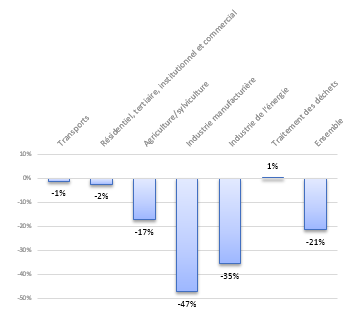
In contrast to manufacturing, transport and waste treatment recorded increases between 1990 and 2013 (+12% and +14% respectively). When these growth figures are adjusted for population growth, only the waste sector shows an increase (+1%), as shown in the figure below.
Change in GHG emissions in 2013 by sector in France compared to 1990
(M tons CO2 eq. / capita)
Source: author’s graph, CGDD and INSEE data
When expressed as a percentage of GDP (non-deflated), total GHG emissions generated in France in 2013 show negative growth of -55% compared to 1990. In other words, the CO2 intensity per euro produced by France (energy intensity of GDP) has fallen. France is therefore producing more and consuming more, while emitting less GHG. While we can congratulate ourselves on this result, relying on these figures is not viable in the long term in an economy where performance targets are defined by positive growth rates. The decoupling of economic activity and GHG emissions must be accelerated worldwide as quickly as possible if the population wishes to continue consuming and producing more without accelerating global warming.
1.2. Instruments for controlling direct emissions
Countries have a number of options for controlling their direct emissions. The regulatory approach involves setting pollution thresholds and standards. The economic approach consists of choosing an economic instrument to control a price (tax) or a quantity (pollution rights system). In France, a carbon tax was introduced in 2014 on the consumption of energy products. The two main sectors affected by the tax are the road transport and construction sectors. The initial tax was €7/ton of CO2 and has since risen to €30.5/ton of CO2. At the European level, an emissions trading system (ETS) is in place and limits the emissions of tens of thousands of energy-intensive industries. Following the introduction of the ETS, many have expressed fears that this will lead to carbon leakage, defined by the European Commission as « a situation in which a company, in order to avoid the costs associated with climate policies, moves its production to another country with less stringent emission limits, thereby risking an increase in its total emissions. » To date, there is no empirical research showing that large-scale relocation has occurred as a result of the ETS, but the risk of carbon leakage remains at the heart of European debates.
2. Challenges of reducing global GHG emissions: controlling indirect emissions
2.1. Changes in France’s total emissions (direct and indirect, related to international trade and consumption)
While we scrutinize the pollution caused by our producers, we should also look at the emissions linked to our consumption (total emissions: direct and indirect). The Organization for Economic Cooperation and Development (OECD) produces estimates of CO2 emissions (equivalent) associated with consumption (Wiebe and Yamano, 2016). These estimates take into account international value chains and trade between countries. Thus, when you buy goods that have been wholly or partly produced in countries that use production techniques that are very CO2-intensive, your purchase increases the OECD’s indicator of consumption-related emissions. The results of this estimate show that France, like most OECD countries, is a « net importer » of GHG emissions (see figure below). Being a net importer of GHG emissions means that the emissions generated by domestic consumption are higher than those generated by the domestic production process.
The figure below shows that, until the 2008 financial crisis, the gap between GHG emissions from consumption and production tended to widen (gray area). This trend suggests that, in periods of normal growth, France’s indirect emissions tend to increase.
CO2 emissions from production and consumption, France
(Millions of tons, CO2 equivalent).

Source: author’s graph, OECD data
A significant part of the difference between production-related emissions and consumption-related emissions can be explained by differences in carbon intensity in electricity production in the various countries involved in trade with the country concerned (OECD report: STI Scoreboard, 2015).
Emissions linked to consumption therefore appear to have increased as a result of increased trade with countries that are less strict in terms of emissions control.
There are two possible explanations for this phenomenon:
1) French consumers have access to new markets (consume new products) located in countries that tend to use CO2-intensive production methods.
2) The French consume the same products they used to consume, but French/European producers have relocated their production wholly or partly to countries with less stringent emissions controls. In this case, French national regulatory policy may prove ineffective if global emissions increase as a result of relocation (all other things being equal).
If relocation is motivated by a desire to escape environmental regulations, then we refer to the Pollution Haven Hypothesis (see Eskeland and Harrison, 2003) and carbon leakage.
In both scenarios, France cannot force another country to develop clean energy production or abandon its open economy model without suffering severe economic and diplomatic repercussions. Today, international negotiations on global warming seem to be the only solution to this problem. However, as we are seeing today with the « Trump example, » the outcome of these negotiations sometimes seems to depend solely on the goodwill of politicians.
If domestic producers became responsible for the indirect emissions of their products, it would be in their interest to choose a « cleaner » supplier, and that same supplier, in order to avoid losing its French customer, would in turn have an interest in producing in a cleaner way. A French producer wishing to relocate part of its production to take advantage of low-cost labor would also be encouraged to finance the development of « green » energy in the country of relocation. If the initial motive was to avoid environmental constraints, the company would have less incentive to relocate its production, knowing that it would also have to produce more cleanly abroad, at least if it wanted to maintain its market share in France.
2.2. Instruments for controlling indirect emissions
One instrument that has been the subject of much research in recent years is carbon border adjustment (CBA). This instrument could take the form, among other things, of a tax on imports of CO2-intensive goods, or, within the framework of the European Emissions Trading System (ETS), an obligation for European importers to surrender a number of certificates equal to the emissions contained in the production of the imported goods (Fouré et al., 2013). Importers, subject to new costs, would therefore be encouraged to choose less carbon-intensive products. The CBA would thus make it possible to reduce indirect French (or European, in the case of a European CBA) emissions.
Kuik and Hofkes (2010) studied the environmental effectiveness of a CFC in the form of an obligation to purchase pollution rights for imported products, within the framework of the European ETS. They show that such a system would only reduce total carbon leakage very modestly, but that it would be relevant for maintaining the competitiveness of certain sectors subject to ETS regulation. Kuik and Hofkes (2010) considered a CEF that would only take into account the direct emissions of the imported product. These emissions therefore correspond to indirect emissions for Europe, but do not account for all emissions from imported products.
The risk of introducing a CBA is that it could be considered a trade policy by the World Trade Organization (WTO) and that countries whose exports would decline as a result of the CBA’s implementation could decide to take trade retaliatory measures against the country using the CBA (Fouré et al. 2013).
Fouré et al. (2016) modeled the impact of trade retaliation following the introduction of a carbon border adjustment at the European Union’s borders, using a general equilibrium model in an open economy. Assuming that countries whose exports would suffer from the European CEF would impose prohibitive tariffs on European agricultural products, the authors find that the macroeconomic consequences on the European Union’s GDP would be minor, while global emissions would fall modestly. However, the European agricultural sector could see its exports fall by up to $3 billion by 2020, with retaliatory measures beginning in 2015.
In general, it would be relevant to study the possibilities of implementing an instrument that would create incentives to reduce France’s total emissions (direct and indirect), in the form of a CEF as described above, or another instrument (tax or carbon market) that would apply to the total emissions of a product or company, and not just direct emissions, as is the case today.
Conclusion: policy recommendations
• National emissions: continue efforts in the transport and waste sectors (waste prevention, recycling, and reuse), and anticipate energy demand related to transport and the needs of other sectors in order to achieve the target of 50% renewable energy in the French energy mix.
• Global emissions: international negotiations are an essential tool for improving dialogue between states and accelerating global awareness of climate change. They also benefit from significant media coverage, which enables citizens around the world to become aware of global warming and engage with their governments. At the same time, it would seem appropriate to continue exploring tools for controlling indirect emissions. This would help accelerate the global fight against global warming by bypassing slow and sometimes fruitless negotiations. Consultations with competition authorities and the WTO must continue to ensure that the measure does not resemble a hidden industrial policy.
Bibliography
Eskeland, G.,S., and Harrison, A.,E., 2003: « Moving to greener pastures? Multinationals and the pollution haven hypothesis, » Journal of Development Economics, Vol. 70, Issue 1
Fouré, J., Guimbard, H., and Monjon, S., 2013: « Carbon adjustment at borders and the risk of trade retaliation: What would be the cost for the EU? », CEPII letter 332
Fouré, J., Guimbard, H., and Monjon, S., 2016: “Border carbon adjustment and trade retaliation: What would be the cost for the European Union?”, Energy Economics, Volume 54, Pages 349–362
Kuik, O., and Hofkes, M., 2010: « Border adjustment for European emissions trading: Competitiveness and carbon leakage, » Energy Policy, Vol. 38(4), pp. 1741-1748
OECD Science, Technology and Industry, Scoreboard 2015, http://www.oecd.org/science/oecd-science-technology-and-industry-scoreboard-20725345.htm
Wiebe, K., and Yamano, N., 2016: “Estimating CO2 Emissions Embodied in Final Demand and Trade Using the OECD ICIO 2015: Methodology and Results”, OECD Science, Technology and Industry Working Papers, 2016/05, OECD Publishing, Paris. http://dx.doi.org/10.1787/5jlrcm216xkl-en