Abstract:
– The concept of the bioeconomy has been around in academic circles since the 1970s, but it has only recently become the focus of significant public policy attention.
– Expectations regarding the uses of biomass are growing: providing food for billions of people by 2050, producing renewable energy with low greenhouse gas emissions, reducing dependence on fossil fuels, and revitalizing the agricultural sector and rural economies.
– Nevertheless, the deployment of an entirely bio-based economy faces numerous technological, economic, regulatory, and social obstacles.
Over the past decade, the term » bioeconomy » has appeared frequently in academic publications and has quickly spread to various institutional, scientific, and entrepreneurial spheres. It is also in these spheres that controversial theories and definitions of the bioeconomy are emerging, despite similarities in the major problems it aims to solve, such as: the depletion of fossil fuels, global warming, and population growth, since it relies on the use of renewable biological resources as raw materials for the manufacture of a multitude of products (energy, chemicals, materials, and food).
This article aims to provide answers to some key questions about the concept of the bioeconomy: how is it defined in different spheres, what are the theoretical frameworks on which it is based, what is its potential for economic development, and what are the main challenges/risks that may be associated with it?
The bioeconomy: from conceptualization in economics…
Today, the prefix « bio, » evoking living things, is juxtaposed with various terms such as « bioproducts, » « biology, » « biodiversity, » « biochemistry, » « organic farming, » etc., is so widely used that it suggests that « bioeconomy » is nothing more than a fad.
Bioeconomy is not a new concept. In economics, the term bioeconomy was incorporated in the early 1970s into the theoretical models developed by the American mathematician and economist Nicholas Georgescu-Roegen in his 1971 book » The Entropy Law and the Economic Process, » and by the French economist René Passet in his 1979 book » L’économique et le vivant » (Economics and Life ). According to Georgescu-Roegen, the bioeconomy relies on all economic actors and activities: the role of businesses in applying efficient, economical, and clean technologies in the production and processing process; the role of public policy in guiding spending and regulating industrial activity; and the role of consumers in changing their behavior toward greater sobriety and greater intergenerational equity.
Georgescu-Roegen and Passet place the economy at the heart of the environmental sphere. Economic laws are therefore subject to the principles of life (cycles, available stocks, conditions for biomass renewal, biological and thermodynamic laws, etc.). The authors thus criticize neoclassical economic thinking with so-called « bioeconomic » models, which integrate both ecological and economic variables to determine a threshold for maximum resource exploitation. Neoclassical economists consider the « environment » component to be an external effect generated by the economic system that needsto be internalized, which for Passet amounts to « denying the specificity of phenomena (environmental externalities) in order to reduce them to a purely economic quantification. » The approach taken by Georgescu-Roegen and Passet consists of considering ecological issues as encompassing economic activities, rather than as something that surrounds them and can be integrated at the margin—as implied by the term « externalities » (Delgoulet and Pahun, 2015). Figure 1 illustrates the divergence between neoclassical economic models (left figure) and Passet’s bioeconomic models (1979) (right figure).
Figure 1. Conceptualization of the bioeconomy by neoclassical economists and Passet (1979)
Source: Author and Passet (1979)
…to inclusion on the European and French political agenda
Although the concept of the bioeconomy has been used mainly in academic circles since the 1970s, it has only gradually spread into European political debates and institutional discourse over the last ten years. The bioeconomy is the subject of considerable attention from public policymakers because it provides a significant part of the solutions expected to the major question that has been raised in recent years in all countries: how to reduce dependence on fossil fuels while ensuring food and basic needs for a global population estimated at around 9 billion in 2050?
The OECD was the first institution to put the bioeconomy on its internal agenda following the report The Bioeconomy in 2030: What is the agenda? (OECD, 2009). The bioeconomy is defined as « a set of economic activities related to innovation, development, production, and use of biological products and processes . » The implementation of the bioeconomy in the OECD publication is closely linked to the development of biotechnologies, described as « disruptive innovations. » Following this report, European institutions and EU member states took up the concept in turn.
In a 2012 communication, the European Commission defined the bioeconomy as an economic system based on the use of renewable biological resources (production and processing of biomass), as well as waste as inputs for the manufacture of products for human and animal consumption, industrial production, and energy production.
Following the example of the European Commission and the national policies of several member states such as Germany, Finland, the Netherlands, and the United Kingdom, France has also implemented numerous initiatives and public policies in recent years aimed at directing research projects towards areas of activity in the field of the « bioeconomy » and encouraging industrial innovation in this sector. The Energy Transition Act of August 17, 2015 plays a key role in the strategy for developing a bioeconomic system. It provides for the implementation of a national strategy for biomass mobilization and regional biomass plans ( Decree No. 2016-1134 of August 19, 2016), which will strengthen economic activities that exploit and promote bioresources, particularly biomass energy.
The application of bioeconomy principles: Which markets/sectors are involved? What are the prospects?
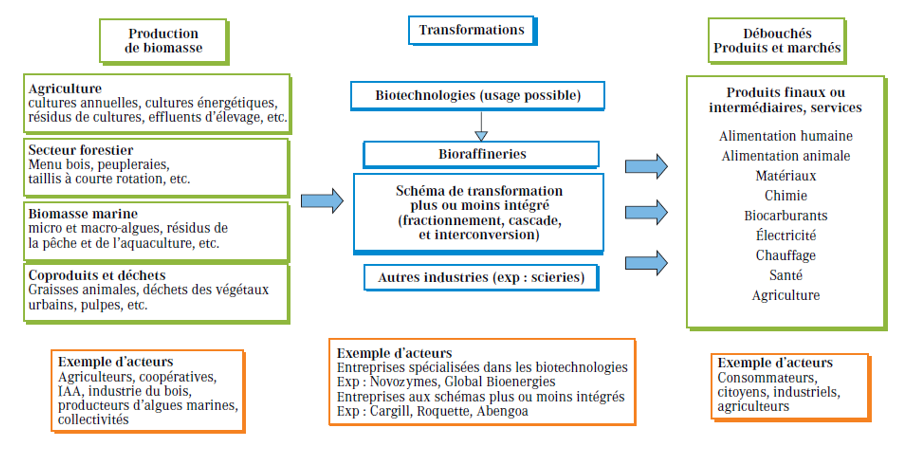
The bioeconomy, according to various economic and institutional definitions, offers a very broad vision for the development of the economic system in the medium and long term. It highlights obvious commonalities across all fields (academic and political), such as the importance given to biotechnologies as a tool for implementing the bioeconomy and the systemic approach (intersection between energy, food, and chemical systems). As public initiatives and policies multiply, the principle of the bioeconomy applies to most areas of the economy, such as agriculture, forestry, fishing, forestry, food and feed, and a wide range of industrial sectors such as pharmaceuticals, energy production, chemical products and materials for hygiene, clothing, housing, and transportation (Figure 2).
Figure 2. Biomass production chain
Source: Delgoulet and Pahun, 2015
From an economic perspective, the bioeconomy should therefore be seen as an opportunity rather than a constraint in terms of economic growth, because it represents a new development strategy that promotes both complementary and competing economic activities. Today, with all the emerging markets such as renewable energies, electric vehicles, smart buildings, and smart cities, new opportunities are opening up for companies whose investment in this field would have more certain effects in a context of ecological transition where less dependence on fossil carbon is being promoted. Since the bioeconomy encompasses all production and processing activities in many sectors (Figure 2), opportunities will be available to all players in the production process.
The European Commission has therefore allocated a significant portion of its funding to the bioeconomy. The new research program (2014-2020) has a total budget of €77 billion. The Commission estimated that in 2012 the bioeconomy sector represented more than €2 trillion in turnover and employed more than 22 million people, or 9% of employment in Europe (European Commission, 2012). In France, with nearly 80% of the country’s land area devoted to agricultural or forestry production, the bioeconomy is a major sector of activity and plays a key role in the country’s economic landscape.
Towards the operationalization of the bioeconomy: what are the challenges?
While the economic prospects and opportunities of the bioeconomy are promising, there are many obstacles to realizing this potential.
The first obstacles are related to technological aspects and associated economic constraints. Indeed, innovation in the field of biotechnology is a prerequisite for the operationalization of a bio-based economy. This involves new technologies that are « sufficiently efficient to be autonomous and sufficiently economical and clean to be integrated into the global ecological system, » as proposed by Georgescu-Roegen in his action program. This requires not only sufficient returns from the scaling-up process (the transition from laboratory research to industrial production), but also adequate investment in existing infrastructure to enable the necessary adaptation to new uses. These conditions create a real barrier to entry for SMEs entering the bio-resources market. Production costs relative to the prices of fossil fuels and biomass can discourage any attempts to invest in biological resources.
The mobilization of biomass in the private sector may also be discouraged by uncertainty surrounding the political and regulatory framework. Given the disparities in production costs between bio-based and fossil-based molecules, public policy must intervene to create sufficient economic incentives to guide industrial activities. However, some stakeholders believe that the current framework does not provide sufficient impetus to drive the development of the bioeconomy (Delgoulet and Pahun, 2015).
The implementation of the bioeconomy also faces difficulties related to social acceptability. Indeed, the bioeconomy has only recently entered the public arena and it is still too early to justify or evaluate the social benefits it could bring. Furthermore, often presented in terms of promises and prospects for development, the bioeconomy is the subject of criticism from environmental NGOs. A report published in 2014 by the Canadian NGO ETC Group entitled Biomassacre suggests that the conversion of living biomass into fuels, chemicals, and energy is nothing more than an aggressive takeover of land, livelihoods, knowledge, and resources of populations in the Global South, where the most productive biomass is found (thanks to a wide variety of plants) but where, by 2050, there will also be two billion more people to feed from land that will experience a sharp decline in productivity due to climate change. Faced with widespread criticism and skepticism, how can we communicate and inform the public about the bio-based economy? This is a key issue in current political debates.
Last but not least, while the development of the bioeconomy relies on the use of biomass, this nevertheless raises major questions: the limits of biomass resources, the effect of indirect land use change (ILUC), ethical choices, conflicts of use, and the need to prioritize needs, etc.
Conclusion
Although the concept of the bioeconomy has been developed in academia since the 1970s, it has only recently been included in the European and national political agenda. Characterized by the use of renewable biological resources and waste as inputs for a multitude of uses (energy, chemicals, materials, and food), the bioeconomy aims to respond to new challenges such as the reduction of non-renewable resources, population growth, and the intensity of global warming.
In an optimal scenario, where our economic model would be based entirely on the biosphere (with bioresources at the heart of our production and processing processes as well as our consumption practices), the bioeconomy would successfully meet its objectives. However, numerous technological, economic, regulatory, and social obstacles make the deployment of this potential unrealistic. A pragmatic short- and medium-term vision would be to encourage innovation of all kinds and promote projects and jobs in the relevant sectors so that the bioeconomy occupies a more important place in the economic landscape of countries.
Reference
OECD, 2009, The Bioeconomy in 2030: What is the Action Plan?
DELGOULET, Élise and PAHUN, Jeanne, 2015, Bioeconomy: challenges of an emerging concept