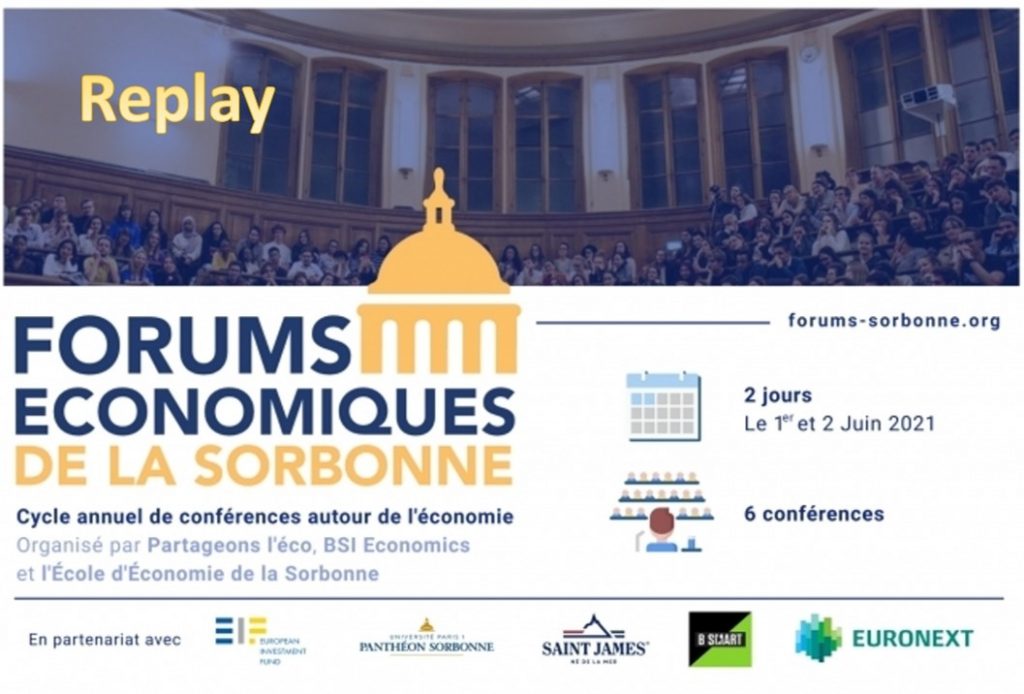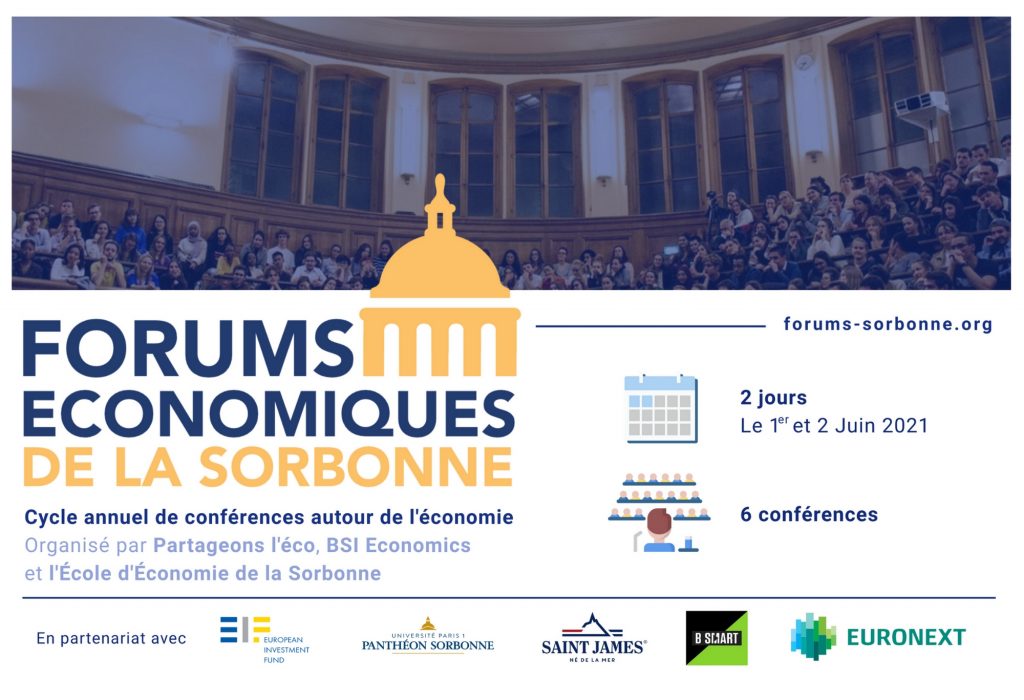
The first Sorbonne Economic Forums will be held on June1 and 2, 2021. This two-day event will bring together nearly thirty economists at the historic Sorbonne center. Interview with Marine Coinon (Executive Director), Victor Lequillerier (Secretary General), and Arthur Jurus (President) on the ambitions of BSI Economics, co-organizer of the Sorbonne Economic Forums with Paris 1 University and Partageons l’Eco.
What is the ambition of the Sorbonne Economic Forums?
Arthur Jurus – The ambition is to develop an annual event to address the economic, political, and financial challenges of the coming decades. The event is set to become a benchmark by bringing together decision-makers with academics, professional economists, and the general public.
Interaction will be the key to success. This is the historic mission of the Forums, which are dedicated to addressing political and economic issues. Organizing these exchanges within the historic13th-century buildings of the Sorbonne, in one of Europe’s greatest capitals, was the ideal setting to express the values that drive the event’s organizers: promoting discussion between generations and between economic circles on an international scale.
One of the key beliefs of the Sorbonne Economic Forums is that the economy is a public good that requires open debate accessible to as many people as possible. The conferences will be interactive and led by analysts, journalists, and senior officials from the economic world.
What will be the themes and participants of this first edition?
Victor Lequillerier – This first edition will consist of six conferences. Each will address major themes in the post-COVID world: ecological transition, digitalization, financing the economy, mixed policies, deglobalization, and digital currency. The speakers will come from academia, industrial and financial companies, as well as governmental and institutional structures.
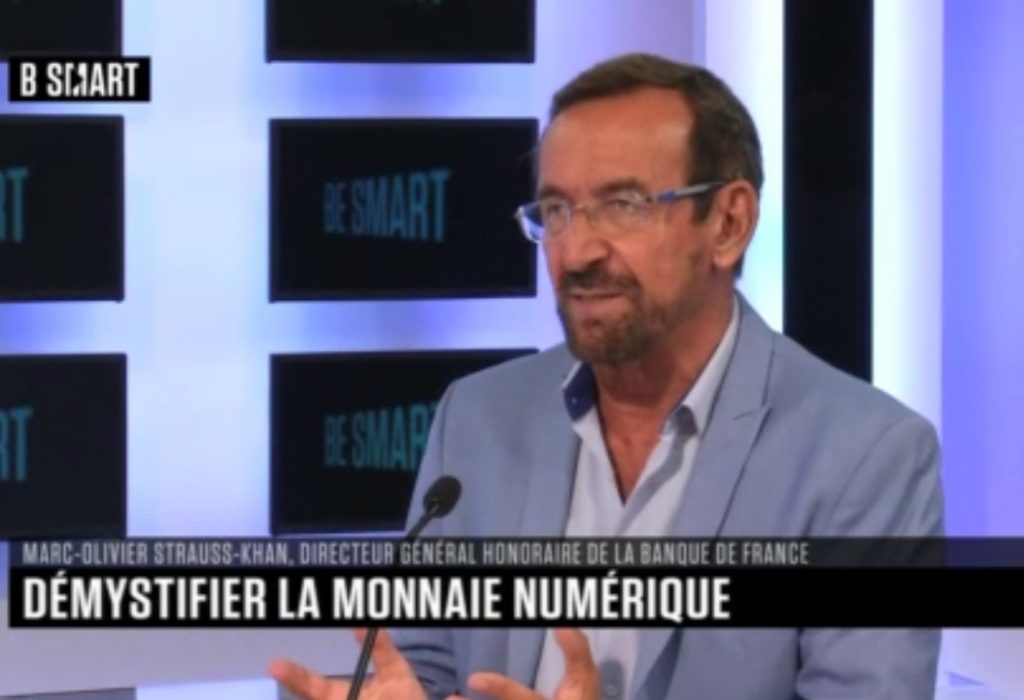
Most of them have important operational responsibilities in the conduct of economic policies or strategies within their own companies. Examples include Benoît Coeuré from the Bank for International Settlements, Isabelle Vaillant from the European Banking Authority, Christine Jucglin from Banque Palatine, and Marc-Olivier Strauss-Kahn, Honorary Managing Director of the Banque de France. Nearly half of the speakers will be women, and the profiles will be divided equally between chief economists, academics, and business leaders.
How can these exchanges be encouraged despite the current environment and health restrictions?
Marine Coinon – Our priority for the 2021 edition is to ensure high-quality recording of the conferences and their live broadcast in order to encourage these interactions. Due to the current health situation, the historic halls of the Sorbonne will not be filled in June. This means we need to rethink the format of the conferences beyond 2021. Interactions will take place live and online. The audience will therefore be able to ask questions to the speakers. Our media partner B-Smart will rebroadcast and organize programs related to the Sorbonne Forums.
The appeal of this annual event should not only be based on the relevance of the topics, the quality of the speakers, or its media impact. The debates must also be entertaining in order to be more effective! No two conferences will be alike in format. Some will take the form of question-and-answer sessions, very short presentations, or lively discussions related to current events.
The aim is to make the discussions accessible to as many people as possible. This is all the more important given that these conferences will have a common theme: they will focus on topics that directly affect or will affect our daily lives.
How do the Sorbonne Forums compare to other events?
Victor Lequillerier – The Forums are above all a promise for the future. The speakers in 2021 will respond to their positioning over the next decade. The speakers’ profiles are therefore intergenerational. We invite young specialists as well as decision-makers with long and distinguished careers. This is essential for the diversity of the debates and to establish real continuity based on the transmission of ideas.
The Forums also aim to give a voice to a wider range of specialists. Conferences are often organized by think tanks, which are by definition closed and exclusive. We want to reverse this trend because these approaches are no longer sufficient. The younger generation is eager to listen to senior leaders, to be inspired by them, but also to approach issues from a new angle. They have grown up with negative interest rates and proactive central banks, and digital currencies seem to them to be a natural evolution of our economies. Their analytical framework is different and highly complementary to that of their elders.
Will the format of events change in the coming years?
Marine Coinon – Yes, we are already working on the 2022 edition. Each theme could be explored in different formats: interviews with prominent figures, round tables with business leaders, or conferences between public decision-makers and economists. Discussions are underway with our initial partners.
Arthur Jurus – There will be more conferences and a more international setting. We urgently need to renew our ways of thinking. Economic models must become more inclusive. Paris needs a new Davos, one that is more inclusive, focused on societal issues, and capable of strengthening cooperation between economic and financial players.