Usefulness: As part of academic research,a representative survey was conducted by the author of this note and by Thomas Douenne to assess preferences in terms of climate policy (3,000 French citizens were surveyed between February and March 2019). The aim is to contribute to the collective intelligence of the citizens’ convention on climate and environmental issues.
Summary:
- According to a recent survey, French people lack knowledge about climate change, but are nevertheless concerned about its consequences.
- They would be willing to adopt an eco-friendly lifestyle, but only if the effort is shared fairly.
- They overwhelmingly reject a carbon tax with dividends, even though it would be progressive. This rejection can be explained by mistrust of the measure’s properties.
- They support other climate policies, such as green investments.


Thomas Douenne and I conducted a representative survey in February–March 2019 of 3,000 French people to understand their preferences in terms of climate policies. The sample was formed by a polling institute, and representativeness was ensured by the quota method (based on six socio-demographic variables). In this article, the main results concerning attitudes toward climate change, carbon taxation, and other climate policies are presented and discussed.
French people are concerned about climate change and willing to make efforts
First, according to this survey, the French population is largely aware of climate change and concerned about its consequences: only 11% think that humans « could live with it » (Figure 1). This is despite the fact that most respondents were unaware of basic scientific facts such as the significance of emissions generated by meat consumption, or the fact that greenhouse gas emissions need to be reduced by at least a factor of five by 2050 if we are to hope to limit global warming to +2°C by 2100. Those who are most informed about climate change are more concerned than others about its effects and are more supportive of climate policies. This observation justifies the proposals of the citizens’ convention, which include launching a massive and sustained information campaign to ensure that the entire population acquires a satisfactory understanding of societal problems and possible solutions.

Our survey reveals that two-thirds of French people would be willing to change their lifestyle, eating less red meat and using almost no (fossil) fuels, provided that the effort is shared equally. This condition was not met by the fuel tax introduced by the government (and frozen following protests by the Yellow Vests), particularly as it did not provide for compensation for poor households against the price increase.
Carbon taxation is overwhelmingly rejected and alternative policies are appreciated
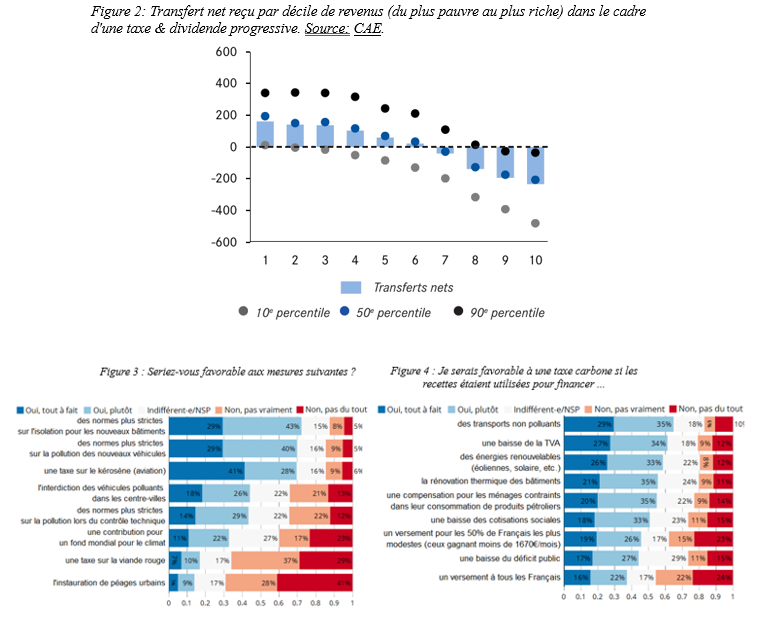
However, even without more general social justice measures « that the convention could propose, » the carbon tax itself can be designed to benefit the most modest households. What more than 3,000 economists, including 27 Nobel Prize winners, are proposing amounts to introducing a « tax with a dividend, » i.e., a carbon tax whose revenues would be redistributed directly to the population. The Economic Analysis Council thus proposes paying a higher dividend to the lowest-income households and not paying any to the wealthiest households, so that the poorest 10% would typically gain €200 per year, and only 14% of the lowest-income half would lose out (the biggest emitters) (Figure 2).
We proposed a series of taxes with dividends to respondents, with the dividend being paid uniformly to each taxpayer or only to the lowest-income taxpayers. In all cases, around 70% of respondents rejected the tax with dividend that we proposed, and less than 20% approved it. Furthermore, we observed systematic approval of the dividend tax among people who believed that such a measure would increase their purchasing power, combat climate change and reduce pollution, and benefit the poorest. Believing in just one of these three properties (i.e., personal interest, environmental effectiveness, and progressivity) is enough to raise the approval rate among respondents to around 30%. Thus, the rejection can be explained by a high level of mistrust regarding the effects of a tax with a dividend. For example, although 61% of people would gain purchasing power as a result of a uniform dividend tax, only 14% believe this would be the case for their own household. In order to combat negative preconceptions about the dividend tax, Climate Action Network has, for example, posted an online simulator to estimate the impact such a tax would have on purchasing power.
Despite these efforts, it seems unrealistic to expect a carbon tax to be accepted in the short term, as shown by the work of the Citizens’ Climate Convention. Furthermore, a moderate tax alone cannot be enough to trigger the ecological transition: with a €50 per ton ofCO2 increase in the fuel tax (corresponding to an 11 cent per liter increase in the price of gasoline), emissions would only be reduced by 1 or 2%. To achieve the 40% reduction target by 2030, this tax could be gradually increased to a much higher level. The forecast of the upward trajectory would then allow individuals to adapt their equipment in anticipation of the tax (when replacing their car or boiler, for example), without this having too great an impact on their purchasing power.
A range of other measures would undoubtedly be required, in particular to offer alternatives to private combustion-engine cars and oil or natural gas heating. However, respondents overwhelmingly support such measures (see Figures 3 and 4). Thus, popular responses to climate issues can be found in stricter standards for new equipment, taxation of kerosene, or investment measures in public transportation and building insulation.
Conclusion
In summary, the French do not trust the distributive and environmental properties of a carbon tax with dividends, even though it would be progressive and effective in reducingCO2 emissions. As a result, carbon taxation is currently rejected by the population. On the other hand, certain alternative climate policies are widely accepted, particularly those that offer alternatives to hydrocarbon consumption.